When Miners Sell: Core Scientific, Riot and the New Supply Shock for Bitcoin
Summary
Executive overview
A notable strategic shift is underway among publicly listed Bitcoin miners: the era of near-automatic accumulation is giving way to targeted liquidation. Two high-profile examples anchor this change. Core Scientific plans to sell most of a reported ~2,537 BTC position in Q1 2026 to finance AI colocation and related capital projects, and Riot Platforms has publicly confirmed it will continue selling BTC from its treasury to fund ongoing operations. These moves are not random — they’re deliberate responses to capex demands, liquidity management and corporate pivots — but the aggregate effect is a renewed supply-side pressure on the Bitcoin market.
For macro and institutional traders, the key question is not just that miners are selling, but how the market will absorb that volume. Below we unpack the specifics of the two companies, the financial drivers behind miner sales, the market plumbing that can soak up supply (or fail to), and practical indicators to track in order to anticipate future selling shocks. Bitlet.app users and other market participants will want to watch miner balance-sheet signals alongside ETF flows and OTC liquidity.
Core Scientific: selling to fund AI colocation
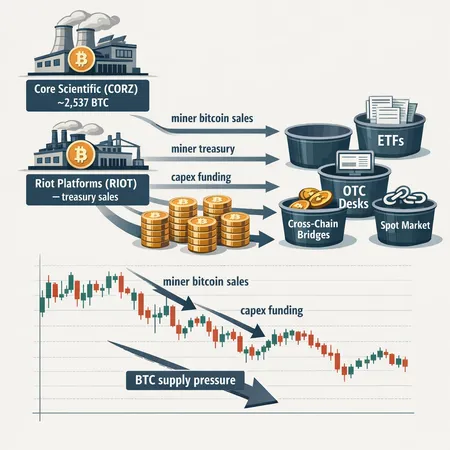
Core Scientific disclosed plans to sell most of the company’s roughly 2,537 BTC stash in Q1 2026. The company frames this as a capital-allocation decision: proceeds will be directed toward expanding AI colocation capacity and related infrastructure buildout. Coverage of the move highlights the twofold logic — monetize a non-core digital asset to fund a strategic pivot, and reduce balance-sheet exposure while raising liquid capital quickly (see reporting by Coinpedia and Blockonomi).
Core’s sale is notable because 2,537 BTC represents several days of global miner issuance (post-2024 halving issuance is roughly ~450 BTC/day), so while it’s not an existentially large volume, it is material and concentrated into a short timeframe. Selling a concentrated block of coins can create short-term liquidity demand that tests spot and OTC markets, especially if executed on a relatively tight schedule.
- Coinpedia reported Core Scientific’s disclosure around the planned sale and timing.
- Blockonomi provided context on the company’s rationale tying the raise to AI colocation expansion.
Together these pieces show a clear pattern: miners are converting mined or held BTC into capital to fund expensive non-mining growth initiatives.
Riot Platforms: balancing record revenue and treasury liquidity
Riot presents a subtler case. The company recently reported a record revenue year and holds a large BTC balance, but executives have confirmed continued incremental sales from treasury to fund operating needs and strategic initiatives. Riot’s business update described strong top-line performance and a sizeable BTC position, yet management also signalled that periodic dispositions remain part of the cash-management toolkit. The company’s VP reiterated the practice of selling coins to cover operational cash requirements.
- Cointelegraph covered Riot’s record revenue and large BTC balance while noting the broader business transition.
- Benzinga relayed Riot’s VP comments that the company will continue to sell BTC to support operations.
Riot’s approach reflects a common corporate calculus: keep a large strategic position while periodically monetizing portions to smooth cash flow or fund capital projects. Because Riot typically discloses sales and maintains active OTC relationships, the market can often anticipate or absorb these dispositions more easily — but that depends on broader market demand.
Why miners are selling: capex, AI spending and liquidity hygiene
There are three interlocking financial drivers behind miner sales today:
Capex and expansion: Modern scaling — whether to add more hashpower or to diversify into adjacent infrastructure like AI colocation — is capital intensive. Public miners face pressure to deploy cash into growth initiatives that promise higher long-term returns but require upfront funding.
Operating liquidity and hedging: Electricity contracts, debt service, payroll and maintenance require steady working capital. For miners with volatile revenue profiles or lumpy receivables, selling BTC can be safer than drawing on credit lines.
Balance-sheet risk management: Some companies prefer to de-risk by converting a portion of crypto holdings to fiat, either to meet covenants, shore up liquidity ratios, or reduce concentration risk.
The Core Scientific example ties directly to the first driver: monetizing BTC to deploy into AI infrastructure. Riot exemplifies drivers two and three — monetization to support operations even while maintaining a substantial strategic holding.
How miner sales interact with ETF and institutional demand
The market’s ability to absorb miner BTC sales hinges on several demand channels:
Spot Bitcoin ETFs and institutional inflows: Since the ETF pathway collects coins from the spot market (directly or via authorized participants), sustained inflows provide a dependable structural bid. If ETF creation demand is strong, it can offset miner supply quietly.
OTC desks and block liquidity: Large miners typically sell via OTC counterparties to avoid slippage. OTC desks act as shock absorbers; their capacity depends on institutional appetite and willingness to warehouse positions.
Cross-chain bridges and derivative flows: Some buyers will take BTC exposure synthetically (via derivatives) rather than absorb spot coins, which reduces direct spot absorption.
Retail and spot exchange flow: Abrupt increases in exchange sell pressure can cascade through order books and amplify price moves if not matched by institutional bids.
In short: if ETF and institutional demand remain robust, miner sales can be digested with muted price impact. If that demand softens, or if miners concentrate sales into short windows, the same volume becomes a greater headwind.
Absorption scenarios: from seamless to disruptive
Below are three practical scenarios and their likely market outcomes.
1) Seamless absorption (base case)
- Profile: Spot ETF inflows are steady and OTC desks are well-capitalized. Miners stagger sales and route most trades through block OTC channels.
- Outcome: The market internalizes miner supply with low volatility. Miners convert fiat back into capex or operations without pressuring the spot price long term.
- Signals to confirm: high ETF creation volume, stable BTC spot premiums, thin change in exchange net flows.
2) Frictional absorption (transitory drag)
- Profile: ETF demand slows modestly and OTC warehousing becomes costlier. Miners still sell but must accept wider spreads or work larger, visible blocks into spot liquidity.
- Outcome: Temporary price drag and increased intraday volatility. Traders may see local selloffs that recover over weeks as buyers digest supply.
- Signals to confirm: rising bid-ask spreads on large blocks, upticks in exchange inflows, wider OTC/spot basis.
3) Stress scenario (short-term selloff)
- Profile: Institutional bids retreat (reduced ETF creations, muted OTC interest) while multiple miners accelerate sales to meet urgent liquidity needs.
- Outcome: Significant downward price pressure; forced selling risks triggering further liquidations and a feedback loop affecting sentiment.
- Signals to confirm: sudden spikes in miner wallet outflows, large exchange deposits, negative funding rates and cascading liquidations in derivatives markets.
These scenarios are not exhaustive, but they capture the critical dependency: absorption depends on the interplay between miner supply scheduling and available institutional demand.
Practical indicators for institutional traders and macro analysts
To spot emerging miner-driven supply shocks, watch the following measurements closely:
Public disclosures and filings (10-Q, 8-K, earnings releases): The fastest formal signal of planned sales. Core Scientific’s public disclosure is exactly this kind of flag.
Miner BTC inventory and wallet flows: On-chain trackers show transfers from known corporate addresses to OTC custodians or exchanges. Persistent large outflows warrant attention.
Exchange net flows and exchange reserve levels: Rising exchange inventories often precede price pressure.
Hashprice and breakeven estimates: If the revenue-per-hash falls near or below operating costs, miners are more likely to sell to fund operations.
OTC desk spreads and quoted block liquidity: Widening spreads indicate that desks are less willing to absorb large lots without premium.
ETF creation/redemption statistics and AUM flows: High net inflows into spot ETFs reduce the net market impact of miner sales; outflows do the opposite.
Corporate capex plans and non-mining pivots: If miners publicly announce capital-heavy pivots (e.g., AI colocation), expect more treasury monetization events to follow.
Operationally, traders should set automated alerts for known miner wallet transfers and monitor filings from tickers such as CORZ and RIOT. Combining on-chain analytics with corporate filings gives a clearer lead time than either signal alone.
Trade and risk-management considerations
For institutional traders positioning around miner selling, consider these actionable steps:
Monitor and size exposure to short-term liquidity risk: avoid heavy long positions ahead of suspected concentrated sales windows.
Use layered entries: buy in tranches to avoid being filled into a temporary miner-induced sell wave.
Watch funding rates and basis: miner sales can depress spot faster than derivatives, creating short-term arbitrage opportunities for sophisticated desks.
Hedge operationally: for desks offering liquidity, build contingency capital buffers in case OTC warehousing becomes prolonged.
Incorporate miner balance-sheet stress tests into macro scenarios: model outcomes under different ETF flow assumptions.
Conclusion
Core Scientific’s announced plan to sell ~2,537 BTC and Riot’s confirmation of ongoing treasury sales underscore a broader dynamic: miners are increasingly active sellers as they fund capex, pivot into new business lines, and manage liquidity. Whether these dispositions cause sustainable downward pressure on BTC depends less on the fact of selling than on market plumbing — ETF demand, OTC desk capacity, and timing.
Institutional traders and macro analysts should track miner balance sheets, on-chain wallet flows, corporate disclosures and ETF flows as early warning indicators. If demand channels remain healthy, miner sales will likely be digested with only noise-level impacts. If demand softens and sales concentrate, the market could face a sharper supply shock.
Ultimately, miner behavior has re-emerged as a meaningful supply-side variable for the crypto market. Keep these metrics on your dashboard, and when you see announcements like Core’s or Riot’s, treat them as actionable data points for liquidity and risk planning.
Sources
- Core Scientific to sell most of 2,537 BTC after weak Q4 earnings (Coinpedia)
- Core Scientific plans to sell 2,500 BTC in Q1 2026 to finance AI colocation expansion (Blockonomi)
- Riot Platforms VP says company will continue to sell Bitcoin from treasury to fund operations (Benzinga)
- Riot records $647M revenue in 2025, large BTC balance context (Cointelegraph)