What Chainlink CCIP’s Base → Monad cbBTC Bridge Means for Cross‑Chain BTC Liquidity
Summary
Overview
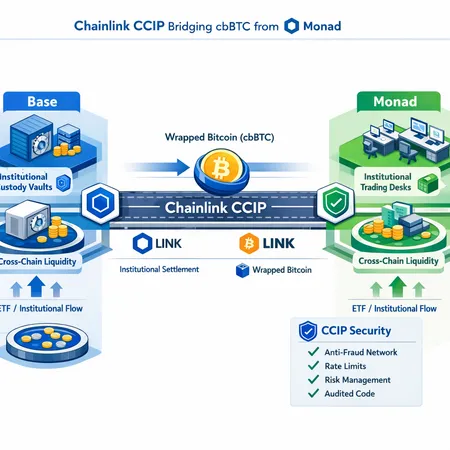
Chainlink’s CCIP (Cross-Chain Interoperability Protocol) enabling cbBTC transfers from Base to Monad is more than a novelty: it creates a programmatic rail for wrapped-BTC liquidity to cross between distinct L2/L3 environments. For infrastructure architects and institutional custody desks evaluating cross-chain settlement options, this event is worth dissecting on three axes: technical mechanics, market and institutional impacts (including how ETF flows may interact), and the security/operational risks that accompany new connectivity.
In this article I’ll explain how CCIP bridging works at a practical level, why cbBTC on Base matters as a source pool of liquidity, what makes Monad strategically important as a destination chain, and how these developments might change the dynamics of BTC liquidity and settlement. I’ll also offer a checklist for custody teams considering integrations.
How Chainlink CCIP bridges cbBTC: technical basics
CCIP is designed as a cross-chain message and token transport layer. At a high level it provides: a standardized messaging protocol, decentralized routing and verification via Chainlink nodes, and token transfer primitives that can lock/mint or burn/redeem wrapped assets across chains.
Messaging and receipts: CCIP sends cryptographically verifiable messages from a source chain to a destination chain. Those messages are bundled and attested by Chainlink’s decentralized set of off-chain agents, which publish proofs that on‑chain contracts can verify.
Token handling patterns: For wrapped assets like cbBTC, CCIP tends to either (a) move a representation by unlocking on the destination and locking on the source, or (b) rely on mint/burn semantics for canonical wrapped tokens. The exact mechanics for Coinbase’s cbBTC will be determined by the custody and contract design agreed between Coinbase (or its custodian) and Chainlink’s CCIP flows.
Routing and relayer decentralization: CCIP’s security model leans on the decentralization and economic incentives of Chainlink node operators. That changes the trust assumptions relative to single-relayer bridges: rather than a single operator, validation becomes federated across node operators that provide attestation and deliver messages.
Technically this reduces single points of failure inherent to bespoke bridges, but it does introduce new dependency surfaces — notably oracle and node-set integrity, plus cross-chain contract correctness. Architects should review CCIP node governance, staking/economic slashing (if any), and the contract-level upgradeability or admin controls before integration.
Why cbBTC on Base matters as a liquidity source
Base has emerged as a highly liquid L2 hub with strong developer traction and sizable token activity. Coinbase’s cbBTC is a wrapped representation of BTC native to Coinbase’s custody model; making it available on Base effectively localizes BTC liquidity in an environment with inexpensive gas and high throughput.
This matters because institutions and market-makers increasingly prefer to minimize round-trip costs and settlement latency. Keeping cbBTC on Base reduces the need to route orders back to Ethereum mainnet for settlement, enabling faster execution within a rich Base-native ecosystem of DEXs, AMMs, and settlement services.
From a systemic point of view, concentration of cbBTC on Base creates a large pool of BTC-denominated liquidity that, with CCIP, can be programmatically moved to other chains like Monad as trading or custody needs dictate. That gives markets optionality: liquidity can be positioned where it’s most efficient rather than being stranded on a single layer.
Monad as a strategically important destination
Monad is attracting attention as a high-throughput destination chain (MON) with design choices appealing to settlement use cases: lower latencies, specialized execution environments, and an ecosystem prioritizing on‑chain primitives for institutional workflows. Moving cbBTC to Monad unlocks several use-cases:
Low-latency settlement: For firms optimizing execution and wanting near-instant finality for internal accounting, Monad-style chains can be advantageous versus congested L2s.
Custom settlement rails: Monad can host bespoke custody, clearing, or matching engines that require on-chain composability but also need predictable fees and throughput.
New liquidity venues: With cbBTC available on Monad, DEXs, lending desks, and CCP-like smart contracts on Monad can tap into BTC liquidity without asking users to touch Ethereum mainnet.
The combination — cbBTC on Base as a primary pool and CCIP opening controlled transfers to Monad — effectively creates a programmable liquidity fabric across layers: liquidity can be staged on Base and deployed to Monad for settlement, then returned or rebalanced as needed.
How bridges and CCIP can affect BTC liquidity and ETF/institutional flows
Institutional demand dynamics — including flows into spot Bitcoin ETFs — already exert pressure on custody and settlement rails. Recent reporting highlights how ETF inflows remain a vector for BTC demand even amid macro shocks Cointelegraph. Programmatically moving cbBTC across chains via CCIP can intersect with those flows in several ways:
Faster allocation of on-chain BTC exposure: Custodians can use CCIP to position cbBTC where an institution needs exposure (e.g., moving from Base to a low-latency chain hosting an exchange or internal settlement smart contract) without multiple on‑chain wraps and manual processes.
Improved arbitrage and market efficiency: Faster cross‑chain movement of cbBTC reduces price disparities between venues on different chains, improving arbitrage efficiency and tightening spreads for institutional trades.
Balance-sheet and capital optimization: Institutions could hold a core pool of cbBTC on Base and dynamically route portions to market-making or settlement venues on Monad when needed, reducing redundant custody requirements.
However, there are limits. ETF creations/redemptions still ultimately interact with spot BTC and custodial reserves. Wrapped BTC movements change where liquidity sits on-chain but do not change off‑chain custody holdings unless the wrapped token is redeemed for native BTC. That nuance matters for risk managers reconciling on-chain positions with ETF ledger entries and cold‑wallet custody records.
What this unlocks for the wrapped‑BTC ecosystem
The base→Monad cbBTC bridge, enabled by CCIP, encourages a more modular ecosystem where wrapped-BTC liquidity is fungible across chains. Practical implications:
New product innovation: Lending pools on Monad can list cbBTC as collateral with confidence that liquidity can be sourced from Base via CCIP, facilitating composability across chains.
Cross-chain market-making strategies: MM desks can programmatically shuttle cbBTC between Base and Monad to capture spreads or provide liquidity to local order books.
Ecosystem growth for MON token economies: As BOs and DEXs on Monad see more BTC-denominated volume, demand dynamics for native services and tokens (MON) could shift, influencing fee capture and incentive designs.
That said, increased mobility also risks liquidity fragmentation if multiple wrapped versions proliferate without clear redemption paths. Standardization of wrapped-BTC representations and watched bridges like CCIP will matter for capital efficiency.
Security and operational risks to watch
Chainlink CCIP changes the trust model — and with it, the risk surface — in predictable ways. Key risks for architects and custody desks:
Oracle/node compromise: CCIP relies on Chainlink node operators to attest and relay messages. While decentralized relative to single relayer models, a coordinated node compromise or sybil attack could enable fraudulent cross-chain messages. Understand Chainlink’s node set composition, slashing (if applicable), and monitoring telemetry.
Smart-contract risk: Contracts on both source and destination chains must correctly implement CCIP hooks. Upgradeability, admin keys, and logic bugs create classic smart-contract risk that can be exploited during cross-chain operations.
Liquidity and redemption risk: Moving cbBTC across chains changes where liquidity is located. If a destination chain faces a liquidity crunch, rapid redemptions back to native BTC or to the custody layer could be delayed or face premium costs.
Finality and reorgs: Cross-chain messages depend on finality assumptions. Short-finality chains or deep reorganizations can complicate the attestation timeline and create race conditions for settlement-sensitive workflows.
Regulatory and compliance exposure: Wrapped assets flow between jurisdictions represented by on-chain ecosystems. Custodians must ensure that moving cbBTC does not violate KYC/AML, custody mandates, or regional regulatory restrictions.
Operational complexity and reconciliation: Cross-chain moves require robust tooling for reconciliation, monitoring, and dispute resolution. Institutions should avoid ad hoc manual processes.
CCIP security has been designed to mitigate some of these, but it does not eliminate them. A layered risk model — combining on-chain verification, off-chain monitoring, insurance, and conservative economic exposure limits — remains necessary.
Practical guidance for custody desks and infrastructure architects
If your desk or platform is evaluating Base→Monad cbBTC transfers via CCIP, consider a phased approach:
Technical due diligence: Review CCIP contract code, Chainlink node governance docs, and the exact cbBTC token contract’s mint/burn or lock/unlock semantics. Ask for audits and post‑audit remediation reports.
Operational playbooks: Define settlement windows, threshold limits per counterparty, and automated reconciliation scripts. Plan for exception handling when cross-chain messages stall or fail verification.
Monitoring and alerting: Instrument metrics for inbound/outbound CCIP messages, orphaned transfers, and node-set changes. Real-time alerts for unusual patterns are essential.
Economic limits: Start with small, time‑bounded transfer caps for production rollout. Use insurance or third‑party guarantees for higher-value transfers during initial operations.
Regulatory mapping: Coordinate with compliance to ensure cross-chain movement doesn’t create exposure across regulated entities or violate custody agreements.
Interoperability with existing rails: Ensure your internal accounting and custody ledger reconcile wrapped positions with off‑chain holdings. For example, swaps or ETF creations/redemptions must be traceable back to native BTC custody.
A measured, test-driven approach reduces the blast radius of unexpected behavior while enabling teams to capture the operational benefits of CCIP-enabled mobility.
Conclusion
Chainlink CCIP’s support for cbBTC transfers from Base to Monad is a concrete step toward a more interconnected wrapped‑BTC landscape. For institutions, the upside is clearer rails for settlement, improved latency options, and greater routing flexibility for liquidity. But those benefits come with nuanced security and operational tradeoffs — oracle risk, contract correctness, liquidity fragmentation, and regulatory complexity.
For infrastructure architects and custody desks, the right stance is pragmatic: validate the CCIP and token contracts, instrument operational telemetry, enforce conservative transfer limits, and align legal/compliance frameworks before expanding usage. Over time, as cross-chain interoperability protocols mature and node governance strengthens, this kind of programmable liquidity could materially improve capital efficiency for BTC-denominated workflows across chains.
Bitlet.app and other platforms that monitor cross-chain flows will likely adapt tooling to help custody desks visualize and manage these new rails.
Sources
- Chainlink CCIP enabling cbBTC Base→Monad: Chainlink unlocks $5B Bitcoin bridge to Monad via CCIP integration
- Context on ETF/institutional demand for Bitcoin: Bitcoin ETF inflows amid geopolitical shocks