WLFI on Dolomite: Lessons on Collateral Concentration and Memecoin Risk
Summary
Introduction
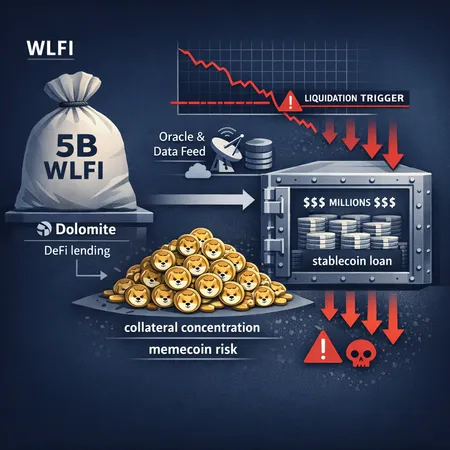
The recent World Liberty Financial (WLFI) position on Dolomite is a timely case study for anyone building or auditing lending markets. A large stablecoin loan backed by roughly 5 billion WLFI tokens exposed how collateral concentration and illiquid memecoin economics can cascade into systemic stress for a lending pool. This article unpacks the deal and the market reaction, explains the mechanics that amplify risk, and offers concrete, implementable changes for protocol designers, risk officers and sophisticated users evaluating counterparty and liquidation risk in on‑chain lending.
What happened: the reported WLFI borrowing on Dolomite
According to reporting, a multi‑million dollar borrowing relied on about 5 billion WLFI tokens posted as collateral on Dolomite. The position drew scrutiny because WLFI is a memecoin with limited liquid markets relative to the collateral size, and because a token unlock proposal and subsequent governance drama changed market expectations quickly. Cryptopolitan reported a sharp WLFI price dip tied to this borrowing, noting a roughly 10% immediate move in market price after details surfaced. The borrowing and ensuing defense of the collateral position were covered in more detail by Bitcoin.com, which described how World Liberty Financial publicly defended its multi‑million dollar loan on Dolomite and explained the mechanics and risks posed by using WLFI as the principal backstop.
The situation escalated when a proposed token unlock — a schedule that would have released a large tranche of tokens into the circulating supply — was shelved, with Decrypt documenting the fallout and how the unlock proposal and loan raised concerns about potential bad debt for the lending protocol. Taken together, the three outlets give a consistent narrative: a large, concentrated memecoin position used as collateral for a stablecoin loan on a lending pool can create outsized, rapid contagion effects when price, liquidity, and unlock schedules interact.
Why collateral concentration and unlock schedules create systemic risk
At a technical level, lending protocols assume collateral can be liquidated without causing the price to collapse below recovery thresholds. That assumption breaks down when a single borrower posts a token that represents a large share of the token’s liquid float or when a material unlock schedule can suddenly expand supply.
Key channels of risk include:
- Market impact from liquidation: If a borrower is liquidated and the protocol attempts to sell a large position on DEXs or CEXs, the slippage can be enormous. The oracle price will likely lag the on‑chain depth, meaning liquidators receive less value and the pool absorbs losses.
- Concentration amplification: A single borrower controlling a high percentage of liquid WLFI compresses the liquidity cushion. Even modest sell pressure from one wallet can cause a cascading price move that makes the collateral insufficient for the outstanding stablecoin loan.
- Unlock schedule shock: Token unlocks (vests, team allocations, or strategic sales) are predictable or sometimes discretionary. When an unlock is proposed or rumored, traders front‑run potential sales. If a protocol treats all collateral identically, it ignores the time‑dimension of supply pressure.
- Oracle feedback lag and manipulation risk: TWAP or spot oracles can either underreact (lags, giving a false sense of safety) or be manipulated (on low‑liquidity pairs) so that the price used to value collateral diverges from realistic liquidation proceeds.
Memecoins like WLFI often exhibit thin order books, large holder concentration, and outsized volatility — all traits that transform what looks like sufficient on‑paper collateral into an unstable, tail‑risk exposure for lenders.
Market reaction and price pressure on WLFI
Market participants reacted quickly once details circulated. Cryptopolitan's coverage highlights an immediate price dip after the $75M loan detail emerged; broader reporting showed the team and related parties publicly defending the collateral position. When news of the token unlock floated and then collapsed (as reported by Decrypt), sentiment swung wildly: the mere prospect of additional tokens hitting the market was enough to induce selling pressure that made any on‑chain liquidation mechanically harder.
Two important dynamics were visible:
- Preemptive selling and front‑running: Traders and market makers reduce exposure ahead of perceived large sells, tightening liquidity and increasing realized slippage for any future forced sales.
- Information contagion across venues: Because WLFI trades across DEXs and CEXs, price moves in one venue transmitted to others, then fed back into oracle prices and liquidation conditions, creating a loop that pushed the collateral valuation lower.
The practical lesson is straightforward: a reported large loan backed by a memecoin can itself be a liquidity event. For many observers, the WLFI episode was a reminder that even well‑intentioned borrowing strategies can become self‑fulfilling solvency risks when distribution and market depth are ignored.
Fixes and design changes for DeFi lending protocols
Below are targeted, implementable design changes and risk controls that address the specific failure modes exposed by WLFI on Dolomite.
Collateral limits and liquidity‑adjusted exposure
- Per‑asset exposure caps: Limit the percentage of pool collateral and the maximum borrowable value that any single asset class (e.g., WLFI) can represent. For example, cap memecoins at a low pool share (1–5%) depending on measured liquidity.
- Wallet concentration limits: Place a ceiling on how much a single wallet can post in collateral for loans that exceed a threshold LTV; large single‑wallet deposits should trigger additional verification or reduced collateral factors.
- Liquidity‑adjusted LTVs (LA‑LTV): Dynamically scale collateral factors based on realized market depth — e.g., the amount that can be executed within X% slippage on primary trading venues. This embeds realistic liquidation assumptions into lending capacity.
Oracle design and price discovery
- Multi‑source oracle aggregation: Use a weighted median across several sources (DEX TWAP, CEX mid‑price, RPC order book snapshots) rather than a single source. This reduces the chance that a single thin market skews valuations.
- Liquidity‑aware oracles: In addition to price, oracles should publish a liquidity score (e.g., USD depth within 5% slippage). Lending pools can require a minimum liquidity score to accept an asset as primary collateral.
- Fast‑path circuit breakers: If price moves exceed a threshold in a short time, freeze new borrowing against the asset and increase liquidation thresholds; this prevents leveraged additions during a liquidity crisis.
Liquidation mechanics and auction design
- Staged liquidation auctions: Rather than an immediate full‑size on‑chain sale, define staged auctions where tranches are sold with time‑based reprice and guaranteed minimum participation windows. This reduces immediate market shock.
- Slippage‑aware liquidation incentives: Reward keepers proportionally for taking on higher slippage and allow the protocol to set maximum acceptable slippage; if slippage will exceed the cap, escalate to a governance rescue or insurance payout.
- Debt auctions versus direct sells: Use Dutch or batch auctions that allow price discovery over a longer window, improving the recovery rate versus single‑tx dumps.
Governance, disclosure, and operational policies
- Mandatory disclosure of unlocks: Protocols should require collateral asset projects to publish unlock schedules and big‑holder distributions on the oracle feed; unreported unlocks should reduce an asset’s collateral factor.
- Stress‑testing and transparent risk metrics: Publish pool stress tests showing how much price movement or how much sell volume would create shortfall; risk officers should run reverse stress tests to identify likely failure points.
- Insurance and backstop funds: Maintain an on‑chain insurance buffer sized to cover conservative estimates of liquidation shortfall for the pool’s riskiest collateral classes.
Practical checklist for risk officers and protocol designers
- Quantify free float and top‑holder concentration for each accepted asset. If a single address controls >5–10% of float, treat it as high concentration.
- Measure on‑chain and on‑exchange liquidity: calculate USD depth within 5% and 20% slippage buckets across primary venues.
- Implement LA‑LTVs and per‑asset caps before enabling an asset as collateral; re‑evaluate weekly during high volatility.
- Integrate multi‑source oracles with published liquidity signals and run simulated liquidations monthly to validate recoveries.
- Design liquidation flows that prefer auctions and staged unwinds over immediate AMM dumps; set keeper incentives accordingly.
Conclusion
The WLFI borrowing on Dolomite is not just a headline — it's a concrete illustration of why memecoin collateral demands bespoke risk controls. Concentration, unlock schedules, and thin liquidity are predictable amplifiers of protocol risk. For teams building lending products or managing on‑chain exposure, the immediate takeaway is to assume liquidity risk as primary, not secondary, and to architect oracles, collateral parameters, and liquidation flows with that assumption in mind.
For an ecosystem perspective, these lessons apply broadly across DeFi — and they matter if you’re assessing how alternative assets might behave in a stress event, even relative to major assets such as Bitcoin. When evaluating counterparty and liquidation risks on platforms (including Bitlet.app), require transparency on distribution, enforce prudent caps, and favor liquidation mechanics that minimize market impact.