What the Ethereum Foundation’s 45,034 ETH Stake Signals for Supply, Validators and Price
Summary
Quick context: what happened and why it matters
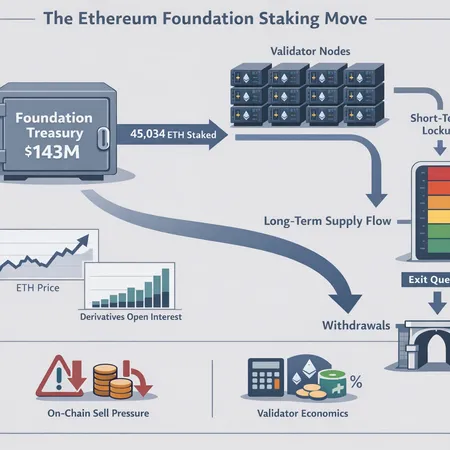
On April 3 the Ethereum Foundation added 45,034 ETH to validators on‑chain, part of a broader staking deployment estimated at roughly $143M across recent transactions. The on‑chain report of the 45,034 ETH move is documented here, and the aggregation framing the Foundation’s broader $143.1M staking activity provides useful context. For many market participants this isn’t just accounting — it’s the Foundation converting treasury capital into protocol participation, which affects Ethereum staking, treasury revenue and liquid ETH supply.
Staking by a major treasury differs from retail or exchange staking. A foundation or treasury allocation is a statement of conviction: funds are being shifted from marketable assets into the protocol’s economic layer, earning rewards and (for now) being effectively removed from circulating supply.
Mechanics of the Foundation staking move
The Foundation’s transaction is straightforward on the technical level: ETH transferred to validator keys and activated in the consensus layer, creating new validators that begin to earn rewards and participate in attestations. Because withdrawals are enabled after Shanghai, these validator balances are now eligible to accumulate withdrawable balances, but those withdrawals are subject to validator exit rules and queue mechanics.
- The immediate effect: those ETH are no longer part of exchange balances or liquid wallets, so short‑term circulating supply is reduced.
- Reward accrual: validators earn protocol rewards and MEV/tip income, which compounds the effective long‑term stake value for the Foundation.
- Exit complexity: while withdrawals are possible, large coordinated exits are capped by the protocol’s exit rate, which prevents instant redeployment of staked ETH back into the market.
This is different from liquid staking derivatives or exchange custody: the Foundation appears to be running validators or delegating to validators directly rather than minting liquid staking tokens, which means the move reduces on‑chain liquid ETH more directly than an LST mint would.
Validator economics: why treasuries choose to stake
At a high level, validator economics combine protocol issuance, transaction fee tips and MEV capture. For a treasury with long time horizons, staking offers several advantages:
- Revenue generation: Stakes earn ETH rewards, converting stationary treasury holdings into an income stream and compounding over time.
- Alignment: By running validators, the Foundation financially aligns with network health — higher security and participation improves the public good the treasury is funding.
- Opportunity cost vs liquidity: The trade‑off is liquidity. Staked ETH can’t be sold quickly without triggering exit queues and market friction, so treasuries accept that illiquidity in exchange for yield and alignment.
Yields are not fixed — they depend on total ETH staked, network activity, and MEV opportunities — but for large treasury allocations the predictable long‑term revenue and signaling value often outweigh short‑term trading considerations.
Short‑term vs long‑term supply effects
Why does this matter for ETH supply? The answer depends on the time horizon.
Short‑term (days–weeks):
- The on‑chain removal of 45k ETH reduces immediate liquid supply, but the market impact can be muted if sellers respond elsewhere. Coined sell pressure — for example, exchange outflows vs sellers producing liquidity — can offset scarcity signals.
- If derivatives markets are primed for selling (high open interest, negative funding), that mechanical pressure can swamp the scarcity effect from a single large stake.
Medium‑to‑long term (months–years):
- Staked ETH accrues rewards and compounds. If the Foundation holds rather than exits, the effective circulating float permanently tightens relative to a no‑stake scenario.
- The protocol’s issuance schedule and total staked ratio matter: the more ETH staked network‑wide, the lower per‑validator yields become, but the cumulative locked supply can be a structural bullish input if demand for on‑chain ETH remains.
Importantly, staking by a large treasury is a one‑way reduction only insofar as the entity does not intend to exit quickly. Treasury motives — revenue, alignment, or governance signalling — determine whether that reduction is transient or persistent.
Interaction with on‑chain sell pressure and derivatives
A locked stake is only half the story. The market impact depends on concurrent selling and derivatives positioning. Recent on‑chain and derivatives analyses highlight two countervailing forces:
- On the one hand, staking signals conviction and reduces spot liquidity. Aggregators flagged the Foundation’s move as treasury conviction, which can shift sentiment among long‑term holders and institutional allocators.
- On the other hand, analysts have noted significant on‑chain sell pressure and concentrated whale risk around ETH that can create downward momentum. For example, reports describing heavy sell pressure and futures positioning suggest that whales and smart money can quickly neutralize a scarcity signal through targeted selling or derivatives strategies.
When derivatives are in focus, several mechanisms matter:
- Futures open interest and funding rates determine whether leverage is biased towards longs or shorts; a negative funding regime amplifies downside pressure as shorts are cheaply financed.
- Options positioning and concentrated put buying can force gamma hedging flows that increase volatility during price moves.
- Large spot sells from exchanges or OTC desks can be amplified by long liquidations when prices dip.
In short: the Foundation staking reduces available spot ETH, but persistent or aggressive on‑chain selling (and derivatives hedging built on that selling) can offset availability and pressure prices lower nonetheless. Analysts linking whale behaviour and smart money risk with staking flows provide context on how these forces play out in practice.
What ETH holders and on‑chain analysts should monitor
To convert this staking move into actionable monitoring, focus on both consensus and market layers.
Consensus‑layer indicators
- Total ETH staked / validator count: Rising stake share increases the portion of ETH that’s illiquid. Watch network dashboards for changes.
- Exit queue length: If the exit queue grows, withdrawals will be delayed and liquidity constrained. A sudden spike implies stress or coordinated selling attempts.
- Withdrawal activity: Track completed withdrawals vs pending withdrawable balances; accelerated withdrawals could indicate a pivot in treasury or validator strategy.
- Slashing & uptime: Poor validator performance or slashing events reduce stake value and may force corrective sells.
Market and derivatives indicators
- Exchange balances: Large declines in ETH balances on exchanges usually signal reduced selling capacity; conversely, stagnant or rising balances imply supply available to meet selling pressure.
- Open interest and funding rates (futures): A buildup of short open interest or negative funding can compound downward moves; long open interest and positive funding indicate the opposite.
- Large transfers & whale wallets: Track concentrated movements out of known treasury wallets and into OTC or exchange addresses.
- On‑chain sell pressure reports: Periodic analysis of sell pressure — including the ~$1B sell pressure observations noted in recent reporting — helps frame whether the staking removal will be meaningful or swallowed by selling.
A practical monitoring checklist: watch total staked, exchange net flows, exit queue length (in validators), futures open interest and funding rates, and any sudden spike in withdrawable balance movements tied to known treasury wallets.
Putting it together: likely scenarios
Scenario A — Bullish structural squeeze: If the Foundation and other large holders continue to stake and exchange balances decline, the effective float tightens. With stable or rising demand, that scarcity can support higher realized prices over months as market participants price in lower available supply.
Scenario B — Supply shock neutralized by selling: If whales or smart money react to any rally with coordinated selling, or if derivatives positioning favors shorts, the immediate price response to Foundation staking can be muted or negative. Recent reporting on whale and smart‑money risk highlights how concentrated sellers can erode scarcity premiums quickly.
Scenario C — Mixed outcome with episodic volatility: Staking reduces structural supply but does not prevent violent short‑term moves. Expect higher volatility around macro or network events as liquidity thins and derivatives amplify price moves.
Final takeaways for ETH holders
- The Foundation’s 45,034 ETH stake (and roughly $143M of broader staking activity) is a clear sign of treasury conviction and reduces liquid ETH supply in the near term.
- That removal of liquid supply is meaningful only to the extent it isn’t offset by on‑chain sell pressure or derivatives flows; therefore, monitoring exchange balances, funding rates and whale transfers is essential.
- Validator economics make staking attractive for treasuries: yield, alignment and long‑term conviction. But validator exit mechanics and slash/uptime risk mean staked ETH isn’t instantaneously fungible back into spot liquidity.
- Tools: watch total staked, exit queue length, withdrawable balances and derivatives metrics. These are the levers that will tell you whether the Foundation’s staking move is creating enduring scarcity or simply reshuffling liquidity.
For technical users and analysts, combine beacon chain dashboards with derivatives dashboards and exchange flow monitors — and remember that staking behavior from major treasuries like the Foundation often signals priorities beyond short‑term trading. Platforms such as Bitlet.app surface staking options and liquidity flows that traders and holders can compare against on‑chain signals.
Sources
- On‑chain report of the Foundation staking 45,034 ETH: Cryip.co report
- Aggregation noting the Foundation’s broader $143.1M staking activity: Aped.ai summary
- Whale and smart‑money risk analysis related to ETH: BeInCrypto analysis
- On‑chain/derivatives evidence of heavy sell pressure: CoinPedia report
For context on market narratives, remember that for many traders Ethereum remains the primary on‑chain bellwether, while shifts in DeFi demand and exchange flows can change the impact of any single staking event.