Decoding Dogecoin’s 28% Active‑Address Surge: Signal or Meme Noise?

Summary
Why the 28% jump deserves attention
A 28% increase in active addresses is the kind of on‑chain headline that gets traders and community managers excited. Reports from outlets such as NewsBTC and local analysis on Cryptonomist document the surge and place it in on‑chain context, but the raw number needs interpretation. Active addresses are a high‑frequency indicator of activity, not always value or stickiness.
For many traders, Bitcoin remains the primary market bellwether; for memecoin communities, sudden address growth can be a rally wick or the start of a longer move. The key question is: who moved, why, and what followed that activity in liquidity and development.
What the spike actually represents
An active‑address metric counts addresses that participate in at least one transaction on a given day. A 28% jump means a lot more wallets touched the network — but that can include:
- New retail wallets buying small amounts, often driven by social signals.
- Exchanges batching inbound/outbound transactions during a liquidity reshuffle.
- Bots performing token sweeps or airdrop claims.
The Cryptonomist analysis cited the scale and distribution of the increase, which helps distinguish broad retail engagement from concentrated flows. If the extra activity comes from a handful of large addresses shuttling funds, that’s very different from millions of newcomers trading or using payments.
What active‑address spikes have meant historically for memecoins
Memecoins often exhibit two behavior patterns after address spikes:
Short, sharp pumps: A viral post or influencer mention drives many small buy orders. Active addresses and price spike together, but without underlying liquidity or utility, the move tends to reverse fast. This is the classic meme wick.
Layered adoption: Repeated spikes followed by stabilization in active addresses, rising unique holders, and improvements in liquidity or on‑chain use (tips, micro‑payments, NFT integrations) can indicate genuine adoption.
Historical memecoin rallies show that a single day of higher active addresses rarely guarantees lasting gains. Look instead for persistence: does the elevated activity remain above pre‑spike levels for weeks, and does it coincide with growth in other metrics?
Sustained network growth or short‑lived speculation?
Distinguishing between the two requires a multi‑metric approach. Here are practical signs for each scenario.
Signs of transient speculation
- Price and address counts spike at the same time, then addresses collapse to baseline within days.
- Exchange inflows surge (new buying), followed by outsized sell pressure on whalish exits.
- Large proportion of new addresses hold tiny balances and turn over quickly.
Signs of durable on‑chain adoption
- Elevated active addresses persist for multiple weeks with an increase in unique holders.
- On‑chain activity diversifies: transfers to merchant addresses, micropayments, or recurring transactions rather than single buy/sell events.
- Liquidity deepens: order books widen and spreads tighten on major exchanges and DEXes.
- Developer or product activity: more commits, launches, or integrations that use the token in an actual flow.
Interpreting address‑based metrics vs liquidity and developer activity
Active addresses are an early warning light — prompt and sensitive — but they're noisy. Here's how community managers and traders should treat the different signals.
Active addresses: use them as a pulse, not a diagnosis
- Strengths: fast, visible, often precedes price moves. Good for spotting emergent interest.
- Weaknesses: can be inflated by bots, exchange housekeeping, airdrops, or single‑use wallets.
As a rule, treat single‑day address jumps as hypothesis generators: ask follow‑up questions rather than take them as confirmation.
Liquidity metrics: the reality check
Liquidity (on both centralized order books and DEX pools) tells you whether the market can absorb buys or sells. Key signals:
- Rising liquidity and tighter spreads reduce slippage risk for new buyers and sellers.
- Sudden inflows into exchange wallets ahead of a price spike may presage dumping rather than adoption.
Traders should favor setups where address growth is accompanied by improving liquidity; community managers should monitor whether exchanges and AMMs are showing stable depth.
Developer activity and product adoption: the long‑hang indicator
Active development — GitHub commits, new dApps, integrations, or partnerships — is harder to fake at scale and often correlates with longer‑term network value. For memecoins, look for tooling (wallet features, tipping bots, merchant plugins) that converts casual interest into recurring use.
A 6‑point on‑chain checklist to separate healthy adoption from hype
Active‑address persistence: Is the post‑spike activity still elevated after 7–21 days? Temporary blips usually revert within a week.
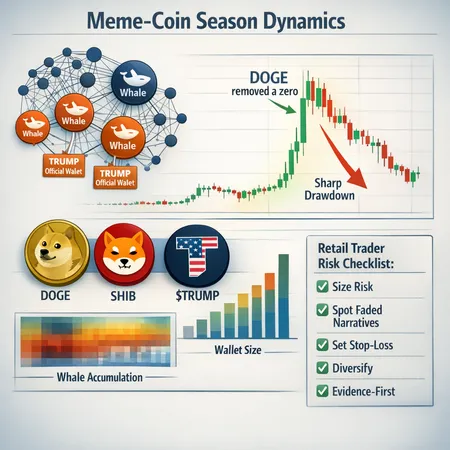
Unique new holders vs clustering: Are many distinct wallets holding meaningful balances, or do a few addresses control most inflows? High Gini/clustering suggests risk.
Exchange flow balance: Compare exchange inflows and outflows. Large net inflows to exchanges during price spikes warn of potential selling pressure.
Liquidity depth and spread: Monitor order‑book depth on major CEXs and liquidity on DEXs. Shallow pools with large price impact are a red flag.
Transaction types mix: Are transfers mostly buy/sell trades, or do you see payments, contract calls, and other utility uses? More diverse on‑chain actions imply real use cases.
Developer and ecosystem signals: Track commit velocity, new integrations, and announcements. One‑off PRs matter less than continuous development.
Use these as a checklist each time you see an address spike. For traders, require at least two of the checklist items to be positive before assuming a durable breakout. For community managers, prioritize turning short‑term attention into the signals in items 5 and 6.
Putting it into practice: a short playbook for traders and community managers
For traders:
- Treat active‑address spikes as a trigger to investigate, not an automatic buy signal. Combine with liquidity and exchange flow checks to manage timing and position sizing. Tools that visualize cluster ownership and flow (CEX in/out charts) cut through the noise.
- Set tight stop rules for memecoins where liquidity is shallow. If elevated addresses are not matched by liquidity improvement in 72 hours, consider trimming exposure.
For community managers:
- Convert traffic into retention. Run small, frictionless utility experiments (micro‑payments, simple NFTs, community‑only features) to nudge one‑time visitors into repeat users. That moves the metric mix from ephemeral addresses to persistent usage.
- Communicate transparently about what the community is building. New contributors and integrations — even modest ones — help change the narrative from “meme pump” to “use case.”
Platforms like Bitlet.app and other retail access points can magnify both upside and downside: ease of entry brings more addresses, but it also accelerates rapid rotation. Emphasize the checklist when you interpret on‑chain signals originating from such channels.
Quick takeaway
A 28% jump in Dogecoin active addresses is noteworthy and worth close study, but it is not by itself proof of sustainable on‑chain adoption. Use a holistic approach: combine active‑address trends with liquidity, exchange flows, transaction types, and developer signals. For community managers, the priority is converting attention into repeatable use; for traders, the priority is managing risk where liquidity and holder concentration remain uncertain.