Meme-Coin Season: Whale Accumulation, Short-Lived Rallies, and a Retail Risk Checklist
Summary
Introduction: why meme-coin seasons still matter
Meme coins aren't just jokes on chain; they're a recurring market ecosystem that concentrates capital, attention, and risk. For retail traders and community managers, understanding the mechanics behind a meme season — who is accumulating, what drives the short squeezes, and when narratives fade — is essential to avoid catastrophic losses and to size positions sensibly.
This post combines recent evidence of whale accumulation (notably around $TRUMP), reporting that millionaire investors are buying memecoins, examples of short-lived psychological price moves in DOGE, and broader market stress signals to build a practical checklist for retail players.
What the data says: whales, millionaires, and round-number moves
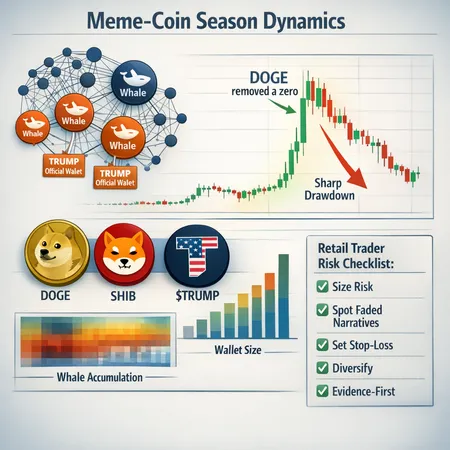
Whale clustering and the $TRUMP example
On-chain analytics platforms have flagged a measurable rise in large wallets holding the TRUMP memecoin ahead of high-profile events. Reporting that cites Santiment data highlights an uptick in large TRUMP wallets as a potential precursor to coordinated accumulation or marketing-driven pumps. You can read the coverage and data summary in this report: Santiment data shows a rise in large TRUMP memecoin wallet counts.
When a small number of addresses account for a rising share of supply, the risk is twofold: those wallets can distribute into retail demand and quickly remove liquidity, and they can stage coordinated buys to sustain a narrative until distribution is complete.
Millionaire interest: does big money change the story?
Mainstream coverage has observed wealthy investors adding meme exposures, with some wealthy individuals reportedly buying Dogecoin and Shiba Inu as speculative allocations. That trend is covered by The Motley Fool, which discusses whether millionaires buying meme coins materially changes the risk profile for retail traders: Millionaire investors are buying meme coins — should you?.
The key takeaway: institutional or wealthy involvement can add liquidity and price support temporarily, but it does not remove the underlying narrative risk or the high likelihood of steep drawdowns after bullish media cycles.
Round-number psychology: the case of DOGE removing a zero
Short-lived, symbolic price moves — like Dogecoin briefly “removing a zero” — are classic examples of retail psychology at work. Coverage analyzing that event points to three reasons why such moves often prove temporary: speculative flow exhaustion, profit-taking by early entrants, and renewed focus on fundamentals (or the lack of them) once the headline fades. See the analysis here: Dogecoin removed zero from its price — why it may be temporary.
These round-number milestones are powerful social-media hooks. They trigger FOMO, media attention, and short-term liquidity surges — and they can reverse quickly when distribution starts.
Broader market stress and meme-coin seasonality
Meme coins are not immune to broader market dynamics. Reporting on market stress and hopes for renewed meme seasons highlights that while narratives can reignite, the cycles are punctuated by sharp corrections and periods of low retail engagement. For a broader perspective on cycles and current market pressure, consult this piece: Meme coin market stress and hopes for renewed seasons.
On-chain signals retail traders should watch
1) Whale concentration and flow metrics
- Monitor the share of supply held by the top 10/100 addresses. A rapid increase over days suggests accumulation.
- Watch for synchronized inflows to centralized exchanges (CE) from whale addresses — large deposits typically precede distribution.
- Useful alert: top-100 supply rising by >5–10% in seven days is a red flag for potential coordinated activity.
2) Exchange flows and liquidity depth
- Rising exchange inflows = elevated selling risk. Sustained outflows, by contrast, can indicate holders taking coins off-market to HODL.
- Check order-book depth at major pairs (e.g., DOGE/USD, SHIB/USDT). Thin depth at higher price levels makes sudden moves fragile.
3) On-chain activity vs. price (real-use vs. speculation)
- Look at active addresses, transaction counts, and transfers between non-exchange wallets. If price rises but active-use metrics lag, the rally is likely narrative-driven.
4) Social and derivative signals
- Spike in social mentions + low on-chain activity = classic memecoin pump signature.
- Options and perpetuals open interest (where available) can amplify moves; watch funding rates and liquidations.
Why round-number moves excite — and mislead — retail psychology
Humans anchor to simple, memorable numbers. When Dogecoin “removed a zero,” headlines and social-media posts made the event feel like a structural change. But psychology-driven rallies often lack the two things that sustain healthy markets: diverse buyer bases and real use-cases.
Narrative-driven buying is contagious: retail sees the milestone, reacts, and inflows grow — until large holders rotate out. That pattern explains why short-term symbolic gains are frequently followed by fast reversals.
Historical drawdowns and scenario planning
History shows meme-coin spikes can lead to 50–90% drawdowns once narratives cool. Even when whales and wealthy investors join the market, the sequence often looks like: accumulation → social amplification → retail FOMO → distribution → rapid drawdown.
A prudent scenario plan:
- Bull case: coordinated accumulation supports a multi-week rally with measured distribution; liquidity improves and narrative expands to new buyers.
- Base case: short-term spike followed by consolidation and 30–60% drawdown from peak.
- Bear case: aggressive distribution into hype, immediate sell-off with liquidity gaps and >60% drawdown.
Checklist for retail traders: sizing risk and spotting faded narratives
Position cap: limit any single memecoin to 1–3% of your total investable portfolio; conservative traders should target 0.5–1%.
Entry plan: prefer dollar-cost averaging (DCA) on accumulation signals rather than all-in at momentum highs. DCA reduces timing risk during narrative spikes.
Liquidity test: only trade coins with sufficient on-chain and order-book depth to enter/exit without >5% slippage at your intended size.
Distribution alerts: set alerts for large whales moving to exchanges, sudden spikes in top-10 supply, or unusual on-chain transfers tied to marketing wallets.
Narrative health check: track media mentions, community sentiment, and whether price gains are supported by increasing active addresses. If social mentions rise faster than on-chain activity, treat the move as higher risk.
Stop and scale-out rules: plan partial profit-taking at pre-defined thresholds (e.g., 25% off at 2x your entry, 50% off at 3x) and use trailing stops or size-based exits to lock gains.
Avoid leverage: memecoins are highly volatile. Leverage can create catastrophic liquidation cascades for retail traders.
Post-trade review: after any trade, log what worked, what failed, and whether distribution signals were ignored. That discipline reduces repeated mistakes.
Practical example: for a small retail account, cap DOGE exposure to 1% of assets; if whales begin depositing 20% of a recent supply increase to exchanges, reduce exposure by 50% and tighten stops.
Tools and next steps
Use on-chain explorers, watchlists, and alerts to detect whale clustering and exchange inflows. Community managers should communicate these signals to members and avoid hype-driven calls. Platforms that facilitate installment buys and disciplined entries, like Bitlet.app, can help retail traders implement DCA strategies without chasing headlines.
Conclusion: stay humble, not greedy
Meme-coin seasons are high-energy windows of opportunity — but they are also traps for undisciplined capital. The presence of whales or millionaire buyers does not eliminate structural risks; it may only change the tempo. Use measurable on-chain signals, a strict risk checklist, and disciplined position sizing to participate without being consumed by the narrative.
Sources
- Santiment-linked coverage on TRUMP whale wallet rise: https://beincrypto.com/trump-memecoin-whale-wallets-mar-a-lago-summit/
- Coverage on millionaire investors buying meme coins: https://www.fool.com/investing/2026/03/18/millionaire-investors-are-buying-meme-coins-should/
- Analysis of Dogecoin "zero removal" and why it may be temporary: https://u.today/dogecoin-removed-zero-from-its-price-but-there-are-3-reasons-why-it-is-temporary?utm_source=snapi
- Broader meme coin market stress and seasonality: https://www.newsbtc.com/meme-coins/meme-coins-dogecoin-shiba-inu/
For reference on long-term market context, many traders still watch bellwethers like Bitcoin while tracking memecoin-specific momentum around projects such as Dogecoin.