T. Rowe Price’s Active Crypto ETF Filing: What It Means for Dogecoin and Shiba Inu
Summary
Quick takeaway
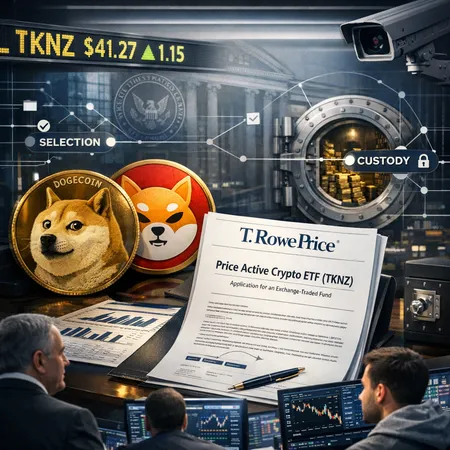
T. Rowe Price’s amended registration for its Price Active Crypto ETF — reported to list DOGE and SHIB among potential holdings — marks a notable shift in how large, traditional managers are framing meme-coin exposure. For investors, the filing signals three things: the idea of meme‑coin ETFs has moved into the practical sphere; an actively managed vehicle changes allocation mechanics and compliance tradeoffs; and regulatory and market-structure obstacles remain substantial.
Why a $1.8T manager filing matters now
Big asset managers change optics and capital flows. When an $1.8 trillion manager like T. Rowe Price files an amended ETF registration (coverage summarized in reporting on the filing), it does more than suggest interest — it forces the SEC, custodians, market infrastructure providers, and counterparties to take operational steps they might otherwise avoid.
An active product can buy and sell exposures without strict index rules, enabling a manager to add nontraditional tokens such as DOGE or SHIB if and when they meet internal risk and liquidity screens. That discretion matters: passive index-based funds require a broad, rules-based approach that many meme coins fail; active funds can apply dynamic sizing, hard exposure caps, and time-limited allocations that appeal to compliance teams.
Coverage of the filing and subsequent press pieces (which reference a proposed fund ticker such as TKNZ) contextualize how fast meme-coin inclusion is moving from idea to application. See the reporting on T. Rowe Price’s filing for details and press reaction.
What “active crypto ETF” means here (and why it’s different)
An active crypto ETF gives the manager authority to select holdings inside a defined prospectus framework rather than tracking a single index. Practically, that allows: manager judgment on liquidity windows, temporary suspensions of purchases, size caps on individual tokens, and dynamic trading strategies to manage volatility.
For meme coins, that matters because DOGE and SHIB frequently trade on thin, fragmented venues and exhibit outsized intraday moves. An active manager can choose to scale into a position only when aggregated liquidity metrics meet internal thresholds, or allocate via derivatives and on‑chain swaps if spot liquidity is too shallow.
Active funds also create different arbitrage and market-making dynamics than passive funds. Where a spot index ETF creates predictable buy/sell pressure tied to index rebalances, active flows are discretionary and can be staggered, reducing immediate price pressure but potentially prolonging liquidity demand over time.
SEC listing hurdles: what the regulator will focus on
The SEC’s primary concerns historically revolve around market manipulation, investor protection, valuation, and surveillance. For meme coins, those concerns sharpen:
- Market manipulation and wash trading: the SEC will want evidence that the markets used for price discovery are not dominated by wash trades or spoofing, and that there are surveillance-sharing arrangements with major trading venues.
- Liquidity and redemption mechanics: ETFs rely on authorized participants (APs) to create and redeem shares. The SEC will ask whether APs can source meaningful blocks of DOGE or SHIB without disrupting markets or creating persistent premia/discounts.
- Custody and valuation risk: how will the fund securely custody tokens and mark their NAV when primary liquidity venues are fragmented or offshore?
- Disclosure and investor protections: prospectus language must clearly state the crypto-specific risks (smart-contract risk for ERC‑20 tokens, network congestion, forks, or airdrops).
Spot Bitcoin ETF precedence helped normalize some SEC concerns after 2023 approvals, but meme tokens carry distinct problems: far greater exchange fragmentation, varying regulatory status internationally, and concentrated holder distributions. The fund’s filing will need to address these head‑on if it hopes to clear comments and eventual approval.
Custody and surveillance: technical but critical
Custody for DOGE and SHIB looks different on the ledger level. Dogecoin is a UTXO‑based network (like Bitcoin in structure), while Shiba Inu is an ERC‑20 token on Ethereum. Custodians must support both models securely, and for ERC‑20 tokens they must manage smart-contract interaction risk and token‑standard quirks.
Third-party custodians (Coinbase Custody, BitGo, Paxos, etc.) already custody large crypto assets, but the SEC will press for proven custody infrastructure specific to each token. For SHIB, smart-contract vulnerabilities, token approvals, and multisig workflows are under additional scrutiny.
Surveillance is the other pillar. The regulator typically looks for surveillance-sharing agreements with exchanges that form the basis of price discovery. Meme coins trade heavily on smaller or offshore venues, which complicates surveillance. That’s why filings that openly discuss signed surveillance arrangements or robust on‑chain monitoring are more persuasive.
On‑chain transparency helps (anyone can see flows and wallet concentrations), but on‑chain data alone doesn’t equate to a regulated surveillance agreement. Expect robust tracing tools and exchange partnerships to play a key role in any SEC review.
Likely selection mechanics and limits inside an actively managed fund
An active ETF prospectus can include guardrails that make meme-coin holdings operationally acceptable to compliance teams and the SEC. Practical mechanics to expect:
- Allocation caps: hard limits on the percentage of fund assets allocated to any single meme coin or to an aggregate “high‑volatility” bucket.
- Liquidity filters: minimum 30‑ or 60‑day realized liquidity thresholds for new or continued inclusion.
- Staggered purchase windows: buy orders executed over multiple days or via block trades to reduce price impact.
- Use of derivatives or swaps: synthetic exposure to manage execution when spot liquidity is poor.
- Temporary suspension clauses: manager discretion to suspend purchases or redemptions under stressed market conditions.
These mechanics allow the manager to prudently scale exposure while meeting fiduciary and regulatory expectations.
Market impact: what happens if a U.S.-listed fund starts buying DOGE and SHIB?
Large, consistent demand from a U.S.-listed fund would change the supply/demand dynamic for both tokens. Immediate effects could include:
- Price appreciation and tighter spreads: if APs and exchanges absorb buy pressure, spreads could tighten; absent that, buying could push up prices sharply.
- Regional flow shifts: as Coinhako data showed in recent SHIB activity, regional exchange flows can concentrate trading volume. A U.S. ETF would reallocate some demand to venues tied to AP liquidity, shifting where price discovery happens.
- Volatility pattern shifts: short-term volatility might increase around creation/redemption windows, but over time an ETF could add a predictable marginal buyer, which some investors interpret as reducing downside volatility (others see it as creating new runups).
- Liquidity incentives: listings could incentivize larger market‑makers to provide deeper liquidity, especially if APs see profit from arbitrage between the NAV and token spot prices.
- Institutional acceptance: a regulated vehicle makes it easier for institutions with custody or compliance constraints to gain exposure indirectly, expanding the investor base.
But beware: meme coins have high concentration of supply in a few wallets, and coordinated selling by large holders can still outpace ETF buying in tight markets. The net market impact will depend on fund size, allocation caps, and AP execution quality.
Practical path and realistic timeline
The path from filing to trading includes a comment period, SEC staff review, potential negotiation on prospectus language, and then either approval, denial, or a request for more information. For complex products, the SEC may issue comment letters pushing for more detail on surveillance or custody.
Even after approval, operational steps—counterparties signing surveillance‑sharing agreements, custodians proving readiness, APs testing baskets—take time. Given precedents, a cautious timeline is months to more than a year, and for meme coins the timeline could be longer because of elevated scrutiny.
Expect multiple iterative revisions if the SEC wants explicit, binding surveillance arrangements and detailed scenarios for market stress. Reporting and analysis of the filing (including the recent pieces that highlighted DOGE and SHIB inclusion) are useful checkpoints but not guarantees of progress.
How retail investors and ETF‑savvy readers should evaluate this development
- Check the prospectus for explicit surveillance and custody partners and any hard allocation caps.
- Watch for AP and market‑maker participation: deep, regulated AP liquidity reduces execution risk for the ETF.
- Treat inclusion as an access route, not a de‑risking event: meme coins retain token‑specific risks that an ETF can mitigate but not remove.
- Consider execution and fee tradeoffs vs. buying tokens directly or using platforms that offer installment or managed exposure (for example, Bitlet.app and similar services), but account for counterparty, custody, and regulatory differences.
Final thoughts
T. Rowe Price’s amended filing brings the concept of meme‑coin ETFs into tangible territory. An active ETF offers a pragmatic architecture to manage DOGE and SHIB exposure, but the SEC’s remaining concerns about manipulation, fragmented liquidity, custody, and surveillance are real and resolvable only with concrete operational commitments. If approved, such a fund could broaden access and materially affect market structure for meme coins — but investors should judge the details, not the headline.
Sources
- T. Rowe Price files for multi-crypto ETF including Dogecoin and Shiba Inu (Blockonomi)
- T. Rowe Price progress and SHIB ETF context (U.Today)
- Coinhako drives surge in Shiba Inu activity and regional trading context (Coinpaper)
For broader context on crypto market structure and how spot products have evolved, see coverage on Bitcoin and market categories like DeFi.