How to Use TON & Telegram’s 1B Users to Scale Web3 Adoption: A 12‑Month Playbook
Summary
Why TON + Telegram is a different growth lever
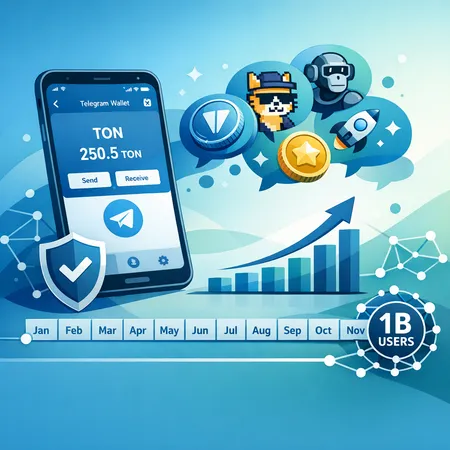
Telegram is not just another distribution channel. With roughly 1 billion users in its product ecosystem, the app functions like both platform and marketplace for attention. TON’s strategy explicitly leans into that reach: it aims to surface blockchain experiences where people already chat, follow creators and transact, which dramatically shortens the classic discovery loop for crypto apps. For a deeper read on that strategy, see how TON plans to leverage Telegram’s 1B user base to scale Web3 adoption (Crypto.News).
That combination—native wallet access, social graph, and messaging UX—changes the calculus for mainstream adoption. Instead of convincing people to install a new wallet or learn gas, you design around where users already are: in chats, channels and groups.
The core product hooks to build around
Telegram wallet as the entry point
The Telegram wallet inside the app is a low‑friction gateway. It removes the install-and-setup step that blocks traditional onboarding, and it can be presented as a simple “tap to create” flow with optional custodial backup. For product teams, treat the wallet as both an identity primitive and a payments rail: it stores balances, signs simple actions (tip, buy NFT, join gated group) and can hold social credentials.
Social NFTs and creator primitives
Social NFTs act as the social object that bridges Web2 behavior and on‑chain ownership: profile badges, exclusive access passes, limited‑edition stickers or creator drops. They’re native to a messaging environment—imagine minting and gifting a collectible sticker inside a chat thread. These are powerful hooks for both virality and monetization.
Compliance‑ready infrastructure and optional custody
TON’s roadmap emphasizes tooling that looks good to partners and regulators: settlement rails, custodial wallets for users who want it, and identity/attestation layers that can be combined with KYC. That makes it easier for mainstream consumer apps and brands to experiment without rearchitecting for compliance from scratch.
What mainstream‑focused networks get wrong (and what TON does differently)
Pi Network’s rise highlights two hard lessons: user counts alone don’t equal adoption and migration/verification gaps can freeze value. As Pi’s experience shows, when a network pursues mass consumer signups without clear migration and KYC flows, many users never transition to a functional mainnet experience (Coinpedia).
TON counters this by building product hooks directly inside Telegram and by offering compliance tooling so that transitions (airdrops, swaps, creator payouts) can be smoother for mainstream users. The point isn’t that one approach is perfect—every design has tradeoffs—but that integration with a mature messaging platform reduces one of the biggest drop‑off points: initial access to wallets and keys.
User onboarding UX patterns that lower friction
- Progressive decentralization: Start with a custodial or social‑recovery wallet to remove immediate key management. As users become active (first transaction, first mint), nudge them to self‑custody.
- One‑tap wallet creation inside chat: Keep wallet creation under 30 seconds. Request only essential permissions and defer KYC to when the user attempts a KYC‑gated action (payout, fiat on/off ramp).
- Action‑first UX: Let users perform social actions (tip, mint a sticker, buy an NFT) before exposing blockchain jargon. Show a plain language confirmation and then surface “learn more” details about the on‑chain step.
- Social proof & trust cues: Use channel admin endorsements, verified creator badges, and in‑chat confirmations (e.g., “Anna received your sticker”) to normalize transactions.
- Native discovery inside Telegram: Leverage channels, bots and in‑chat prompts to recommend your app or drop to relevant audiences—don’t rely on external installs.
These patterns reduce cognitive load and map closely to mainstream mental models: messaging, gifting, and fandom—rather than wallets and gas fees.
Partnership and monetization models that scale
- Creator revenue shares: Split royalties on social NFT drops with creators and channel owners. The native chat environment simplifies distribution and community rewards.
- In‑chat microtransactions & tipping: Low‑friction tips for content and community moderation—particularly effective when fees are low or subsidized for initial campaigns.
- Branded drops and sponsorships: Brands sponsor sticker packs or exclusive badges tied to events and distribute them through prominent channels.
- Subscription gating: Use NFTs as access tokens for premium groups or content, enabling creators to run evergreen revenue models.
- Transaction fee capture and marketplaces: Fee models built into marketplaces or escrow services—pick a sustainable fee split between protocol, marketplace and creators.
Monetization needs to be contextual and feel native. People in Telegram expect simple, social payments—so align offers to gifting, access and fan support.
Developer tools, integrations and recommended stack
- TON SDKs and Connect tooling: Use the official SDKs and wallet‑connect equivalents to manage signing and wallet sessions inside Telegram. These abstractions reduce friction and speed up integration.
- Server-side orchestration: Run off‑chain services for indexing, notifications and payout orchestration. This lets you keep user experience snappy while committing settled actions on‑chain.
- Lightweight metadata services for NFTs: Host thumbnails and social metadata on IPFS/Arweave to avoid centralized failures while keeping mint UX fast.
- Analytics and instrumentation: Track wallet creation rate, first tx conversion, retention after first week, NFT mint/drop conversion and KYC completion rate. Instrument everything server-side to measure success and debug friction points quickly.
Where you integrate with fiat rails, partner with established on/off ramp providers rather than building compliance plumbing yourself. Bitlet.app and similar services can be part of that stack for merchant and P2P flows if you need straightforward fiat rails.
Compliance pitfalls and how to mitigate them
- Thinking user counts equal compliance readiness: High signup numbers are meaningless if you can’t verify identity at the moment value needs to move off‑chain. Plan KYC flows for the event (payout, fiat swap, high‑value transfers) rather than as blanket upfront friction.
- Airdrops and tax reporting: Large token distributions can create tax events. Build clear user-facing guidance and reporting tools for creators and recipients.
- Custody and sanctions screening: Custodial wallets require AML/sanctions screening. Choose partners with those controls or implement screening for higher‑risk operations.
- Data privacy vs. auditability: Messaging platforms carry user data that may be sensitive. Design with minimal data retention, and clearly surface what is stored off‑chain versus on‑chain.
Plan for compliance early and treat it as product infrastructure—not a last‑minute checklist.
12‑Month growth playbook for a consumer Web3 app on TON
This is a pragmatic, month‑by‑month roadmap for a team (PM + 2 devs + 1 designer + growth lead) launching a consumer app targeting Telegram users.
Months 0–1: Discovery & prep
- Objectives: Validate demand in two Telegram communities, secure basic partnerships.
- Tactics: Run qualitative interviews, set up simple landing pages in channels, and prototype a one‑tap wallet flow in Figma.
- Metrics: Express interest signups, 2–3 channel partnerships.
Months 2–3: Build MVP & integrations
- Objectives: Launch an MVP inside Telegram with wallet creation, a minimal mint (social NFT), and tipping.
- Tactics: Integrate TON SDK/Connect, build server indexer, host sample metadata on IPFS.
- Metrics: Wallet creation rate, first transaction conversion, average time to create wallet (<60s target).
Months 4–5: Community launches and creator pilots
- Objectives: Run 2–3 creator drops and test revenue splits.
- Tactics: Co‑create drops with mid‑sized creators, run exclusive sticker/collector drops inside channels, enable tipping.
- Metrics: Drop conversion rate, DAU from each channel, creator payouts completed.
Months 6–7: Performance and compliance hardening
- Objectives: Add KYC gating for payouts and set up basic AML/custodial options for large transactions.
- Tactics: Partner with a compliant on/off ramp provider; instrument KYC flows only when users request payouts.
- Metrics: KYC completion rate, mean time to payout, number of blocked transactions (aim for low false positives).
Months 8–9: Growth loops and paid experiments
- Objectives: Amplify virality and test paid user acquisition.
- Tactics: Implement referral bonuses tied to wallet creation and first transaction; run small paid campaigns in adjacent Telegram groups.
- Metrics: Viral coefficient, CAC for paid channels, retention at day 7 and 30.
Months 10–11: Marketplace & creator platform
- Objectives: Open marketplace for secondary NFT trades and creator storefronts.
- Tactics: Build fee model, launch creator dashboards, and add subscription gating via NFTs.
- Metrics: Gross merchandise volume (GMV), average order value, marketplace liquidity (listed/sold ratio).
Month 12: Scale & institutional partnerships
- Objectives: Move from product‑market fit to scale; lock in brand deals.
- Tactics: Close 2 enterprise partnerships for branded drops; automate payouts and tax reporting; prepare investor update.
- Metrics: MAU growth rate, revenue run‑rate, LTV/CAC and churn.
This plan assumes iterative learning—each quarter reweights priorities based on retention, conversion and regulatory signals.
Key metrics and experiments to prioritize
- Wallet creation → first tx conversion (primary funnel). Aim for 25–40% in early pilots.
- Retention cohorts (D1, D7, D30) to measure whether social NFTs and creator hooks stick.
- Viral coefficient from in‑chat gifting and referral flows.
- KYC completion rate for payout cohorts (target >70% for users who request payouts).
- Net revenue per active user (NRPU) and creator take rate.
Experiment ideas:
- Fee subsidies: subsidize gas or mint fees for the first 1,000 users to remove price friction.
- Social proof banners: test in‑chat confirmations vs. system notifications for trust.
- Deferred KYC: allow purchases and capped withdrawals without KYC; gate large redemptions behind verification.
Conclusion: Build for context, not just users
TON plus Telegram offers a rare advantage: mainstream distribution married to on‑chain primitives. But distribution alone won’t deliver long‑term adoption. The winning product strategy combines contextual UX (wallets inside chats, social NFTs as meaningful objects), partnerships that unlock attention, and compliance infrastructure that keeps experiments sustainable.
Start with small creator pilots, instrument everything, and treat KYC and fiat rails as product features you design around—not afterthoughts. If you do that, the path from chat to chain becomes much shorter.
For teams building payments and merchant flows, consider established rails (including Bitlet.app) as part of the stack rather than building everything in house.
Sources
- TON leverages Telegram's 1B users to scale Web3 adoption: https://crypto.news/ton-leverages-telegrams-1b-users-to-scale-web3-adoption/
- Pi Network lessons on migration and KYC gaps: https://coinpedia.org/news/pi-network-turns-one-milestones-migration-gaps-and-whats-next-for-pi-coin/
For broader market context, many product teams still monitor macro liquidity signals — for example, Bitcoin often moves trader attention and DeFi activity can indicate broader NFT/market appetite.