What 100M FXRP on Flare Means for DeFi: Liquidity, Composability, and Yield Tactics
Summary
Why 100M FXRP is more than a vanity metric
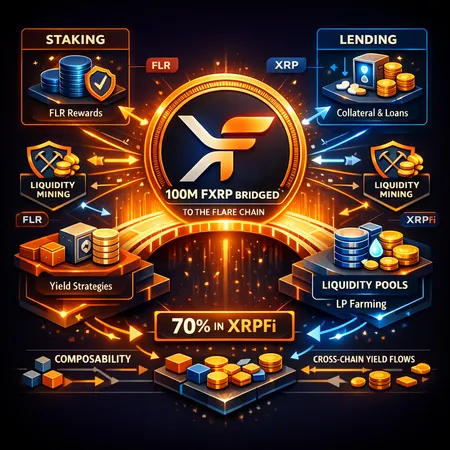
FXRP recently crossed the 100 million mark in total supply, and ecosystem reporting shows about 70% of that supply is currently deployed into the XRPFi DeFi stack—staking, lending pools and vaults. That concentration means tens of millions of tokenized XRP are now active, not idle, on Flare. For context, that’s roughly 70M FXRP working inside DeFi primitives rather than sitting on custodial ledgers or being used only for custody.
This matters for three reasons: liquidity depth, on‑chain price signals, and composability. The first two help traders and market makers form tighter bids/asks and enable on‑chain price discovery. The third—composability—creates tooling and yield opportunities, but also multiplies smart‑contract and oracle risk. For many readers this is a practical signal: tokenized XRP on Flare is no longer experimental—it's becoming an operational liquidity layer for builders and yield strategists.
How FXRP works (brief, practical view)
FXRP is a tokenized representation of XRP that lives natively on the Flare EVM environment. Holders of genuine XRP can convert or mint FXRP through bridge mechanisms and minting flows designed to represent on‑chain claims to XRP value. Once minted, FXRP behaves like an ERC‑style asset on Flare: it can be staked, lent, used as LP collateral, and composited into vaults.
That fungibility is the technical enabler for cross‑chain yield strategies: FXRP can move into lending markets, be paired in liquidity pools, or be used as collateral for RLUSD borrow/leveraging schemes—bringing XRP liquidity into DeFi primitives that historically lived on other chains.
(Reporting on the milestone and how that FXRP supply is being used can be found in recent ecosystem coverage.) — see the FXRP milestone report for supply and deployment specifics: FXRP milestone reporting.
What heavy deployment into XRPFi means for on‑chain liquidity and price discovery
When a large share of tokenized supply is actively deployed into staking, lending, and vaults, several dynamics emerge:
- Deeper on‑chain order books: Pools and lending markets using FXRP generate quoted bids and asks for FXRP <> stable pairs or FXRP <> FLR pairs, narrowing spreads and increasing tradability.
- Enhanced price reference points: Smart contracts and oracles can draw on more granular FXRP activity to inform on‑chain price feeds, which improves pricing for derivatives and structured products.
- Shorter settlement cycles for cross‑chain strategies: Liquidity already on Flare reduces bridging friction and lets LPs rotate capital faster between strategies.
These dynamics accelerate price discovery for XRP because tokenized supply becomes part of the market’s visible on‑chain liquidity. Combine that with growing social interest and partnership activity around XRP—recent coverage shows elevated social buzz for XRP as BTC and ETH cooled—which can increase trading volumes and attention on Flare liquidity pools as arbitrageurs hunt basis opportunities (social buzz reporting).
At the same time, parallel developments in Ripple’s stable‑dollar arena (for example, additional RLUSD minting and liquidity) create cross‑product demand drivers: more RLUSD in circulation can be used to pair with FXRP in pools or to borrow against FXRP positions, creating endogenous yield loops see the RLUSD liquidity mint coverage.
DeFi composability on Flare: opportunities and structural risks
Composability is the lore of DeFi: combine building blocks and new products emerge. On Flare that looks like FXRP being routed into:
- Liquidity pools (FXRP/FLR, FXRP/RLUSD, FXRP/stables)
- Lending markets (FXRP as collateral or borrowable asset)
- Vaults and automated strategies (yield optimization that auto‑compound incentives)
Opportunities
- Native asset synergies: FXRP pairs with FLR or RLUSD let protocols design native incentive programs that bootstrap liquidity mining and capture swap fees.
- Cross‑product leverage: borrow RLUSD against FXRP to farm additional LP positions or enter vaults—creating leveraged yield arcs.
- Arbitrage and market‑making: concentrated FXRP supply on Flare invites market makers to provide depth and capture basis trades between on‑ and off‑chain XRP markets.
Structural risks
- Oracle dependency: FXRP price feeds and cross‑chain price references require reliable oracles. Manipulation or outages can cascade into mispriced liquidations or insolvent vaults.
- Bridge and peg risk: FXRP inherits the security profile of its bridging/minting mechanism. Redemption lags or slippage can cause mismatch between FXRP and off‑chain XRP value.
- Composability contagion: when a large portion of FXRP is in a small number of protocols, a bug or exploit in one vault can rapidly affect lending markets and LPs due to collateral re‑use.
Understanding these tradeoffs is essential before routing large allocations into yield strategies built on FXRP.
Tactical ideas for liquidity providers and yield farmers
Below are actionable strategies for DeFi users and protocol strategists seeking to integrate FXRP into yield stacks. Each idea includes practical guardrails.
1) Concentrated LP on FXRP/RLUSD or FXRP/stable pairs (capital efficient fees)
- Why: RLUSD minting increases native on‑chain dollar liquidity; pairing FXRP with a stable-ish RLUSD or a well‑capitalized stable reduces impermanent loss while capturing swap fees and liquidity mining rewards.
- How: Start with a small allocation (1–5% of treasury or wallet), monitor pool depth and fees for 1–2 weeks, and scale as APR proves sustainable.
- Guardrails: Use pools with audited contracts and stagger voting power across multiple pools to avoid single‑protocol exposure.
2) Collateralized borrowing and rotate into yield (levered farming)
- Why: FXRP as collateral can be used to borrow RLUSD, then redeploy borrowed RLUSD into yield farms or stable LPs—amplifying returns.
- How: Maintain conservative LTVs (<40%) to avoid liquidations if FXRP price basis moves; set automated health checks to deleverage on volatility.
- Guardrails: Watch oracle spreads and maintain liquidation buffers; avoid maximum leverage during low liquidity windows.
3) Vault stacking with diversified counterparties
- Why: Vaults abstract strategy execution and auto‑compounding. Using multiple vetted vault providers reduces single‑strategy risk.
- How: Split assets across vaults that emphasize different strategies (e.g., fee capture vs. incentive capture vs. long‑term staking).
- Guardrails: Prioritize audited vaults and providers with proven insurance/backstop mechanisms.
4) Basis arbitrage between FXRP pools and off‑chain XRP markets
- Why: When FXRP accumulates on a chain, price basis can form relative to native XRP. Skilled market makers can capture arbitrage between exchanges and Flare pools.
- How: Use risk‑managed bots that account for bridging/redemption time and cost; ensure you hedge spot exposure on centralized venues where appropriate.
- Guardrails: Factor in withdrawal settlement times and on‑chain congestion; small basis opportunities can evaporate quickly.
5) Liquidity mining programs that align incentives
- Why: Protocols can design mining schedules to incentivize long‑term liquidity rather than short‑term yield grabs.
- How: Implement time‑weighted rewards, vesting for incentives, or ve‑style locks to maintain deeper, more stable pools.
- Guardrails: Avoid hyper‑inflationary rewards that attract mercenary liquidity prone to quick exits when incentives shift.
Practical risk checklist before allocating capital
- Contract audits: Confirm audits and bug‑bounty programs for bridge, vault and LP contracts.
- Oracle architecture: Understand which price feeds the protocol uses and whether there are fallback mechanisms.
- Redemption mechanics: Know how FXRP redeems for native XRP and the latency or fees involved.
- Concentration exposure: Measure what percentage of FXRP supply your chosen protocol(s) control; avoid single‑point concentration.
- Social/market signals: Track social momentum and onchain flows—rapid inflows can change slippage dynamics (see social buzz coverage for context).
Where this fits in broader strategy and final thoughts
Tokenized XRP on Flare is moving from concept to operational infrastructure. The 100M FXRP milestone and the fact that about 70% is deployed inside XRPFi push tokenized XRP into the same strategic category as other major wrapped or bridged assets: useful for liquidity, price discovery, and composability—but carrying unique bridge and peg risks.
For protocol strategists and active yield farmers, Flare offers interesting building blocks. Pair FXRP with RLUSD or stables for lower‑risk fee capture, use conservative collateralization for leveraged farming, and prioritize audited, decentralised oracles and bridge designs. If you’re integrating FXRP into a multi‑chain stack, factor in redemption time and cross‑chain settlement costs.
As you prototype strategies, treat FXRP like any other significant tokenized asset: it can deepen on‑chain markets and enable creative yield arcs—but its rapid composability also means risks compound faster. Keep position sizing disciplined, monitor on‑chain flows, and consider insurance or hedges where possible.
Bitlet.app users and protocol teams building flows that include FXRP should also incorporate operational checks into their treasury playbooks—automated alerts for oracle divergence and bridging delays can prevent simple issues from becoming existential ones.
Sources
- FXRP supply and deployment into XRPFi: FXRP milestone reporting
- Social interest and on‑chain activity context: XRP social buzz coverage
- RLUSD mint and Ripple liquidity context: RLUSD mint report
For deeper reads on composability and tokenized asset risk, consult protocol docs and current audits before deploying capital.
Internal topics you may want to explore next: see how Flare primitives compare to other networks, and more on cross‑chain yield in the DeFi category.