Why Tether's $150M Bet on Gold Could Fast-Track Tokenized RWA and Reshape Stablecoins
Summary
Executive snapshot
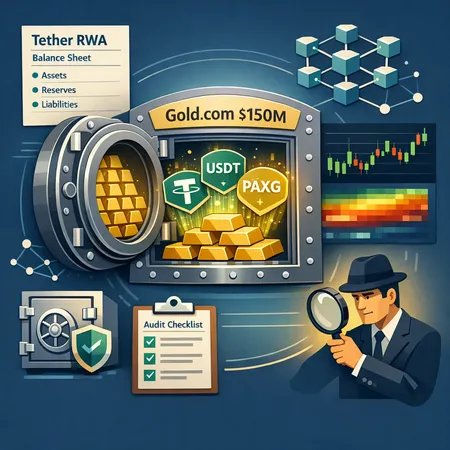
Tether’s $150 million stake in Gold.com — reported as part of a strategic push into tokenized gold markets — is more than a portfolio tweak. It signals that large stablecoin issuers are testing a new playbook: use tokenized real-world assets (RWA) like gold to diversify reserves, generate yield, and build product moats around liquidity and custody services. For asset managers and regulatory analysts, the practical questions are operational (how is the gold held and audited?), market-structural (how will on-chain gold affect price discovery?) and legal (what regulatory frameworks will apply?).
Strategic rationale: why Tether bought gold exposure
Tether’s move — documented in coverage of the $150M deal — is strategically multifaceted. On one level it’s risk allocation: adding a hard-asset hedge to USDT’s reserve mix can reduce exposure to any single asset class or counterparty. On another, tokenized gold is a product opportunity: owning a stake in a tokenized-gold platform aligns fee revenue with the growth of tokenized commodities.
Industry reporting outlines the mechanics of the deal and Tether’s intent to expand tokenized-gold access (NewsBTC analysis; Cryptopolitan report; Coinpaper coverage). Those pieces collectively suggest two aims: broaden collateral composition and vertically integrate capabilities around custody and token issuance.
For stablecoin issuers, tokenized gold serves as both a reserve asset and a marketable product. Unlike cash or short-term government securities, tokenized gold can be traded on-chain, plugged into DeFi rails, and used as a collateral layer that supports yield-bearing strategies or synthetics. That dual role—reserve plus revenue generator—is why a deep-pocketed issuer would commit material capital.
How tokenized gold fits into stablecoin balance-sheet strategies
Tokenized gold tokens such as PAXG and XAUT demonstrate two properties valuable to a balance sheet: recognizability (gold’s intrinsic market) and on-chain composability. Stablecoin issuers can use tokenized gold in several ways:
- Reserve diversification: Holding tokenized gold alongside cash equivalents reduces concentration risk and provides an inflation hedge.
- Liquidity provision and market-making: Issuers can deploy tokenized gold to provide liquidity on centralized exchanges and DeFi, capturing spreads and improving peg stability for tokens like USDT.
- Collateral for synthetic products: Tokenized gold can collateralize lending, structured products, or even backstop new stablecoins denominated against commodities.
These uses create an interesting accounting dynamic: a tokenized-gold holding is simultaneously an asset on the issuer’s balance sheet and a tradable liability (in the form of minted tokens). That duality requires rigorous governance to avoid mismatches between on-chain token supply and off-chain physical reserves.
Implications for commodity price discovery and liquidity
Bringing material flows of gold on-chain has measurable market effects. Tokenized gold increases the number of market participants who can trade gold frictionlessly, around the clock, and in smaller denominations. That should, in principle, improve liquidity and narrow spreads for on-chain gold markets. It also tightens the arbitrage link between traditional venues (COMEX, OTC dealers, ETFs) and on-chain markets.
But there are caveats. Real-world liquidity remains concentrated in large physical venues and ETF share-redemption mechanisms; tokenized-gold liquidity will likely be a complement rather than a replacement. Where it matters most is price discovery at the microstructure level: intraday on-chain prices could diverge during stress events if redemption or custodian frictions appear. Market participants—and supervisors—will watch whether tokenized flows amplify volatility or provide genuine price signals that feed back into the broader commodities markets.
For many traders, Bitcoin remains the primary crypto bellwether, but tokenized gold could become a secondary anchor for risk-off flows, particularly in macro-stress periods when traders seek both crypto-native liquidity and a traditional hard-asset hedge.
Custody, audit and redemption expectations for tokenized RWA
Operational rigor is the linchpin of credibility for tokenized gold. Three areas demand high standards:
Custody: Physical gold backing tokens must be held in secure, segregated vaults with clear chain-of-custody documentation. Insured commercial vaults with reputable custodians reduce counterparty risk.
Auditability and proof-of-reserves: Regular, verifiable attestations that link on-chain token supply to off-chain holdings are essential. Independent third-party audits—ideally with public reports and clear methodologies—help bridge the transparency gap. For asset managers, the audit frequency and scope (including testing of redemption processes) are a due-diligence priority.
Redemption mechanics and settlement finality: The ability to redeem on-chain tokens for physical gold or escrowed claims under reasonable terms prevents lasting basis risk between tokenized markets and physical markets. If redemption is limited, tokenized gold becomes more of a synthetic exposure than a fully backed commodity instrument.
Those expectations shape how regulators and counterparties treat these assets. Platforms that can demonstrate proactive custody segregation, frequent third-party audits, and efficient redemption routes will win trust—both from professional allocators and from the platforms that integrate tokenized gold into lending pools and treasuries.
Regulatory consequences and oversight vectors
Tether’s step into tokenized gold raises regulatory questions on several fronts. Stablecoin issuers already operate under intense scrutiny over reserve composition and proof-of-reserves. Adding commodities touches different regulators: securities or banking supervisors may be concerned about systemic risk, while commodities regulators (e.g., CFTC-equivalent bodies) will look at whether on-chain gold trading constitutes a detained commodity market.
Key regulatory threads to watch:
- Disclosure and audit standards: Will regulators mandate minimum audit frequencies, scope, or realtime attestations for commodity-backed tokens?
- Custody and segregation rules: Are retail and institutional custody models sufficient, or will specific segregation and insurance requirements be imposed?
- Market integrity rules: If large stablecoin issuers provide significant liquidity, do they become market makers subject to market-manipulation rules?
- Prudential and systemic-risk oversight: Could major issuers’ balance-sheet exposure to commodities prompt capital or ring-fencing rules similar to banking regulations?
This is not speculative; coverage already points to Tether’s strategic intent to expand tokenized-gold access and the likely regulatory conversations that follow (Cryptopolitan; Coinpaper). Regulators typically react to growth: as tokenized gold trading volumes and on-chain intermediation expand, expect rulemaking and enforcement actions to follow.
Competition among stablecoin issuers: new moats and new battlegrounds
Tether’s deal signals a competitive playbook: vertical integration into tokenized RWA can be a durable moat. Firms that control issuance rails, custody links, and liquidity provisioning can internalize revenues that otherwise flow to third-party market makers. That may push other issuers to pursue similar stakes or partnerships with tokenized-asset platforms.
The result could be bifurcation in the stablecoin market: issuers with integrated RWA stacks (reserves, custody, issuance) versus leaner issuers reliant on short-duration government debt and third-party partners. Each model has trade-offs — integrated issuers may earn incremental revenue but carry higher operational and regulatory complexity; lean issuers maintain simplicity but risk losing yield and product breadth.
This competition also reshapes product design. Expect to see hybrid stablecoins collateralized by mixes of cash, short-dated treasuries and tokenized commodities; cross-chain liquidity arrangements that use tokenized gold as bridge collateral; and bespoke instruments for institutional clients who want regulated, auditable RWA exposure on-chain.
Practical takeaways for asset managers and regulators
- Due diligence: Ask for custody agreements, audit cadence, redemption terms, and counterparty limits before allocating capital to tokenized gold or to issuers holding it on their balance sheets.
- Stress testing: Model scenarios where redemptions spike or custodian access is impaired—what happens to on-chain price and peg stability?
- Regulatory engagement: Expect dialogues with both financial and commodities regulators; prepare for new reporting requirements linked to on-chain activities.
Platforms like Bitlet.app that operate in crypto-native markets will watch these developments closely: tokenized gold can unlock new liquidity and products, but it requires strong operational controls to avoid injecting new systemic vulnerabilities.
Conclusion: a structural pivot, not just a headline
Tether’s $150M stake in Gold.com is a signal event: large stablecoin issuers are advancing from passive reserve management to active RWA participation. Tokenized gold delivers real benefits—diversification, yield, on-chain composability—but also demands mature custody, transparent audits, and a clearer regulatory framework. How the industry responds will determine whether tokenized RWA becomes a stabilizing force in crypto finance or another vector for concentration and regulatory intervention.
Sources
- NewsBTC — Analysis of Tether's gold strategy: https://www.newsbtc.com/news/tethers-gold-strategy-disrupts-commodities-as-subbd-presale-disrupts/
- Cryptopolitan — Report on Tether acquiring stake in Gold.com: https://www.cryptopolitan.com/tether-invests-gold-crypto-winter/
- Coinpaper — Coverage of Tether's $150M stake in Gold.com: https://coinpaper.com/14341/tether-takes-150-m-stake-in-gold-com-to-expand-tokenized-gold?utm_source=snapi