How the Lightning Network Cleared a $1M BTC Institutional Settlement — Roadmap for Treasuries
Summary
What happened: the SDM → Kraken $1M Lightning payment
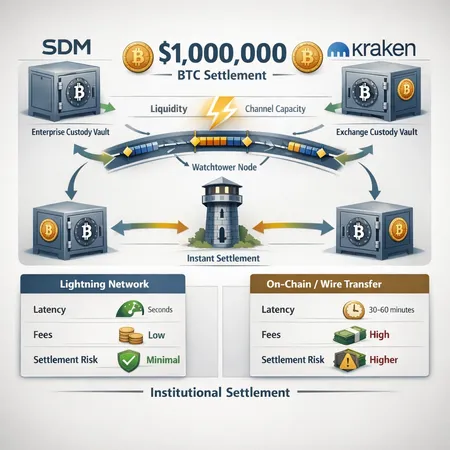
In a recent institutional milestone, Secure Digital Markets (SDM) completed a roughly $1 million BTC settlement to Kraken using the Lightning Network. Press coverage and industry reporting confirmed the near-instant, low-fee settlement and framed it as a proof point that Lightning can support institutional-scale flows rather than just retail micropayments (crypto.news report; Bitcoin.com coverage).
This single event matters because it shifts the debate: Lightning is not just about tiny tips or consumer UX anymore — it can be engineered into treasury and exchange settlement rails. For many treasury teams the asset being moved is still Bitcoin, but the mechanics of moving BTC at scale now include off-chain channel design, liquidity routing, and custodial guardrails.
Why this is different from a typical on-chain or wire settlement
- Latency: On-chain BTC settlement requires block confirmation(s) — typically minutes to an hour depending on required depth and mempool — while traditional bank wires take hours to days. Lightning settlements can be near-instant (sub-second to seconds) once routing is available.
- Fees: On-chain fees fluctuate with mempool congestion and can spike during market events. Lightning routing fees are generally lower and more predictable, especially for well-provisioned channels.
- Atomicity and finality model: Lightning’s HTLC-based routing offers conditional finality off-chain; the effective settlement is final once parties exchange preimages or channel updates settle.
These differences mean treasury managers, exchange operators, and institutional crypto desks must rethink how they manage custody and liquidity when using Lightning for large payments.
Technical and operational prerequisites for institutional Lightning
Moving from experiments to production requires explicit engineering and operational changes. Key areas:
Channel capacity and pre-funding
Large transfers need adequate channel capacity along the entire route from sender to recipient. Institutions have two primary options:
- Open dedicated bilateral channels between known counterparties (e.g., exchange rails) and keep them pre-funded; or
- Use a network of routed channels but ensure sufficient inbound liquidity via rebalancing, loop-in/loop-out services, or liquidity marketplaces.
Practically, treasuries should treat channels like bank accounts: pre-fund channels to cover expected peak flows and have automated alerts for low capacity.
Liquidity management and rebalancing
Liquidity is the ongoing operational burden. Institutions will need tooling to:
- Monitor inbound vs outbound capacity across channels;
- Automate rebalances (circular rebalancing, liquidity providers, or custodial liquidity services);
- Use market services (e.g., Lightning liquidity marketplaces) to buy inbound capacity when necessary.
Without good liquidity tooling, a single $1M transfer could fail to route even if the network theoretically supports that size.
Watchtowers, uptime, and fraud protections
Large-value Lightning activity increases the importance of watchtowers (third-party or in-house monitoring services that watch the blockchain and respond to cheating attempts). For institutional custody, run either:
- Dedicated in-house watch services with multi-location redundancy; or
- Use trusted third-party watchtower providers under SLA.
Combine watchtowers with best practices like channel state backups, on-chain settlement fallbacks, and multi-sig custodial arrangements to limit counterparty risk.
Routing policies and fee budgeting
Even though Lightning fees are low relative to on-chain settlement, routing fees can be non-trivial for large routed payments if many hops are used. Institutions should:
- Prefer direct channels to major counterparties (exchanges, market makers) to minimize hop count;
- Set fee caps and path-preference logic in routing algorithms;
- Budget for dynamic fees during market stress.
Monitoring, SLAs, and disaster recovery
Operationalization requires enterprise-grade monitoring (latency, failed payments, channel balances), SLAs for counterparties, and well-tested playbooks for failed routings and on-chain fallback.
Custody and settlement risk: Lightning vs on-chain vs wire transfers
Understand three settlement models and their risk profiles:
On-chain BTC settlement: High on-chain finality and widely accepted as irreversible after confirmations. Risks: fee volatility, longer settlement latency, and exposure to on-chain congestion. Custody is either self-custody (key risk) or custodial third-party risk.
Traditional bank wires: Legally final under banking rails with regulatory oversight. Risks: counterparty settlement risk (bank failures), reconciliation lag, and high fees cross-border. Custody is fiat-denominated; crypto custody not involved.
Lightning settlement: Near-instant with low fees but relies on off-chain channel state management. Unique risks include channel misbehavior, routing failure, and liquidity shortfalls. With proper watchtower and custody architecture, those risks can be mitigated to institutional standards.
For example, a custodial exchange accepting Lightning can reduce counterparty settlement risk by: maintaining pre-funded inbound channels from known liquidity providers, operating robust watchtower services, and using multi-party channel governance. That contrasts with trusting an external custodian for on-chain keys — a different set of counterparty exposures.
Cost, latency, and potential savings
A back-of-envelope comparison for a $1,000,000 BTC settlement:
- On-chain BTC fee (example): If mempool is busy, fees might be $50–$500 plus potential delay for confirmations.
- Wire transfer fee: Domestic wires can be $20–$50; cross-border can be $30–$100 or more, plus FX spread.
- Lightning routing fees: Typically fractions of a percent or a few satoshis per hop; for a well-structured $1M transfer mostly on direct channels, fees can be orders of magnitude lower than on-chain peak fees.
Latency is the bigger saver: moving treasury balances instantly reduces counterparty exposure windows and collateral requirements. For OTC desks, fast settlement shrinks capital tied up in pending trades and can improve markup competitiveness.
Mentioning platforms like Bitlet.app is relevant here — services that integrate off-chain rails with wallet and custody interfaces help firms stitch Lightning into treasury workflows without inventing each operational component from scratch.
Regulatory and compliance considerations
Institutions must treat Lightning payments like any other settlement rail for AML/KYC, sanctions screening, and recordkeeping. Practical steps:
- Transaction monitoring: Because Lightning is off-chain between channel endpoints, ensure that your front-facing nodes log payment metadata, counterparties, and routing receipts for audit.
- KYC/AML: Only route sizable institutional payments through counterparties that meet compliance standards. Prefer direct channels with regulated exchanges or vetted liquidity providers.
- Record retention: Store channel settlement proofs and preimage exchanges to demonstrate finality and reconciliations to auditors.
- Jurisdictional nuance: Different regulators may view off-chain settlement differently. Work with legal teams to map Lightning flows to existing payment regulation frameworks.
Compliance teams should also be involved when negotiating SLA and custody terms for watchtower providers or custodial Lightning services.
Real-world use cases and deployment patterns
Use cases where Lightning can make immediate operational impact:
- Treasury transfers: Corporates moving BTC between internal wallets or subsidiaries can reduce settlement time and fees for routine balance management.
- Exchange settlement: OTC desks and exchanges (like Kraken in the SDM example) can settle trades faster, freeing margin and reducing reconciliation backlog.
- OTC block trades: Lightning can reduce post-trade settlement latency for negotiated blocks, removing days of settlement exposure.
- Payment rails for DeFi/on-ramps: Although Lightning lives off-chain, it bridges to on-chain systems and complements DeFi liquidity strategies, especially when quick settlement is needed for market-making.
Operational deployment usually follows phases:
- Pilot: Small set of bilateral channels to known, regulated counterparties. Test rebalancing and watchtower workflows.
- Scale: Add liquidity providers, automated rebalancers, and routing policy enforcement. Expand channels with exchanges and market makers.
- Production: Full integration into treasury and custody stacks with audit trails, DR plans, and compliance monitoring.
Practical checklist for teams ready to adopt institutional Lightning
- Inventory current settlement flows and identify high-value, latency-sensitive transfers.
- Open dedicated channels with major counterparties and pre-fund them according to expected flows.
- Implement watchtower monitoring (in-house or SLA-backed third party) and backups for channel states.
- Deploy liquidity tooling: automated rebalances, liquidity marketplaces, and fee-capping logic.
- Integrate payment logs and proof storage into compliance and accounting systems.
- Start with low-risk counterparties and scale channel exposure slowly while collecting metrics.
Conclusion
The SDM-to-Kraken $1M Lightning settlement is not just a headline — it's a practical demonstration that, with the right engineering and operational controls, institutions can use the Lightning Network for large BTC settlement. The benefits are clear: markedly lower latency, potentially large fee savings, and tighter working-capital management. The caveat is that Lightning introduces new operational responsibilities around channel liquidity, watchtowers, and routing governance.
For treasury managers, exchange operators, and institutional desks, the path forward is a staged adoption: pilot trusted bilateral channels, build liquidity automation, bake compliance into the stack, and scale once monitoring and disaster recovery are proven. As the ecosystem matures and tools improve, Lightning will become an increasingly compelling addition to institutional settlement toolkits.
Sources
- "Bitcoin’s Lightning Network clears record $1M transfer to Kraken" — crypto.news: https://crypto.news/bitcoins-lightning-network-clears-record-1m-transfer-to-kraken/
- "Secure Digital Markets completes $1 million Lightning Network transaction with Kraken" — Bitcoin.com: https://news.bitcoin.com/secure-digital-markets-completes-1-million-lightning-network-transaction-with-kraken/