When Miners and Treasuries Move BTC: Reading On-Chain Signals and Managing Drawdown Risk
Summary
Why miner and treasury BTC movements matter now
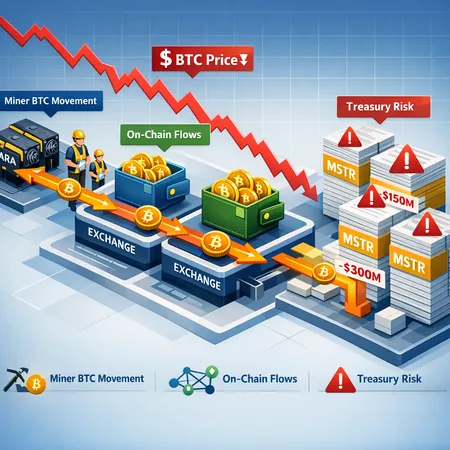
Crypto markets are peculiarly sensitive to who moves large blocks of BTC and where they send them. When a publicly traded miner or a firm with a public treasury sends coins to an exchange, markets interpret that as potential selling pressure — and often act before the coins hit order books. For CFOs and treasury teams, decoding miner BTC movement, tracking on-chain flows, and understanding treasury risk should be part of routine risk management.
For many traders, Bitcoin remains the primary bellwether; when large stakeholders shift behavior, volatility follows. Recent headlines about Marathon Digital and similar miners moving roughly $87 million in BTC sparked fresh debate about intent and downstream selling.
The recent miner transfers: what happened and who is ‘Mara’?
In late market weakness, multiple on-chain alerts flagged sizable withdrawals from miner-linked wallets. Coverage pointed to Marathon Digital (ticker MARA) as a headline example — roughly $87 million worth of BTC was moved in a way that attracted attention from exchanges and on-chain analysts (crypto.news, NewsBTC).
Practically every quarter, public miners create predictable on-chain patterns: block rewards accumulate, coins move from cold storage to operational wallets, then either to OTC counterparties, custodians, or exchanges. The nuance in this episode is timing — transfers clustered into a broader market slide — which amplifies the perceived need to sell.
Moving to exchanges: sell intent or operational choreography?
A key question for treasurers and investors is: when BTC goes to an exchange, does it mean immediate sell intent? The short answer: sometimes — but not always.
- Sell intent signals: direct transfers from known treasury or mining cold wallets to centralized exchange hot wallets, especially in the context of price drops and following previously disclosed debt covenants, increase the probability of selling. When the receiving wallet is a labeled exchange deposit address and the flows are timed with market risk events, those are classic sell signals.
- Non-sell reasons: rebalancing, hedging via OTC desks, collateral movements for lending or liquidity provisioning, or custodian consolidation can also result in exchange-address movements without an eventual spot sale.
Contextual clues matter: accompanying transfers to derivatives addresses, swaps into stablecoins, or immediate interaction with OTC counterparties (visible sometimes via chained on-chain flows) suggest a different intent than a straightforward deposit to a retail-facing order book.
How deep are corporate unrealized losses?
The market correction pushed many public treasury holders into meaningful unrealized losses. Analysis compiled after BTC sank to the $60K range showed that the largest treasury companies were collectively roughly $10 billion underwater relative to their historical cost basis, and one major firm faced a far deeper potential impairment scenario (CryptoSlate).
That same risk manifests at individual firms. MicroStrategy (ticker MSTR) — a canonical corporate BTC holder — has publicly discussed price levels that could threaten solvency or force strategic change. Executives disclosed thresholds and stress scenarios tied to BTC's drawdown, illustrating how treasury exposures translate into balance-sheet and covenant risk (Finbold).
This combination — concentrated exposures and public visibility — can create feedback loops. If markets believe a large treasury is under stress, on-chain observers will scrutinize every outgoing transfer, amplifying volatility and sometimes forcing firms into reactive liquidity decisions.
What “who moves BTC” signals about impending selling pressure
Monitoring custodial labels, miner payout addresses, and the timing of flows provides timely signals for traders and treasury teams:
- Exchange deposits from labeled treasury wallets: high probability of selling within a short window, especially during downtrends.
- Miner hot wallet consolidation followed by exchange deposit: miners often monetize immediate operational costs; sustained sequences indicate ongoing selling pressure.
- Chained flows into OTC/derivative platforms: could signal hedging rather than spot sales, but large volumes on short notice often precede a flood of liquidity into the market.
- Unusual rebalancing into stablecoins: signals risk-off behavior from corporate treasuries.
For treasury teams, the lesson is twofold: (1) maintain clear public communications and predictable policies where possible to avoid market misinterpretation; (2) proactively model how on-chain patterns might be read and the market impact if a large tranche were sold.
Treasury frameworks for miners and corporate treasuries during drawdowns
CFOs need an operational playbook that balances long-term conviction with short-term survival. A pragmatic framework includes:
Defined risk tolerances and trigger points — codify price bands and percentage drawdowns that prompt action (e.g., staged liquidity taps, temporary hedges, or asset reallocation). Make these quantifiable and reportable to the board.
Liquidity buffer policy — keep a multi-month runway in fiat or short-term liquid assets to avoid forced sales during spikes in volatility. Miners should model operating costs, debt service, and capex under several BTC price scenarios.
Staged monetization plan — avoid one-off large exchange dumps. Use layered OTC executions, algorithmic execution, or time-weighted approaches that minimize market impact and signaling.
Hedging ladder — pre-approved hedging instruments and counterparties reduce reaction time. Ensure hedges are sized and structured to avoid margin calls that could worsen liquidity strain.
Transparent governance and disclosure — clearly communicate treasury policy in investor decks or public filings. When markets know the playbook, the informational advantage of on-chain spectators diminishes and panic selling probability lowers.
Operational separation — distinct wallets and custodial arrangements for operational funds, treasury reserves, and recently mined rewards help prevent accidental signaling when routine operational transfers occur.
These principles are relevant to miners like Marathon Digital (MARA) and corporates like MicroStrategy (MSTR), both of which must manage the dual pressures of market volatility and stakeholder expectations.
Practical monitoring and an operational checklist for CFOs and treasury teams
- Track large on-chain flows from labeled treasury/miner addresses in real time. Integrate alerts for exchange-address deposits and chained flows into OTC venues.
- Simulate the market impact of selling X BTC under current liquidity conditions. Use T+0, T+1, and multi-day scenarios.
- Maintain documented counterparties for urgent liquidity (prime brokers, custodians, OTC desks) and test them periodically.
- Rehearse emergency treasury playbooks, including pre-signed approvals for staged sales or hedges to avoid decision paralysis.
- Publish a concise treasury policy publicly where possible to reduce market speculation — transparency can be a stabilizer.
Tools that combine on-chain analytics with treasury dashboards are increasingly important; platforms that tie address labels to counterparty reputations reduce ambiguity about intent. Bitlet.app’s suite (contextually mentioned here) and other analytics providers can help treasury teams keep an eye on on-chain flows without overreacting to every headline.
Final thoughts: read the chain, but act with governance
On-chain signals are powerful early indicators, but they are not deterministic. Miner BTC movement and corporate transfers can mean different things depending on context, counterparty, and policy. For CFOs and treasury teams, the right mix is disciplined governance, realistic liquidity planning, and tools that surface true intent rather than noise. Investors watching on-chain flows should combine label-aware monitoring with an understanding of corporate incentives; not every transfer is a fire sale — but when multiple signals converge, the market tends to respond quickly.
Sources
- Report on Marathon Digital moving BTC amid the slide: Marathon Digital moves $87M BTC as crypto markets slide
- Coverage attributing on-chain transfers to a large miner ('Mara'): Bitcoin miner 'Mara' moves $87M BTC amid market moves
- Analysis of treasury companies' unrealized losses after BTC dipped: As Bitcoin sinks to $60K, BTC treasury companies go $10 billion underwater
- Discussion of MicroStrategy's downside thresholds and corporate exposure: MSTR executive reveals Bitcoin price at which the company could go under