Hyperliquid’s HYPE Rally: HIP‑3, Record Open Interest, and What Whales Reveal
Summary
Executive snapshot
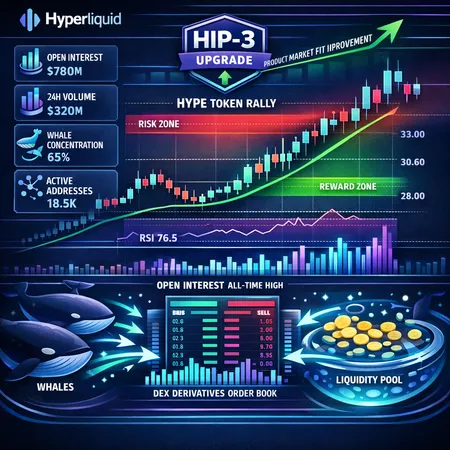
Hyperliquid’s HYPE token exploded higher after a HIP‑3 upgrade coincided with record open interest and a spike in derivatives volume. What looks like a straightforward rally at first glance is actually a useful case study in how DEX derivatives can move quickly once product tweaks hit a receptive market: new trading flows, concentrated whale participation, and self‑reinforcing liquidity cycles. For active traders and DeFi analysts this means parsing on‑chain signals (open interest, volume, wallet concentration) alongside traditional market structure to size positions and hedge appropriately.
What actually happened: HIP‑3, open interest and a volume surge
The short version: HIP‑3 — the recent Hyperliquid proposal — catalyzed a wave of derivatives activity that pushed open interest to fresh highs and attracted larger, more concentrated players. Multiple market write‑ups point to the same triad: HIP‑3 changes, record open interest, and whales stepping in as the immediate drivers behind HYPE’s step up in price. Reporting linked the rally to the HIP‑3 open interest spike and to a shift in commodities and derivatives volume on Hyperliquid’s venue (Invezz, Crypto.News).
That combination matters: when product improvements meet a high‑leverage derivatives market, incremental demand can cascade—funding rates and liquidations interact with order books to amplify moves.
On‑chain metrics: reading the tape for DEX derivatives
Traders who rely on on‑chain signals should focus on three core metrics here: open interest, traded volume, and wallet concentration.
Open interest — why the record level matters
Open interest (OI) measures outstanding perp positions and is the most direct gauge of how much leverage is active on a venue. HIP‑3 coincided with a record OI print on Hyperliquid: that signals more capital at risk and a higher likelihood of forced deleveraging dynamics. Higher OI creates two practical consequences: (1) liquidations can move price more violently when positions are crowded, and (2) rising OI accompanied by rising price usually confirms momentum, but only until funding flips or whales unwind.
Volume and order flow concentration
Volume spiked alongside OI, but the key detail from reporting was where that volume came from. Commentators noted increased commodities trading and concentrated order flow from a handful of large wallets (Crypto.News, CoinSpeaker). High volume with few active players raises the short‑term price impact of each whale trade and shortens the time it takes to flip market structure.
Wallet concentration and whale behavior
Multiple analyses observed whale participation as an important engine of the move—big limit entries, over‑the‑top leverage, and quick accumulation into liquidity bands. Coinpedia frames this as both validating the rally and increasing risk: whales can and do engineer squeezes or snap off positions that cascade to retail traders if funding and liquidity are not managed tightly (Coinpedia).
Why HIP‑3 matters for product‑market fit in DEX derivatives
HIP‑3 was the proximate catalyst. While different outlets emphasize different aspects of the upgrade, the market’s reaction suggests HIP‑3 reduced friction for a subset of professional derivatives flows — whether by introducing new instrument types, improving matching/settlement, or increasing capital efficiency. The important takeaway: product tweaks that matter to pro traders will often produce outsized liquidity responses on DEX derivatives platforms.
That’s the classic product‑market fit arc for DeFi derivatives: a functional UX/UX change (easier hedging, lower slippage, faster settlement) attracts pros; pros bring deep, concentrated orders; concentrated orders attract counterparties and market makers; the platform’s liquidity profile graduates to top‑tier status. Hyperliquid’s leap into a top liquid venue for certain macro/commodities flows is precisely that progression as noted in market coverage (CoinSpeaker).
Market structure and technical levels: what traders should watch
The price action around HYPE has shown classic momentum characteristics: a tight consolidation, then a high‑volume breakout that drew in follow‑on buyers. Analysts have pointed to near‑term upside targets around psychological levels (the $50 area has been discussed in commentary) and to layered resistance at previous highs.
From a technical process standpoint, focus on:
- The breakout zone and retest behavior (volume on retest matters).
- Funding rate dynamics: prolonged positive funding often precedes sharp mean reversion.
- OI/price divergence: rising price with falling OI = weak rally; rising price with rising OI = strong but fragile if concentrated.
Coinpedia’s technical pieces flagged both the momentum and the presence of nearby resistance that could cap the move if whales begin to take profits (Coinpedia). In practice, traders should layer exits across price bands and use dynamic stop rules keyed to funding and OI shifts rather than fixed forex‑style stops alone.
How whale concentration changes the calculus
Whales create both opportunity and fragility. On the opportunity side, a few aggressive players can generate predictable momentum and visible liquidity pockets to trade against—perfect for event‑driven scalps or tactical participation. On the fragility side, the same concentration means:
- Liquidity dry‑ups outside whale ranges can spike slippage.
- Coordinated or accidental unwind by a whale can trigger cascaded liquidations across the OI stack.
- Market depth is shallower than headline volume suggests because much of the volume is routed through large, singular execution windows.
Practically: treat whale accumulation as a signal but not as proof of sustainable demand. Watch the top whale addresses, their margin ratios (if visible), and changes in their realized P&L to gauge the risk of a rapid unwind.
Risks and rewards: sizing positions and protecting capital
This is the heart of the trade plan for HYPE‑style DEX derivatives themes. Below are tactical guidelines for both active traders and liquidity providers.
For traders (momentum and event‑driven plays)
- Position sizing: limit initial exposure to a small percentage of account (e.g., 1–3% per trade) when OI is elevated and wallet concentration is high. Increase only with confirmed re‑tests and OI/volume breadth.
- Leverage discipline: cap leverage relative to funding volatility—higher funding swings = lower allowed leverage. Remember: DEX perps often allow high leverage; you should not use it by default.
- Exit framework: tiered profit taking at pre‑defined liquidity bands, with a trailing mechanism tied to funding and OI contraction.
- Signal suite: combine OI, perp volume, funding rates and whale wallet flows. Divergence between price and OI is a red flag.
For liquidity providers and market makers
- Inventory hedging: delta‑hedge exposures via spot or cross‑venue swaps rather than letting inventory sit unhedged while funding moves.
- Concentrated liquidity: it can be profitable to concentrate within tight bands if you expect whale flow to persist, but this increases gas and liquidation risk. Employ automated rebalancing thresholds.
- Fee vs. risk calculus: fees earned from providing depth must be weighed against tail risk of sudden liquidations triggered by concentrated whales.
Simple checklist to size risk
- Is OI rising faster than volume? If yes, risk of squeeze increases.
- Are the largest 5–10 addresses responsible for >30% of volume? If yes, treat market as concentrated.
- Are funding rates persistently skewed? If yes, prepare for mean reversion events.
- Do you have stop/hedge layers that trigger on OI or funding thresholds, not just price?
Tactical scenarios and sample plays
- Short‑term momentum: buy on breakout with aggressive stops; take quick, staged profits into known whale accumulation bands.
- Mean reversion: if price runs while OI drops, consider fading with lowish size and tight risk limits.
- LP strategy: provide liquidity in narrow bands but hedge delta continuously off‑chain or cross‑venue; allocate a small, bounded portion of treasury as liquidity buffer.
Platforms like Bitlet.app show how retail access to derivatives and P2P tools is maturing; however, the core tradecraft—watching OI, whales and funding—remains the professional edge.
Bottom line
HYPE’s rally is less a pure token narrative and more an emergent story about what happens when a DEX derivatives product reaches product‑market fit: pro traders arrive, open interest balloons, whales concentrate flow, and price moves fast. That combination creates both lucrative opportunities and pronounced tail risks. Successful traders and LPs will read the on‑chain tape (OI, volume, wallet concentration), limit leverage, tier profits, and maintain dynamic hedges rather than rely on static stop prices.
Maintaining discipline—sizing positions to OI exposure and whale concentration—separates those who capture the upside from those who get caught on the wrong side of a squeeze.
Sources
- https://crypto.news/heres-why-hyperliquid-price-rallied-over-20-today/
- https://invezz.com/news/2026/01/27/hyperliquid-hype-price-soars-as-hip-3-drives-record-open-interest/?utm_source=snapi
- https://coinpedia.org/price-analysis/hype-price-climbs-as-hip-3-trading-surges-and-whales-step-in-is-a-rally-toward-50-next/
- https://www.coinspeaker.com/hypes-price-explodes-as-hyperliquid-quietly-becomes-top-liquid-venue-for-traders/