Bitcoin's New Volatility Regime: Options Open Interest, Gamma Risk and Macro Tariffs
Summary
Why options open interest is eclipsing futures — and why it matters
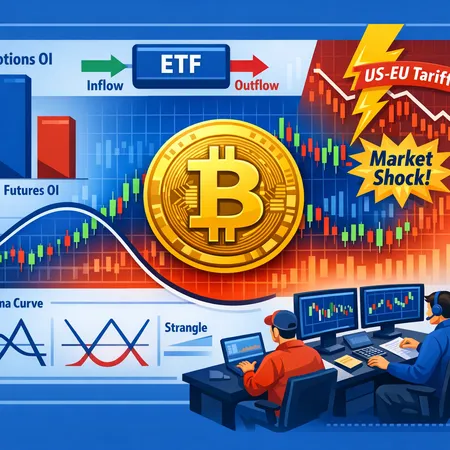
Over the past 18–24 months the derivatives footprint behind BTC has shifted. Options open interest (OI) is now at levels that often surpass futures OI, a structural development documented in recent market analysis. This isn’t just a vanity metric: when options OI dominates, the marginal source of leverage and short-term liquidity comes less from linear futures positions and more from convex, nonlinear options exposures.
Options bring gamma (convexity) and skew into focus. Market makers who sell options take on directional and gamma risk; they manage that risk by delta-hedging with spot or futures. The consequence: hedging flows are endogenous and dynamic — they depend on price moves, time-to-expiry and strike concentration — which makes liquidity more state-dependent than in a futures-dominated world. For an intermediate trader or risk manager, that means anticipating dealer hedging is now as important as anticipating large directional flows.
What open interest actually measures
Open interest counts live contracts — the standing obligations between counterparties. For futures, high OI generally reflects directional bets funded with leverage. For options, OI reflects both directional and volatility (or tail) bets: it quantifies the notional exposure to strikes and expiries that will induce gamma and vega hedging. The CryptoSlate piece framing a “new volatility regime” shows precisely this dynamic: options OI surpassing futures can presage a market where convexity and dealer hedging amplify realized volatility rather than damp it (CryptoSlate).
How gamma and delta-hedging change liquidity
When dealers are short options they sell volatility and carry positive cash positions that they hedge by trading underlying BTC. As price moves, dealers rebalance — buying to cover losses when price rises and selling when it falls — which can create a feedback loop. The strength of that loop depends on the gamma load: total gamma exposure concentrated around particular strikes and expiries.
Practical implications:
- If large OI clusters at a narrow band of strikes, pinning becomes possible near expiry: dealers dynamically hedge toward that strike.
- Near key strikes or during expiry windows, liquidity can dry up quickly because hedging flows are directional and immediate.
- Options-driven liquidity is stateful — calm markets can flip quickly once hedges move from passive to active.
This is different from a futures-first market where liquidity stress mostly shows up through funding rate swings and forced liquidations. Both can cascade, but options-driven cascades tend to be concentrated around specific price levels and event windows.
Why macro shocks still trigger outsized moves (even with ETFs)
At a glance, hefty spot demand from ETFs would seem stabilizing: they take BTC off exchanges and put it in custody, reducing available float. Indeed, spot Bitcoin ETFs recorded major inflows during recent periods — supportive evidence that institutional spot demand remains important (CoinTribune).
But macro shocks — for example, sudden tariff escalations or geopolitical surprises — can rapidly reprioritize liquidity across portfolios. The episode of tariff escalation reported in recent coverage shows how macro moves can be immediate catalysts for market stress and liquidation events (CryptoNews). Here’s why ETFs don’t fully immunize BTC from outsized moves:
- ETF flows are often slower and one-directional (buying into custody or timed redemptions). In a sudden shock, margin calls and dealer hedging are immediate. When dealers sell spot to hedge short gamma, they quickly tap available liquidity — including the same pools that ETFs rely on for execution.
- ETF inflows can give a false sense of abundance. Large inflows can reduce visible sell depth on exchanges (spot is moved to custody), which increases the price impact of a fast sell order.
- Redemption or outflow episodes can flip supportive ETF flows into selling pressure. Recent reports show mixed ETF dynamics — major inflows at times but also episodes of outflows (Currency Analytics). The coexistence of large inflows and sudden outflows increases tail risk because there’s less continuously available market-making inventory.
Put differently: ETFs change the plumbing of spot ownership, but they don’t eliminate cross-market hedging flows or the speed at which options-market adjustments occur.
Derivatives positioning + sudden macro shocks = possible market paths
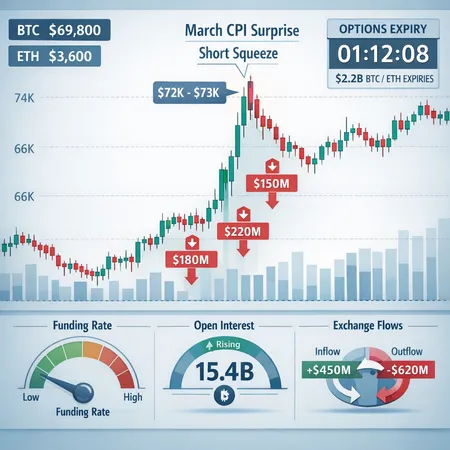
Consider an abrupt macro shock (tariffs, shock CPI print, geopolitical event). The likely sequence under heavy options OI:
- Immediate repricing: implied volatility jumps as dealers mark options wider and options traders chase protection.
- Dealer hedges: sellers of options sell spot/futures to remain delta-neutral; buyers of puts might sell futures to finance positions, creating directional pressure.
- Liquidity feedback: as spot moves, gamma forces further rebalancing, amplifying the move in a short window.
- ETF interaction: if ETF sponsors pause creations/redemptions or if authorized participants (APs) cannot source liquidity, the price dislocation widens between spot and NAV, and arbitrage frictions grow.
This path explains how a tariff headline — even if not directly linked to crypto fundamentals — can produce outsized BTC moves. The market’s structure matters: chief among those structural factors today is where the notional risk sits (options vs futures) and how concentrated it is across strikes and expiries.
Reconciling ETF inflows/outflows with derivatives dynamics
Too often traders treat ETFs and derivatives as separate arenas. In reality they’re tightly coupled:
- ETFs create base demand/supply for spot, but APs arbitrage through futures and options when sourcing or returning BTC — this connects ETF flows to derivatives markets.
- When ETFs are in buy mode, arbitrageurs may sell futures or options to hedge — adding to derivatives liquidity. But that liquidity can flip when APs need to unwind quickly.
- The interaction is time-dependent: slow, predictable ETF inflows are stabilizing; fast redemptions during stress create outsized execution costs.
Both the CoinTribune coverage of sustained ETF interest and the Currency Analytics note on recent outflows are instructive — they show ETF flows are real but not monolithic. This mixed-flow environment increases the potential for short-term liquidity gaps when derivatives hedges need to transact immediately.
Practical hedging and timing strategies for intermediate traders and risk managers
Below are actionable ideas that balance cost, effectiveness and execution complexity.
1) Tail hedges: long puts and collars
- Buy puts or create collars (long put + short call financed) to cap downside while letting upside run. Collars reduce cost vs naked puts but cap upside if you also sell calls.
- Use staggered strikes (e.g., 10–20% OTM put wings) to balance cost and protection.
- Beware: implied vol often rises ahead of macro events; buying protection too late can be prohibitively expensive.
2) Gamma-aware sizing and calendar spreads
- If options OI is concentrated near an expiry, reduce position size or hedge more aggressively during that window.
- Calendar spreads can exploit expected term-structure moves: buy time (longer-dated vol) vs sell near-term vol if you expect realized vol to mean-revert after a shock.
3) Delta-hedged straddles and vega plays (for experienced traders)
- For traders who expect a big move but don’t want direction, a delta-hedged long straddle can be effective. You’ll need capital to manage margin and frequent rebalancing.
- Practically, calibrate strike and notional to the implied vs realized variance and be prepared for gamma burns around expiries.
4) Gamma scalping and active rebalancing
- Dealers do this by default; sophisticated traders can also gamma scalpe: buy options and dynamically hedge to capture realized vol higher than implied.
- Requires speed, low slippage execution, and discipline on rebalance thresholds.
5) Execution and venue tactics
- Split large hedges across spot venues and OTC desks to avoid slippage. Use TWAP/POV for large spot trades.
- Consider using block trades or working with APs for ETF-related flows. For sizable options exposure, use listed options plus OTC to manage strike concentration.
6) Scenario sizing and stress tests
- Model tails: run scenarios where implied vol jumps 50–150% intraday and estimate the market impact of dealer hedging.
- Size positions so that a single macro shock won't force ruinous, margin-induced liquidations.
Practical checklist before heavy macro windows (tariff headlines, data prints)
- Check options OI heatmap for strike concentration and major expiries.
- Monitor bid-ask and displayed depth on top spot venues; reduced depth means higher slippage risk.
- Review ETF creation/redemption flows and recent AP behavior; mixed inflows/outflows raise execution risk (CoinTribune, Currency Analytics).
- Preposition hedges where cost-effective; don’t wait for the headline if the event is probable.
Final takeaways
We are operating in a derivatives landscape where options increasingly drive short-term BTC dynamics. That shift creates a volatility regime shaped by gamma, strike concentration and event timing. Macro shocks — even ones that seem tangential to crypto like tariff escalations — can still trigger outsized BTC moves because hedging flows are instantaneous while ETF activity is often slower or frictional. For traders and risk managers, the path to survivability is simple in concept if not always easy in execution: know where the gamma sits, size positions for stress, use cost-effective hedges, and treat execution as a core part of risk management.
Bitlet.app users managing exposure should consider these structural dynamics when sizing positions or using P2P/earn services, since cross-product liquidity frictions affect realized slippage.
Sources
- CryptoSlate on options OI vs futures
- CryptoNews coverage of tariff-driven market stress
- CoinTribune on ETF inflows
- Currency Analytics on ETF outflows
For additional reading on option Greeks and hedging mechanics, check fundamentals on Bitcoin and how macro shocks ripple through ETFs and broader DeFi liquidity.