Dogecoin Bullish Signals: Interpreting $0.088 Support, a 10% Open-Interest Spike, and Realistic Trade Plans
Summary
Why the current DOGE setup matters
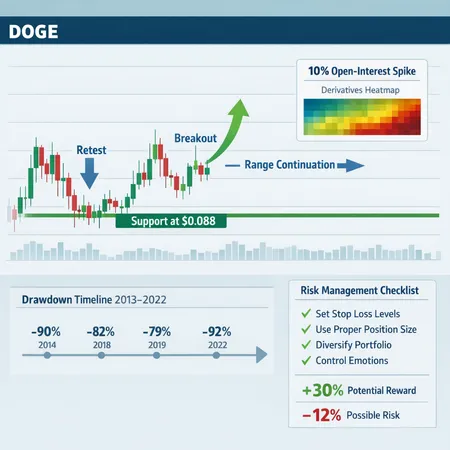
Dogecoin (DOGE) is back in the headlines not because of a single hype tweet but because price action and derivatives flows are lining up. Technical support is clustering near $0.088, and derivatives markets are showing a meaningful increase in commitment — a reported 10% spike in open interest for DOGE futures and options. That combination is important: price levels attract liquidity, while open interest shows how much money is betting on the next directional leg. When both align, active traders get a clearer signal to plan entries, stops, and size.
This article translates those signals into practical scenarios and a structured, risk-aware playbook for retail and quant traders who want to trade an altcoin recovery thesis without gambling the house.
Quick historical context: 2013–2022 drawdown and what it teaches us
DOGE began life as a meme coin in 2013 and spent many years trading under the radar. Between 2013 and 2020 the token experienced a prolonged, low-volatility period punctuated by brief spikes; the major secular rallies only arrived around the 2020–2021 crypto mania. That long 2013–2022 drawdown teaches two lessons:
- Memecoins can stay depressed longer than expected, and longs need patience and capital discipline. The stretch before 2021 wasn’t a simple reversion-to-mean trade — it required either timing narrative cycles or riding liquidity waves.
- Post-rally, price becomes highly sensitivity to headlines and leverage. That means when open interest rises (as it has recently), the move can be amplified in either direction.
Those lessons are relevant now: a tactical bottom near $0.088 is useful, but it’s not a free ticket to outsized returns without proper sizing and exit rules.
The technical picture: $0.088 as tactical support
Multiple market participants and chart overlays have flagged ~$0.088 as a short-term support band. That level matters for three reasons:
- Price memory: past congestion and volume nodes often become future support/resistance.
- Risk asymmetry: buying close to a defined support gives a cleaner stop placement and a better risk-reward profile for intraday/swing trades.
- Liquidity concentration: order books and limit orders tend to cluster around rounded, recognizable levels.
From a practical trading lens, treat $0.088 as the reference for size and stops. If price holds and shows a candlestick-based rejection (wicks, lower tail, RSI divergence), a scaled long with a stop just below the band preserves favorable risk-reward.
Why a 10% open-interest spike matters (and what it doesn't)
Open interest measures outstanding derivative contracts. A 10% spike in DOGE open interest — as documented by market reports — signals more capital is now exposed to DOGE price moves. Here’s how to interpret it:
- Bullish implication: rising open interest alongside stable or rising price often means fresh long positions are entering, which can support a trend.
- Cautionary implication: rising open interest with collapsing price can indicate aggressive shorting or leveraged sellers; that raises squeeze risk.
- Practical trade utility: a sudden OI increase tells you to expect higher intraday and short-term volatility — which changes both entry timing and stop sizing.
For more detail on the recent spike and context, see the Finbold report documenting the 10% open-interest rise and the $0.088 support band (Finbold report).
Three plausible short-term scenarios and trade plans
Below are practical scenarios with entry logic, stop placement, and realistic targets. These are tactical plays for active retail and quant traders — not long-term investment calls.
Scenario A — Retest-and-bounce (high probability, lower upside)
- Trigger: Price reclaims $0.088 and posts a clear rejection candle (or positive intraday momentum) with OI stabilizing or growing modestly.
- Trade: Enter a scaled long near $0.09.
- Stop: 6–10% below entry (place stop just under $0.082–$0.085 depending on volatility).
- Target: Initial target 15–30% (roughly $0.10–$0.12), take partial profits on intraday strength.
- Rationale: Lower tail risk because support is defined; reward is limited but probability is relatively higher.
Scenario B — Breakout and momentum (lower probability, higher upside)
- Trigger: Price breaks above recent swing resistance on rising volume and open interest continues to climb, signaling commitment. Confirmation could be a multi-period close above a short-term EMA band.
- Trade: Enter on a pullback after breakout or use momentum entries with tighter time stops.
- Stop: Below breakout level with trailing stops to capture momentum.
- Target: 30–100% depending on momentum and market correlation; keep targets realistic — extreme targets like $1 remain implausible in the near term for most scenarios (see The Motley Fool’s analysis for a sober view) (Motley Fool).
- Rationale: Breakouts with OI growth can fuel leveraged continuation, but they can also wick violently if liquidity dries.
Scenario C — Range continuation (neutral, time decay risk for options)
- Trigger: Price oscillates between defined bands (e.g., ~$0.07–$0.12) with OI choppy and no clear trend confirmation.
- Trade: Range traders sell into resistance and buy into support, or use neutral derivatives plays such as short-dated iron condors if liquidity and margin permit.
- Stop: Tight, structure-dependent; exits should be mechanical to avoid emotive losses.
- Target: Modest returns per trade (5–20% swings), but a steady edge repeated with good risk controls can be profitable.
- Rationale: Many altcoins spend long stretches in ranges; treating this as normal reduces overtrading and blowups.
Quant and derivatives-aware tactics
For quants and derivatives traders, the 10% OI jump can be used as a signal input: filter for OI growth plus positive or negative basis (funding rates) to time entry. Example systematic ideas:
- Momentum filter: trigger long when price > short-term EMA and OI rising above a percentile threshold.
- Volatility regime: increase stop width proportional to realized volatility; reduce size when funding rates spike (indicating crowded leverage).
- Options overlays: use options to define one-way risk (buying calls vs naked futures) if you want asymmetric exposure without open-ended downside.
Remember slippage and funding costs — memecoins can have wide spreads and sudden funding rate shifts.
Concrete risk-management rules (for active retail and quant traders)
Below are succinct rules to reduce tail risk while pursuing the DOGE recovery thesis:
- Position sizing: risk no more than 1–3% of your overall portfolio per trade. Scale into positions rather than all-in on a single signal.
- Stop discipline: set stops in advance and rarely move them outward unless you add size with an adjusted stop that preserves the risk profile.
- Leverage limits: avoid using extreme leverage on derivatives; a modest leverage multiplier (2–5x) is more sustainable than 10x+ on volatile altcoins.
- Profit-taking: take partial profits at predefined targets; let a smaller portion run with adaptive trailing stops.
- Correlation hedge: monitor correlation to Bitcoin and broader crypto volatility; if BTC breaks down, many altcoin trades fail regardless of signal.
- Liquidity and execution: factor in spread, slippage, and order-book depth. Use limit orders or TWAP for large entries.
- Record-keeping: log every trade, the signal that triggered it (e.g., OI spike + candlestick rejection), and post-trade analytics.
These rules are straightforward but discipline is the difficult part.
Setting realistic returns and risk expectations
DOGE can produce rapid percentage moves, but that volatility cuts both ways. For short-term tactical trades tied to the $0.088 support and the current OI dynamics, expect:
- Swing trades: typical targets in the 15–50% range are realistic; higher returns are possible but unlikely to be repeatable or without increased risk.
- Momentum breakouts: 30–100% moves can occur during strong bull phases, but they demand strict risk control and quick profit-taking.
- Longer-term price targets like $1 are extreme tail scenarios and should not be the basis for standard position sizing — The Motley Fool notes the implausibility of a $1 DOGE in the near term and why such targets require outsized flows and sustained narrative tailwinds (Motley Fool).
Frame every DOGE trade as a tactical bet inside a defined time window (days to a few weeks) rather than a multi-year home run.
Execution checklist before pulling the trigger
- Confirm price behavior at $0.088; look for rejection patterns or clean breakout candlesticks.
- Verify open interest context: is OI rising on price strength or weakness? (they imply different mechanics).
- Check funding rates and exchange liquidity.
- Set entry, stop, and profit targets; compute position size using a fixed percent risk rule.
- Be ready to trim or add on volume-confirmed moves; keep a small “runaway” allocation if you want exposure to continued momentum.
For traders exploring installment buys or P2P flows, platforms like Bitlet.app can be used operationally, but the same risk rules and discipline apply.
Bottom line
A clustering of technical support around $0.088 and a recent 10% spike in open interest for DOGE creates a tradable setup for active retail and quant traders — but it is not a green light to overleverage. Treat the level as a tactical reference, use open interest as a regime signal (more OI = more volatility), and adopt strict position sizing and stop rules. Expect sensible swing returns (tens of percent, not multiples of 10x) and always plan the trade before reacting to headlines.
Sources
- Finbold — Dogecoin price signals rebound as open interest spikes 10%: https://finbold.com/dogecoin-price-signals-rebound-as-open-interest-spikes-10/?utm_source=snapi
- The Motley Fool — Can Dogecoin reach $1 in 2026?: https://www.fool.com/investing/2026/03/04/can-dogecoin-reach-1-in-2026-the-answer-shock-you/