MEXC and Ondo Finance Add 17 Tokenized U.S. Stock Pairs — What Product and Compliance Teams Need to Know
Summary
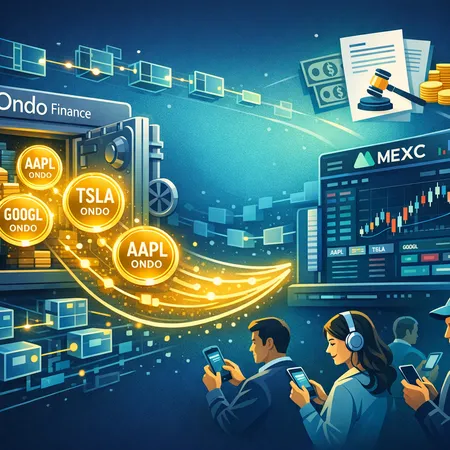
MEXC’s recent announcement, in partnership with Ondo Finance, that it will list 17 tokenized U.S. stock spot pairs is one of the clearest signals yet that centralized crypto exchanges are serious about bringing regulated U.S. equities to a global retail base in token form. The move (detailed in industry coverage) opens new product rails for MEXC’s ~40M users while forcing product, compliance, and ops teams to grapple with custody, legal wrappers, tax reporting, and cross-border regulatory risk.
What exactly did MEXC and Ondo launch?
In short: 17 spot trading pairs that represent tokenized versions of U.S. equities, created under Ondo’s tokenization framework and listed on the MEXC order books. Industry write-ups outline the program and provide launch context — for background see the original announcement and additional coverage by crypto press. These listings are not derivatives; they are marketed as tokenized shares where each token is backed by an underlying U.S. share (or a pro rata ownership interest) held by a custodian or issuer vehicle.
The practical implication is straightforward: a MEXC user outside the U.S. can trade a blockchain token that mirrors exposure to a U.S. equity without opening a U.S. brokerage account. But the architectural and legal plumbing under the hood is more complex.
How tokenized equities work: custody, settlement, and legal wrappers
Tokenized equities are a hybrid product: the economic rights sit with the underlying security but the trading, transfer, and settlement happen on-chain via tokens. There are three core components to unpack.
Custody and backing
At issuance, a custodian (or a licensed broker-dealer/issuer vehicle) holds the underlying shares or a legally-recognized claim on them. That custodian issues a token on-chain that represents the beneficiary claim. Custody models vary: some programs use segregated accounts per token class; others use omnibus custody with internal reconciliation. The legal enforceability of token holders’ claims depends on the custody agreement, the issuer’s legal wrapper, and applicable securities law.
Legal wrappers and redemption rights
Tokens must be accompanied by contractual rights defining redeemability, voting, dividends, and fees. Typical wrappers include a trust or an issuing vehicle that holds the shares and issues tokens representing fractional interests. Redemption mechanics—how and when token holders can convert tokens back into actual shares or cash—are a critical part of the user promise and a major operational risk if poorly specified.
Settlement and tradability
Once minted, tokens settle on a blockchain (near-instant or fast finality depending on the chain). That on-chain settlement enables 24/7 trading, atomic transfers, and permissioned transparency. However, regulatory obligations tied to the underlying share (reporting, transfer restrictions, shorting constraints) still exist and must be enforced off-chain through the custodian and the wrapper.
For MEXC and Ondo, the end result is a marketable token that mirrors equity exposure while relying on off-chain legal and custodial guarantees for the ultimate claim on the underlying security.
Why this expansion matters now for global retail access
Three macro trends make the timing meaningful:
- Retail demand for U.S. equities remains high globally, and tokenized stocks lower the friction of access (no U.S. brokerage account, no fractional-trading restrictions in some jurisdictions).
- Exchanges like MEXC have large, distributed retail bases and can offer 24/7 access and tighter microsecond settlement than legacy brokerages.
- Infrastructure providers such as Ondo Finance are maturing their custody, legal wrappers, and redemption rails to reduce operational friction.
For many users, tokenized stocks provide a faster, cheaper, and more composable way to gain exposure to U.S. markets. For product teams, that implies new user flows (onboarding, fiat rails, custody selection) and new liquidity dynamics: liquidity can be sourced from both crypto-native market makers and traditional broker-dealers working with the custodian.
Regulatory and market-structure implications
Tokenized stocks sit at the intersection of securities regulation, custody law, and payments law. Product and compliance teams should pay attention to several specific issues:
- Securities status: If the token confers the economic rights of a share, many regulators will treat it as a security. That triggers prospectus, offering, and secondary-market rules in the issuer’s and holder’s jurisdictions.
- Custody regulation: Custodians that hold the underlying shares are often licensed as broker-dealers or custodial banks; the token operator must ensure custodial arrangements comply with custody rules and client asset segregation requirements.
- Market data and licensing: Exchanges listing tokenized shares may need to license real-time market data or reconcile on-chain prices with off-chain primary market prices to prevent arbitrage or false signaling.
- Cross-border trading and AML/KYC: Global retail access creates AML/KYC obligations for the exchange; differing national regimes for securities trading complicate compliance.
- Reporting and withholding: Dividend distribution, corporate actions, and tax withholding need operational hooks into the custodian and token wrapper.
Regulators in the U.S. and Europe have already signaled that tokenized securities will be regulated. For exchanges and issuers, the choice architecture matters: a token program that aligns custody, legal wrapper, and disclosure with local rules reduces enforcement risk.
Benefits and risks for MEXC’s ~40M users
Benefits:
- Broader access: Global users can trade exposure to U.S. equities without U.S. brokerage accounts.
- Fractionalization and composability: Tokens can be fractionalized and used in DeFi primitives (lending, collateral, synthetic overlays) if allowed.
- Speed and cost: On-chain settlement and automated custody reconciliations can reduce latency and some settlement costs.
Risks:
- Counterparty and custodian risk: If the custodian fails or the legal wrapper is weak, token holders may have limited recourse to actual shares.
- Regulatory risk: A token classified as an unauthorized security in a user’s jurisdiction could expose both exchange and user to enforcement and asset freezes.
- Liquidity & price discovery: Token markets may diverge from the underlying exchange’s price if liquidity is thin or if settlement frictions appear.
Tax and compliance considerations across jurisdictions
Tax treatment varies widely: jurisdictions may view tokenized stock trades as securities trades, crypto trades, or a separate asset class. Practical implications for exchanges and users include:
- Transaction-level reporting: Recording trade timestamps, on-chain settlement events, and fiat rails is necessary for tax authorities that require basis and gain/loss computations.
- Withholding and dividend taxation: The custodian/issuer must implement systems to collect and remit withholding taxes where applicable.
- Residence-based obligations: Users should be informed that their home jurisdiction’s tax rules apply; exchanges must provide statements and possibly tax forms.
Product and compliance teams should build reporting APIs, maintain accurate provenance of on-chain tokens vs off-chain holdings, and coordinate with custodians to ensure dividend and corporate action flows are tracked. Tools like tax engines and reconciliation platforms will be essential for scaling to millions of retail users — something Bitlet.app and similar fintech bridges have shown in adjacent rails.
How tokenized stocks compete with or complement traditional brokerages
Tokenized stocks are not a one-to-one replacement for brokerages; they are an alternative, with overlapping and distinct value propositions.
Complementary aspects:
- Faster settlement and 24/7 trading provide incremental product features that brokerages can’t easily replicate without tokenized infrastructure.
- Fractionalization and programmability enable new products (tokenized ETFs, collateralized lending) that complement brokerage offerings.
Competitive aspects:
- Global retail can bypass local broker restrictions and costs, which may divert order flow away from traditional broker-dealers.
- If exchanges and token issuers manage corporate actions and voting poorly, incumbents can compete on reliability, custody guarantees, and regulatory clarity.
For incumbent broker-dealers, the sensible path is often to partner with tokenization providers or to offer tokenized rails themselves. For Ondo Finance, that creates an opportunity: providing standardized legal wrappers, trusted custody linkages, and predictable redemption mechanics can make their tokenization service the de facto industry standard.
What this means for Ondo Finance (ONDO)
Ondo positions itself as a specialist tokenization provider and market infrastructure partner. The MEXC program validates Ondo’s product-market fit: exchanges need trusted tokenization partners who can deliver custody relationships, legal wrappers, and operational runbooks.
Commercial upside for Ondo includes:
- Fee income from issuance and ongoing program management.
- Increased demand for ONDO as a governance or access token if Ondo spins up utility or revenue-sharing models.
- Network effects: the more exchanges and custodians that use Ondo’s wrappers, the more standardized the market becomes, lowering onboarding friction for new listings.
Risks and dependencies for Ondo:
- Regulatory outcomes: A restrictive regulatory environment could limit token utility or require changes to the wrapper, increasing compliance costs.
- Custody counterparty risk: Ondo’s reputation depends on partner custodians and their robustness.
- Competitive pressure: Other tokenization platforms and broker-dealers could replicate wrappers or offer superior legal protections.
Practical checklist for product, compliance, and go-to-market teams
For teams planning similar rollouts or integrating tokenized equities, prioritize the following:
- Legal clarity: Obtain jurisdictional legal opinions on whether the token constitutes a security and document redemption rights and investor protections.
- Custody contracts: Ensure segregation, default protocols, audit rights, and insurance where available.
- Operational SLAs: Define DAO-level or provider-level SLAs for redemption timing, corporate actions processing, and dividend flows.
- AML/KYC and licensing: Map user flows to local licensing requirements and build robust KYC/AML controls.
- Tax & reporting pipeline: Implement trade-level reporting, dividend withholding mechanisms, and user tax statements.
- Market data and fair pricing: License or ingest primary market quotes to minimize price divergence and support best execution policies.
- User disclosure and UX: Make redemption mechanics, custody risk, tax obligations, and jurisdictional limitations highly visible in the UX.
- Incident response: Prepare playbooks for custodian default, smart-contract incidents, or regulatory freeze.
Final takeaways
MEXC and Ondo Finance’s launch of 17 tokenized U.S. stock pairs is a meaningful step toward mainstreaming tokenized equities for global retail. The product offers clear benefits—wider access, fractionalization, and faster settlement—but the payoff depends on rigorous custody arrangements, unambiguous legal wrappers, and operational maturity.
For product and compliance teams, the immediate priorities are legal certainty, robust custody relationships, clear tax reporting, and user communication. For Ondo Finance, the commercial opportunity is real, but success will hinge on demonstrating reliability and aligning token economics with the operational realities of securities markets.
If executed thoughtfully, tokenized stocks can complement traditional brokerage rails and unlock new market access for retail investors worldwide; if handled poorly, they risk regulatory pushback and reputational damage. This moment is a test case for how crypto infrastructure and traditional capital markets can be integrated at scale.
Sources
- MEXC launches 17 tokenized stock pairs with Ondo Finance partnership: https://thecurrencyanalytics.com/bitcoin/mexc-launches-17-tokenized-stock-pairs-with-ondo-finance-partnership-245873
- MEXC and Ondo Finance expand tokenized stock partnership with 17 new spot pairs: https://news.bitcoin.com/mexc-and-ondo-finance-expand-tokenized-stock-partnership-with-17-new-spot-pairs/
(Referenced coverage above provides launch details and market context.)
For related background on exchange-driven tokenization programs see MEXC and broader discussions about Tokenization.