How 21Shares’ Spot Dogecoin ETF Could Reshape DOGE Liquidity, Flows and Price Discovery
Summary
Why 21Shares’ spot Dogecoin ETF matters
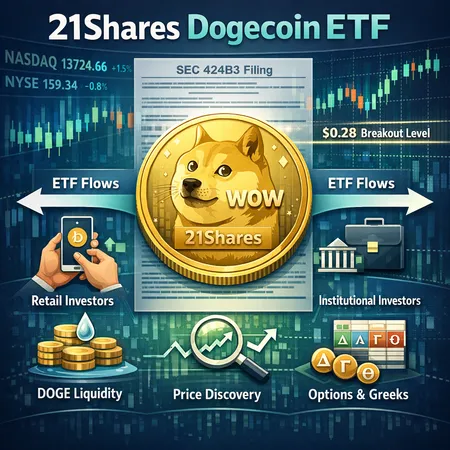
21Shares' filing of a SEC 424B3 prospectus for a spot Dogecoin ETF is more than a product announcement — it's a structural change in how U.S. capital markets can access DOGE. Reports indicate the ETF is set to go live shortly, with market coverage describing imminent trading commencement Coinspeaker and the 424B3 prospectus filing detailed in press coverage TokenPost. For traders and investors watching altcoins, the key question is not whether the ETF exists, but how it alters DOGE liquidity, who supplies demand, and where price discovery will happen.
A spot ETF creates a regulated on‑ramp for brokerage accounts, pensions, and funds that prefer or require securities exposure instead of direct tokens. That has three main knock‑on effects: increased trading volumes via ETFs themselves, new flows into the underlying DOGE via authorized participant (AP) activity, and a shift in derivatives dynamics as U.S. exchanges and clearinghouses list ETF-linked options.
SEC 424B3, timing and what “go live” means
The SEC 424B3 filing is a standard prospectus supplement used to update registration statements for imminent trading or distribution events. That step signals the issuer is readying the ETF for public trading and has finalized terms. Coverage suggests 21Shares is in the final sprint to list the spot Dogecoin ETF this week Coinspeaker, and TokenPost has summarized the 424B3 filing details TokenPost.
Timing matters because the initial days and weeks after listing concentrate flows and headline-driven volatility. Authorized participants will start creating or redeeming shares against DOGE, which means markets need deep, reliable liquidity from exchanges and custodians. If APs face slippage or custody frictions, ETF NAV may temporarily diverge from spot DOGE. Conversely, a smooth AP pipeline should tighten spreads and improve price alignment between the ETF and on‑chain DOGE.
How the ETF is likely to change DOGE liquidity
An ETF’s creation/redemption mechanism acts as a liquidity amplifier for the underlying asset. When the ETF sees net inflows, APs buy DOGE on spot venues to deliver to the fund; on redemptions they sell DOGE to replenish inventories. That creates a predictable bid for DOGE that can materially increase trading depth and reduce quoted spreads across exchanges.
Key caveats:
- Liquidity improvement depends on AP behavior and custody arrangements. ETFs that permit in‑kind creation with physical DOGE require spot DOGE sourcing — which will pull supply from exchanges and OTC desks. If APs prefer cash creations due to custody costs, on‑chain liquidity gains will be smaller.
- Market fragmentation matters. DOGE liquidity is spread across centralized exchanges, DEXs, and OTC desks. The ETF’s effectiveness in smoothing price depends on a robust plumbing that connects these venues to APs and custodians.
Overall, expect an initial tightening of spreads, larger block trades, and more resilient order books during times of stress — provided APs operate at scale.
Retail vs institutional flows: distinct motivations and mechanics
Retail adoption will likely come through brokerage platforms where a spot DOGE ETF is listed — ease of use, tax transparency and conventional custody are big draws. Retail flows tend to be momentum‑driven and headline reactive: ETF listing day and subsequent news cycles could produce outsized retail inflows (and outflows).
Institutions, by contrast, look at regulated access, custody standards, and portfolio construction. A spot Dogecoin ETF gives institutions a balance‑sheet friendly way to gain DOGE exposure without handling keys. They may use the ETF for: strategic allocations, hedging, or tactical short/long exposure. Institutions are also more likely to use block trades and AP channels, which in turn deepen the underlying DOGE market.
Net effect: the ETF lowers a structural barrier to institutional capital while providing an easier vehicle for retail. That combination tends to raise persistent baseline demand, even if day‑to‑day net flows ebb and flow.
How price discovery and the options market structure may evolve
Price discovery often migrates to the most liquid, capital‑efficient venue. For large caps, that has historically been centralized exchanges and, increasingly, regulated venues when ETFs are present. A widely traded spot Dogecoin ETF can become a focal point for price discovery for U.S. dollar‑based investors; its NAV and secondary market price provide a consolidated signal that funds and advisors will reference.
On the options front, the impact is twofold:
- Exchange‑listed options on the ETF (U.S. exchanges like CBOE or NYSE Arca) are likely to appear sooner than a fully regulated, widely used options market directly on DOGE. That route brings cleared, standardized options with institutional counterparties and margining — changing how implied volatility is priced for U.S. participants.
- Crypto‑native options venues (Deribit, OKX) will still cater to high-frequency, directional traders wanting native DOGE exposure and settlement in crypto. Over time you may see volatility arbitrage strategies operating between ETF options and crypto options, compressing basis and altering implied volatility skew.
Expect implied vol curves to evolve: ETF-based options could exhibit lower implied vol and tighter skew compared with crypto‑native DOGE options at first, given differences in margining, liquidity, and investor base. Arbitrageurs will bridge these markets, but regulatory and settlement differences mean material spreads can persist, especially in stress episodes.
Technical levels traders will watch (and the $0.28 breakout)
From a trader’s perspective, technical targets retain importance even when structural flows change. Analysts and technical traders have pointed to a $0.28 breakout as a meaningful resistance level that, if cleared on sustained volume, could invite momentum buyers and short-covering NewsBTC. Watch list for altcoin traders:
- $0.28: near-term breakout level cited by technical reports. A clean break with volume would likely accelerate ETF inflows and on‑chain buying from APs.
- $0.20–$0.22: intermediate support zone where AP selling and retail stops may cluster on weakness.
- VWAP and 50/200‑day moving averages: still useful to gauge whether ETF-driven flows are sustaining a higher trend.
Remember: ETF flows can amplify moves. A sizeable creation wave could push price through resistance quickly, while a redemption wave could steepen sell pressure. Combine technical signals with flow indicators (ETF AUM updates, AP creation data if released, and exchange order book depth) for better context.
ETF allocation scenarios and market impact models
Estimating the ETF’s market impact requires thinking in scenarios. Below are simplified buckets and their likely consequences:
- Conservative (AUM < $250M): limited structural impact. ETF acts more as a convenience vehicle, with modest AP activity and limited on‑chain draw on DOGE liquidity.
- Moderate ($250M–$1B): measurable liquidity tightening. APs execute regular buys/sells, narrowing spreads and increasing block trade sizes. Options on the ETF begin to see volume, and price discovery partially shifts toward the ETF during U.S. trading hours.
- Aggressive (>$1B): material structural change. Large, persistent AP flows reshape on‑chain supply-demand. ETF options and cross‑market volatility arbitrage become significant sources of trading volume. The ETF becomes a primary reference price for many U.S. investors.
Which scenario unfolds depends on fee structure, listing venue support, marketing, and the broader crypto market cycle. For perspective, Bitlet.app users considering exposure should model both the potential for ETF‑driven liquidity and scenarios where native DOGE markets remain the dominant price discovery venue.
Comparing to prior spot‑ETF launches (lessons from Bitcoin and large caps)
When large‑cap spot ETFs launched previously, the market saw a pattern: initial headline-driven inflows, followed by a normalization as arbitrage paths matured. For Bitcoin, spot ETF approvals unlocked significant institutional flows and reduced the premium/discount volatility between hosted products and spot liquidity over time. That experience suggests a similar multi‑stage path for DOGE: headline move, arbitrage-driven smoothing, then structural consolidation.
Differences to keep in mind for DOGE:
- Market cap and market structure: DOGE’s free float and distribution differ from BTC, so the same dollar of ETF inflows will have a larger percentage impact on DOGE price and liquidity.
- Narrative and retail sensitivity: DOGE remains more retail‑driven and narrative‑sensitive (memecoin dynamics), which can lead to sharper, sentiment‑driven swings even with institutional flows present.
Practical takeaways for ETF investors and altcoin traders
- If you want regulated, brokerage‑friendly DOGE exposure with simpler custody and tax handling, the ETF will likely be attractive — especially for retail and many institutions.
- If you trade volatility, arbitrage opportunities will emerge between ETF options and crypto options; expect basis and skew trades to become viable strategies, but watch for settlement and margin differences.
- For liquidity plays, large inflows will tighten spreads and improve execution quality, but that benefit scales with ETF AUM. Monitor early AUM and AP creation/redemption prints.
- Technical traders should treat levels like $0.28 as actionable only in context: confirm with volume and flow data rather than price alone.
Conclusion
A 21Shares spot Dogecoin ETF backed by a SEC 424B3 filing is a catalyst that can materially change DOGE liquidity, bring new retail and institutional flows, and reshape options market structure and price discovery. The degree of change will hinge on early AUM, AP behavior, custody choices and whether the ETF becomes a go‑to vehicle for regulated exposure. Traders should combine technical signals (e.g., the $0.28 breakout) with flow and on‑chain indicators to decide whether to use the ETF primarily as a proxy for DOGE exposure or as a liquidity-driven trading instrument. Bitlet.app users and other market participants will want to monitor AUM updates, AP creation data, and the emergence of ETF‑listed options to adapt strategies as the market mechanics evolve.
Sources
- TokenPost — 21Shares files a 424B3 prospectus for spot DOGE ETF: https://www.tokenpost.com/news/investing/18286
- Coinspeaker — Coverage that 21Shares' spot DOGE ETF is set to go live this week: https://www.coinspeaker.com/dogecoin-doge-etf-21shares-go-live-this-week/
- NewsBTC — Technical piece on Dogecoin breakout signals and $0.28 target: https://www.newsbtc.com/altcoin/dogecoin-bulls-watch-0-280-as-breakout-signals-stack-up/