Privacy Tokens Under Pressure: Dubai’s Reset, Tether’s Freeze, and Practical Steps for Exchanges and Developers
Summary
Executive summary
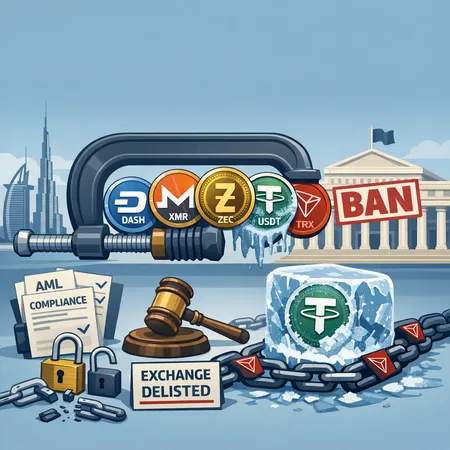
Dubai’s recent regulatory reset—explicitly banning privacy tokens and tightening stablecoin rules—has accelerated a global rethink about which assets can be listed, how custody is handled, and how on-chain privacy tools are treated. Regulators cite AML and counter‑terror financing (CTF) risks as core rationales; markets are responding with delistings, geofencing, and heightened due diligence. At the same time, enforcement actions such as Tether freezing roughly $182 million in USDT on TRON wallets tied to scams demonstrate the practical levers that centralized stablecoin issuers and some chains can use to enforce compliance. This piece maps the legal logic, technical limits, and pragmatic steps that compliance officers, exchange operators and privacy‑focused developers should prioritize now.
Why this matters now
Regulatory signals from major crypto hubs change not only policy but market plumbing. When a jurisdiction like Dubai reclassifies stablecoin standards and removes privacy tokens from permitted lists, exchanges, custodians, and projects that want on‑ramps or institutional access must adapt quickly—or risk being squeezed out of regulated markets.
What Dubai changed — the headline actions and rationale
In January 2026 Dubai’s financial regulators moved decisively: privacy tokens such as DASH, Monero (XMR) and Zcash (ZEC) were explicitly targeted in a new regulatory framework, and regulators also tightened the criteria for what qualifies as a permitted stablecoin and who can approve token issuance.
Regulators framed the change around AML/CTF obligations and market integrity — the core legal rationales are: stronger transaction transparency requirements, the need to ensure stablecoins are redeemable and backed to defined standards, and the prevention of anonymity tools facilitating illicit finance. Coverage from CoinDesk and Blockonomi provides a detailed account of the ban and the new stablecoin rules, including how approval duties were shifted and how privacy assets are treated under the new framework (CoinDesk report; Blockonomi report).
Those regulatory choices are defensible under most jurisdictions’ AML statutes: privacy features that obscure counterparty or flow details are treated as an AML risk vector. The policy choice in Dubai is not an isolated spectacle — it signals a trend where licensing and access will hinge on auditability and the ability to demonstrate chain-level compliance.
Enforcement trends on-chain: Tether freeze and what it reveals
Shortly after these regulatory moves, market enforcement mechanics were put on display: Tether froze approximately $182M USDT on TRON wallets linked to scams, an action reported by The Block and Cryptopolitan (The Block; Cryptopolitan). That event underscores two complementary realities:
- Centralized stablecoin issuers can and will act as gatekeepers: freezes and blacklists are practical instruments for enforcing sanctions or complying with law enforcement requests.
- The network matters: the TRON ecosystem’s operational model allowed rapid enforcement on TRC‑20 USDT balances — illustrating how choice of chain changes enforcement surface area.
For exchanges and custodians this means relying on centralized stablecoins is not a purely neutral risk: counterparty controls (and their willingness to freeze tokens) affect custody guarantees and legal exposure.
How legal rationales map to operational decisions
Regulators argue that privacy tokens increase AML/CTF risk because they can obscure origin, destination, and amounts. Practically, that legal position pushes a handful of predictable operational responses:
- Listing policies: exchanges seeking licenses in strict jurisdictions will delist or geofence privacy tokens to avoid licensing jeopardy.
- Custody and hot wallet practices: custodians will insist on whitelists, enhanced monitoring, and in extreme cases refuse any exposure to privacy tokens.
- KYC and transaction monitoring: exchanges must show they can trace flows or refuse transactions that impede traceability.
Many compliance officers will prefer conservative approaches until clearer supervisory guidance or standardized compliance tooling for privacy assets emerges.
Likely market shifts: delistings, regional availability, and user experience
Expect a three‑tiered market reaction:
- Tier‑1 regulated exchanges and custodians in strict jurisdictions will restrict or delist DASH, XMR and shielded ZEC usage outright.
- Some smaller or offshore platforms will continue to list these assets — but with limited fiat on/off ramps and higher counterparty risk. Regional availability will fragment: what’s tradable in one country may be banned in another.
- Centralized stablecoins and permissioned tokens will grow in relative importance for institutional flows, because their issuer controls and compliance features align better with AML demands.
These shifts will reduce interoperability for privacy tokens and increase friction for users who require regulated access. At the same time, it creates arbitrage and regulatory arbitrage opportunities for platforms willing to assume higher compliance risk.
Technical limits: can privacy ever be fully compliant?
There is a nuanced technical truth: not all privacy is equal, and some protocols have built‑in compromises that can be used to satisfy compliance requests — while others are deliberately resistant.
Monero (XMR): uses ring signatures, stealth addresses and confidential transactions to obscure senders, recipients and amounts. Monero has view keys, but they do not disclose ring member selection in the same way many regulators expect; full traceability is effectively infeasible without protocol‑level changes.
Zcash (ZEC): offers optional shielded transactions based on zk‑SNARKs. Users can transact transparently or in shielded pools. Shielded addresses provide strong privacy, but optional transparency can be used for selective disclosure where users opt‑in.
DASH: implements PrivateSend (a coinmixing mechanism derived from CoinJoin) that pools UTXOs in a way that complicates traceability but relies on denomination pooling rather than the stronger cryptographic privacy of Monero or Zcash.
On‑chain mixers and tools: CoinJoin, tumblers, and layer‑2 privacy tools can obfuscate flows; however, many are detectable by analytics firms and may be blocked by exchanges.
The practical implication: compliance vs privacy is a spectrum, not a binary. Some privacy primitives allow for selective disclosure or view‑key models; others are purposefully censorship‑resistant. That technical variance should inform policy and product design rather than blanket bans.
Practical steps for exchanges and custodians
If you operate an exchange, wallet service, or custody business, take these immediate actions:
- Review listing and delisting policies: adopt clear criteria tied to regulatory obligations and publish a transparent policy that references AML/CTF controls.
- Geofence and risk‑profile assets: implement region‑based availability and restrict fiat pairs where regulatory exposure is high.
- Strengthen blockchain analytics: integrate tools that flag mixing patterns, shielded transactions, or unusual UTXO behavior; but acknowledge analytic gaps with certain protocols.
- Expand issuer‑level dialogues: for stablecoins, require legal comfort letters and operational commitments around freezes, blacklists, and auditability. Tether’s freeze of USDT on TRON is a reminder that issuers can be asked to act (The Block report; Cryptopolitan coverage).
- Update custody contracts: ensure terms cover frozen assets, recovery, insurance scope, and dispute handling.
These are pragmatic, not theoretical, steps — they reflect what licensing exams and supervisory reviews will scrutinize.
Practical steps for privacy‑focused projects and developers
Privacy projects need a defensive, pragmatic checklist if they want broader market access without losing core properties:
- Consider selective disclosure tools: implement mechanisms that enable users or auditors to prove provenance or amounts for specific transactions without public disclosure (e.g., view keys, selective proofs, or audit APIs).
- Offer opt‑in transparency modes: Zcash’s shielded/transparent model shows how optional privacy can balance user needs and compliance demands.
- Build compliance decks for exchanges: document how your protocol handles abuse reports, supports law‑enforcement requests, and the technical limits of disclosure.
- Engage with regulators and submit testable compliance proposals: proactive dialogue can prevent blunt policy responses and build trust.
- Evaluate governance for de‑risking: consider on‑chain governance tools that can facilitate emergency freezes only under unanimous or supermajority‑agreed processes — though such mechanisms trade off privacy for political and legal flexibility.
Developers should also avoid relying on obscurity as a defense; technical explanations that map exactly how and why certain privacy primitives protect users — and how they do not — are far more effective in regulatory discussions.
Practical steps for institutional users and compliance officers
If you control compliance programs or institutional treasuries, update your risk framework:
- Reassess asset approval matrices: treat privacy tokens as higher‑risk until you can document traceability options or legal pathways.
- Tighten counterparty checks: counterparties that handle privacy assets should provide stronger attestations and remediation commitments.
- Diversify stablecoin exposure: include both centralized and regulated stablecoins in treasury operations, and document the counterparty freeze risk.
- Train legal and investigations teams: ensure they understand on‑chain forensic limitations and the operational steps needed to comply with law‑enforcement requests.
These steps are about institutional resilience: you can’t eliminate risk, but you can document and manage it.
Longer term consequences and where to watch next
- Policy harmonization: expect other major hubs to clarify their positions. Dubai’s move is likely to be evaluated and echoed or adapted, not necessarily mimicked verbatim. For ongoing context, follow how hubs produce guidance on stablecoin standards and AML expectations (Blockonomi analysis).
- Tech innovation: privacy projects that provide selective disclosure or standardized audit interfaces will enjoy better market access.
- Stablecoin architecture: the governance and technical designs of stablecoins will be increasingly evaluated for freeze mechanics, custody assurances, and redemption guarantees — not just peg stability.
Closing notes and practical checklist (quick reference)
For compliance officers and exchange operators:
- Audit your listings and update public policies.
- Integrate advanced analytics and geofencing.
- Require issuer commitments for stablecoins (freeze/blacklist terms).
For privacy projects and developers:
- Prioritize selective disclosure, opt‑in transparency, and regulator engagement.
- Produce clear technical documentation of limits and remediation paths.
For institutional users:
- Rebalance stablecoin exposure and document custody risk.
- Update KYC/AML playbooks and train investigators.
Bitlet.app users and platform designers should treat these winds of policy change as operational realities: markets will bifurcate based on traceability and compliance posture, and technical design choices now determine future access.
Sources
- CoinDesk — Dubai bans privacy tokens and tightens stablecoin rules: https://www.coindesk.com/policy/2026/01/12/dubai-bans-privacy-tokens-tightens-stablecoin-rules-in-crypto-reset
- Blockonomi — Dubai updates crypto rules: https://blockonomi.com/dubai-updates-crypto-rules-no-privacy-tokens-new-stablecoin-standards/
- Cryptopolitan — Tether froze $182M USDT on Tron wallets tied to scams: https://www.cryptopolitan.com/tether-froze-182m-tron-based-stablecoins/
- The Block — Tether freezes $182M: https://www.theblock.co/post/385051/tether-freezes-182-million-usdt
For a broader background on privacy and market dynamics, readers may want to review how privacy narratives intersect with broader markets such as Bitcoin price and DeFi infrastructure.