How Oobit's Wallet-to-Bank Stablecoin Settlement Could Break the Banking Wall
Summary
Why wallet-to-bank matters now
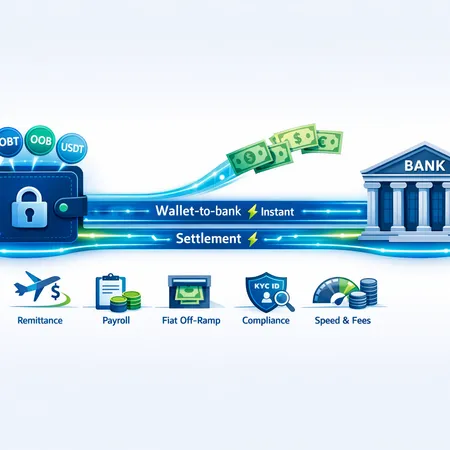
For many institutional and retail users the “banking wall” — the friction between self-custody crypto assets and local bank deposits — remains the single biggest barrier to mainstream stablecoin utility. If you hold USDT or other stablecoins in a private wallet, converting to local currency usually means on‑ramps or centralized exchanges, settlement delays, counterparty exposure, and sometimes high fees. Real-time wallet-to-bank settlement promises to collapse that friction by turning a blockchain transfer into a near-instant local bank deposit.
That matters for several reasons: lower counterparty risk, faster liquidity for businesses, simpler remittance rails, and a cleaner user experience for payroll and payouts. It also intersects with macro narratives: for many traders Bitcoin remains the market bellwether, but for payments and payroll stablecoins are where crypto can win real-world use.
What Oobit is offering and the basic tech stack
Oobit's recent announcement describes real-time wallet-to-bank transfers that settle stablecoins into local bank accounts, effectively bridging on‑chain stablecoin rails with fiat banking corridors. The service layers three components:
- On-chain settlement: the payer transfers stablecoins (USDT or other supported stablecoins) from a self-custody wallet to Oobit's settlement address or smart-contractized gateway.
- Off-chain conversion and fiat payout: Oobit nets on-chain inflows, converts stablecoins to fiat at a pre-agreed rate, and instructs a local banking partner to credit the beneficiary’s account in local currency.
- Reconciliation and proof: Oobit provides transaction receipts and on-chain settlement proofs to both sender and recipient for auditability.
This architecture mirrors a hybrid rails approach: the speed and finality of blockchains for value transfer combined with the ubiquity and reach of local clearing systems (RTPs, ACH, SEPA, or domestic instant payment rails). Oobit's description suggests a focus on real-time payout by partnering with local banks and payment processors rather than relying solely on custodial exchange liquidity or manual settlements (Oobit launch announcement).
On‑chain vs off‑chain considerations
On‑chain settlement provides transparency and provable transfers, but the fiat leg requires trusted counterparties. That creates necessary tradeoffs: you retain noncustodial control up to the point of settlement, then rely on Oobit's (or its banking partners') off‑chain guarantees for fiat credit. Architecturally, good implementations use ledgered netting, predictable FX engines, and near-real-time reconciliation to minimize float and settlement risk.
Settlement rails, speed and fee dynamics
Speed and cost depend on how the fiat payout is implemented:
- Real-time payment rails (RTP/Instant Payments): If fiat payouts route over local instant rails, end-to-end settlement can be minutes or seconds after on-chain confirmation. This is the ideal for payroll and high-frequency remittances.
- Batch rails (ACH, non-instant clearings): These reduce cost but increase delay—days instead of minutes.
- Liquidity and FX: To deliver instant fiat, Oobit or its bank partners must maintain local liquidity (float) or use prefunded accounts. That implies capital costs and potential spreads on conversion.
Fees will reflect these costs: instant settlement with local fiat float will command a premium vs a slower batch settlement. For high-volume corridors (remittances) spreads can be compressed; for low-volume rails the per-transfer fee will be higher. Also, settlement finality depends on both chain finality (fast on many L1s) and the receiving banking system's policy on inbound credits from crypto-correspondents.
Compliance tradeoffs: AML, KYC and bank expectations
Moving from on‑chain tokens to bank deposits draws regulatory attention. Banks and payment partners expect strong controls because they bear regulatory risk when receiving crypto-origin funds.
Key compliance considerations:
- KYC at the point of conversion: Even if a sender is pseudonymous on-chain, the fiat recipient will typically require identification. Providers must implement KYC/identity verification that meets the bank partner’s standards.
- Transaction monitoring and provenance: Chain analytics are essential. Providers should enrich on-chain transfers with origin metadata, cluster analysis results, and risk scores to satisfy bank-level AML checks.
- Sanctions and PEP screening: Banks will insist on sanctions screening for beneficiaries and counterparties. Crypto-native heuristics should be mapped to standard AML rules.
- Recordkeeping and SAR processes: Expect banks to demand long retention windows, transaction logs, and swift suspicious activity reporting processes.
- Licensing and local regulatory fit: Operating wallet-to-bank services often requires money transmitter, e-money, or payment institution licenses depending on jurisdiction.
These requirements push firms to choose between tighter user friction (strong KYC, limits) or higher risk exposure. In practice, real-time off‑ramp schemes usually implement tiered KYC: small-value transfers with lightweight KYC and larger transfers subject to enhanced due diligence.
Regional banking partnerships and corridor strategy
Success depends on bank-by-bank acceptance and a corridor-by-corridor approach. Some practical realities:
- Bank appetite varies: Even if a payment rail supports instant credit, individual banks may reject or delay credits originating from crypto partners due to their internal risk policies.
- Correspondent banking gaps: For certain emerging-market corridors, correspondent banking relationships are thin. That increases the cost of delivering local fiat and can limit coverage.
- Regulatory variance: Countries treat stablecoins and crypto differently. Some jurisdictions permit crypto-derived deposits freely; others impose limitations or additional reporting.
Therefore, product teams should prioritize a set of pilot corridors where banking partners are permissive, remittance volume is high, and FX spreads are competitive. Over time, networks of local partners and netting arrangements can reduce float and capital requirements.
How instant settlement changes stablecoin utility
For retail users: instant wallet-to-bank settlement reduces reliance on centralized exchanges for cashing out. That lowers user migration costs and makes stablecoins practical as a medium for everyday payments and remittances.
For businesses: payroll, supplier payouts, and payroll-as-a-service offerings can benefit from predictable, near-instant conversion into local currency. Employers can pay in stablecoins and let workers receive cleared local-currency funds without the recipient needing to use crypto exchanges.
Operational advantages include lower FX timing risk, less counterparty custodial exposure, and streamlined reconciliation from on-chain receipts to bank settlement records. However, businesses must still manage accounting treatment, tax withholding, and payroll regulatory compliance in each jurisdiction.
Competitive implications for remittances, payroll, and fiat on/off‑ramps
- Remittances: Wallet-to-bank reduces the classical friction in corridor payments. It competes with legacy remittance players by offering faster speed and potentially lower end-to-end cost when network effects deliver scale.
- Payroll: For cross-border payroll, instant conversion avoids hold-ups and reduces exchange-rate exposure for the payer and payee. Companies that imagine paying salaries in crypto to offshore employees may opt for a wallet-to-bank model to meet local payroll laws.
- On/off‑ramp businesses: Centralized exchanges have historically dominated off‑ramp liquidity. Instant settlement to bank accounts enables new entrants and specialized services to capture flow without custodial custody of user assets for long periods.
But this pressure comes with bank friction: incumbents may block counterparties, or banks may require transaction-level disclosures that slow UX. A thoughtful go-to-market will pair product simplicity with robust compliance.
Telegram Wallet vaults and the broader in‑app finance landscape
Telegram Wallet’s introduction of in‑app vaults and yield features is an example of expanding on-chain financial features inside consumer apps. Vaults focus on on‑chain functionality — yield aggregation, in-app custody options and user experience improvements — but they still rely on banking rails or exchanges for fiat settlement when users need currency in bank accounts (Telegram Vaults overview).
Comparatively:
- Oobit (wallet-to-bank) solves the fiat leg — turning stablecoins into cleared bank deposits quickly.
- Telegram vaults solve the on-chain utility leg — offering yield and in-app financial services that keep assets on-chain longer.
These are complementary. A user might keep funds in a Telegram Vault to earn yield and, when they want cash, route from their wallet through a wallet-to-bank provider like Oobit to receive local fiat. From a product perspective, firms that integrate both rails (in-app yield + instant off‑ramp) can offer a seamless experience, but they must manage two distinct compliance regimes: DeFi user protection and banking-grade AML/KYC.
Practical recommendations for product leads and compliance officers
For product leads:
- Prioritize corridor selection: start with 2–4 pilot markets where you can secure bank partners with a clear compliance appetite.
- Design for liquidity efficiency: use netting, prefunded pools and dynamic FX engines to minimize float and cost.
- Invest in reconciliation: automated matching between on-chain TXIDs and bank confirmations reduces disputes and operational headaches.
- Build UX for KYC tiers: allow low-friction small transfers while gating larger flows behind enhanced due diligence.
For compliance officers:
- Integrate chain analytics providers into the onboarding and transaction-monitoring flows to provide provenance and risk scores.
- Establish strong SAR/SUSP reporting workflows and SLAs to respond to bank partner queries promptly.
- Model the regulatory classification across key corridors and ensure appropriate licensing (MSB, e-money, payments institution) where required.
- Negotiate contractually robust liability and indemnity terms with banking partners, including expectations around sanctions screening and data sharing.
Finally, coordinate with banks on the data format they require for inbound crypto-origin transfers. The more metadata (sender identity, memo, chain proof) you can provide, the lower the friction when banks perform their AML checks.
Conclusion: Can Oobit break the banking wall?
Technically and commercially, wallet-to-bank settlement reduces a key friction in crypto adoption. Oobit's model — bridging stablecoin rails to local bank accounts in real time — addresses a tangible pain point for remittances, payroll, and fiat off‑ramp providers. But the solution is not purely technical: it hinges on regional bank partnerships, liquidity economics, and rigorous compliance frameworks.
Instant settlement improves stablecoin utility by lowering settlement risk and making crypto payments practical for everyday business use. Yet banks’ risk appetites, varying regulation across corridors, and the capital cost of maintaining local payouts mean that scaling will be an operational and regulatory marathon, not a sprint.
For fintech product leads and compliance officers evaluating these rails: prioritize corridor pilots, embed strong chain analytics, negotiate clear bank SLA and compliance requirements, and be prepared for a tradeoff between UX simplicity and regulatory assurance. Platforms like Bitlet.app and other on/off-ramp providers will need to evolve their stacks to interoperate with both on-chain innovations and banking realities.
Sources
- Oobit launches real‑time wallet‑to‑bank transfers: https://news.bitcoin.com/oobit-launches-real-time-wallet-to-bank-transfers-to-bridge-stablecoins-and-local-banking/
- Telegram Wallet vaults and in‑app DeFi features: https://www.theblock.co/post/391338/telegram-crypto-wallet-yield-bitcoin-ethereum-usdt-holdings