CFG’s 180% Upbit Rally — Listing Mania vs. Sustainable Fundamentals (Trader’s Playbook)
Summary
Quick overview: what happened with CFG
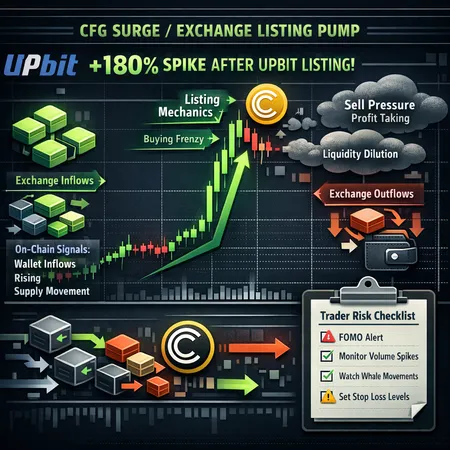
Centrifuge’s native token, CFG, surged roughly 180% intra‑day after news that Upbit would list the token, then experienced rapid profit taking as traders locked gains and liquidity rebalanced. Coverage at the time captured both the explosive price move and the follow‑through selling that trimmed the advance CryptoNews reported the ~180% intraday jump and subsequent profit taking, while regional reporting noted the listing and the pressure it put on traders’ conviction levels Cryptonomist covered the Upbit listing and the price reaction.
For active altcoin traders and on‑chain analysts, this is a useful case study: listings create clear, repeatable mechanics and predictable risks. Knowing those mechanics and watching the right signals helps you trade with a plan instead of reacting to headlines.
Why exchange listings pump — the mechanics behind the move
Listings are not a single cause; they’re a stack of interacting market forces. The typical listing pump pattern is driven by:
- Orderbook scarcity: Before a large exchange listing, much of the tradable supply may sit off‑exchange or in a few wallets. When a major exchange opens a new market, initial bids far outnumber available asks, so prices gap up quickly.
- Regional demand shock: Platforms like Upbit expose tokens to concentrated user bases (in this case, South Korea). Local demand can be higher than global demand, creating outsized buying pressure immediately after the listing.
- Retail FOMO and media amplification: Price action itself becomes the news — social channels amplify gains and attract momentum buyers who buy into a rising price, pushing the move further.
- Market‑maker behavior: Makers may widen spreads and wait for liquidity to replenish before quoting tight books. That widening effectively magnifies moves because each market order walks a thin book.
- Speculative arbitrage flows: Bots and traders try to arbitrage price gaps across venues, but when latency or withdrawal limits exist, arbitrage is imperfect and prices can diverge temporarily.
Put together, these factors create the classic “exchange listing pump”: a sharp, often short‑lived spike that can be detached from fundamentals.
How the CFG Upbit event fits the pattern
The CFG move showed the usual checklist of listing‑driven behavior: an announcement, a fast price run, then profit taking as liquidity reappeared and early buyers exited. Reporters highlighted both the surge and the immediate retracement, emphasizing that large intraday gains often invite quick selling as traders de‑risk into strength (see the CryptoNews piece). The Cryptonomist writeup focused on how this listing tested traders’ conviction, which is exactly what happens when novelty meets low pre‑listing depth.
On‑chain signals to watch after a listing announcement
If you want to separate mania from sustainable demand, monitor these on‑chain and exchange metrics in real time:
1) Exchange inflows and outflows
- Watch for large, sustained inflows to exchange wallets: rising inflows ahead of or immediately after a listing often precede selling pressure as whales or teams prepare to distribute. A sudden spike in exchange balance is a red flag for near‑term supply pressure.
- Conversely, persistent outflows to cold wallets or DeFi bridges can signal accumulation and long‑term conviction.
Practical watch: set alerts for daily exchange inflows > 1–2% of circulating supply (adjust by token liquidity). The CFG episode saw classic inflow/outflow swings as traders repositioned post‑announcement.
2) Large transfers / whale behavior
- Large transfers between unknown wallets and exchanges are often the first sign of distribution. Follow the top 10 holders and monitor any sudden reduction in on‑chain concentration.
- Look at the timing: transfers to exchanges right after public announcements are frequently profit taking.
3) Orderbook depth and slippage across venues
- Before committing capital, check orderbook depth on the listing exchange and existing venues. Thin bids mean your market order will move the price. Use small test fills to gauge real slippage.
4) Token age and newly moved supply
- Newly unlocked or recently vested tokens increase available supply and can dilute price action. Always check tokenomics and vesting schedules. Liquidity dilution is real — a big spike in spendable supply can amplify sell pressure after a listing.
5) Social and on‑chain activity signals
- Rising active addresses, increases in protocol interactions, or new DeFi integrations are leading indicators of sustainable interest. A listing alone is not the same as growing product usage. For a DeFi project like Centrifuge, check whether protocol activity or TVL is following the price move.
A tactical trader’s checklist for listing rallies (step‑by‑step)
Below is a practical playbook you can apply to any exchange listing pump, distilled into actionable bullets.
- Size your position first
- Determine a small, predefined position size for speculative listing trades (e.g., 0.25–1% of portfolio) to limit tail risk. Listings are high‑variance events.
- Check immediate liquidity
- Verify orderbook depth and simulate fills. If 5–10% of open buys gets filled with tight slippage, the market is thin.
- Split entries and use limit orders
- Prefer staggered limit buys rather than one large market buy. If you must enter quickly, use iceberg or TWAP strategies on platforms that support them.
- Predefine profit‑taking tiers
- Set multiple sell targets (for example, 30%, 75%, 150% gains) and realize portions as targets hit. The CFG move showed how quickly early gains can disappear.
- Have an exit plan before entering
- Know your stop, but expect whipsaws. Consider using a combination of hard stops for catastrophic risk and trailing stops for winners.
- Watch funding and futures liquidity
- If the token has futures or perpetual markets, check funding rates and open interest. High long funding suggests retail leverage — a funding squeeze can accelerate reversals.
- Hedge if your exposure is material
- If you hold a larger exposure post‑listing, consider hedging with short futures or options to lock partial profits while retaining upside.
- Monitor exchange inflows/outflows live
- Use real‑time on‑chain dashboards to detect abrupt inflows to the listing exchange. A surge in exchange deposits typically precedes selling.
- Check tokenomics and upcoming unlocks
- Any near‑term unlocks or team vesting create liquidity dilution risk. That should change your sizing and profit targets.
- Don’t chase illiquid spreads
- If the spread is >2–5% and depth is poor, your risk of permanent loss increases; sometimes the best trade is to wait for consolidation.
Post‑listing scenario planning: what to watch next
After the initial pump-and-snapback, tokens typically follow one of three paths — use these as playbook triggers:
Mean reversion to pre‑listing levels: Expect this if the listing exposed an exhausted demand pool and no new fundamentals emerged. Indicators: exchange inflows persist, social buzz fades.
New higher base: If listings lead to sustainable integration (more listings, partnerships, or utility), the token can form a higher base. Indicators: rising on‑chain activity, growing TVL, consistent outflows from exchanges.
Choppy consolidation: Price ranges between early buyers’ break‑evens and late entrants’ stops. Indicators: balanced inflows/outflows, flat active addresses.
Your capital allocation and risk controls should be different in each scenario.
Case study takeaways specific to CFG and Upbit
- The Upbit listing catalyzed regional demand and a large intraday spike; coverage noted the surge and fast profit taking, which fits the classic listing pattern (CryptoNews; Cryptonomist).
- For CFG specifically, traders should check token distribution, any pending unlocks, and whether the Upbit market shows sustainable depth after the initial hype. If inflows to Upbit persist without meaningful outflows to cold storage, that’s a sign selling pressure may continue.
- Remember: a listing jump tests conviction. If the move is primarily liquidity‑driven rather than usage‑driven, expect higher volatility and a shorter horizon for profits.
Practical tools and dashboards to use
- Real‑time exchange flow trackers and wallet monitors (on‑chain dashboards) for inflows/outflows.
- Orderbook and depth aggregators across venues to measure slippage.
- Tokenomics explorers for vesting and unlock schedules.
Platforms like Bitlet.app can be useful for managing entry sizes and scheduling buys across time, but the core job is watching liquidity and controlling position sizing.
Final rules of thumb
- Listings are great for short‑term opportunity—but they’re also one of the most eventful sources of short, ruthless volatility. Trade listings with a plan.
- Always expect profit taking: price spikes invite sellers. Predefine your exits.
- Use on‑chain flows and exchange balances to read supply dynamics in real time. That’s your edge.