Telegram TON Vaults: On‑Chain Yield for BTC, ETH & USDT — Product Analysis
Summary
Quick framing: Why this matters
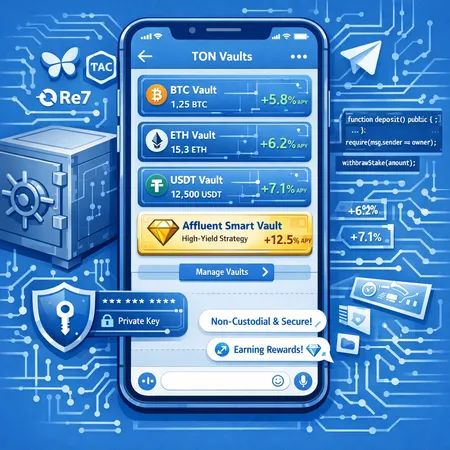
Telegram’s TON Wallet Vaults take a decisive step: instead of merely storing keys, the wallet now surface‑mounts onchain yield strategies for BTC, ETH and USDT inside the messenger. That’s significant because it converts a ubiquitous consumer app into a conduit for yield generation, using integrations with protocols and aggregators like Morpho, TAC, Re7 and Affluent smart vaults. The announcement and coverage make the same point: Telegram is moving beyond self‑custody UX to act as a gateway for third‑party DeFi strategies (Cryptonomist announcement; The Block report).
For product‑focused crypto journalists and DeFi product managers, the core questions are: how do these vaults actually deliver yield, what are the UX/security and custody trade‑offs, and how will this change competitive dynamics for exchanges and custodians? Below I unpack the mechanics, risks and go‑to‑market implications.
How TON Vaults and Affluent smart vaults deliver yield (product mechanics)
At a high level, the TON Vaults provide a UI layer inside the Telegram Wallet that routes user deposits into external onchain strategies. The technical pattern is familiar in DeFi: a smart vault (here, Affluent smart vaults and partner contracts) aggregates funds, executes yield strategies across lending markets, and tracks per‑user shares. The novel piece is that Telegram is the access point and key manager for that flow.
Mechanically:
- Users tap a native “Vaults” flow in the TON Wallet and select a product (e.g., BTC yield, ETH yield, USDT yield). The wallet shows expected APY, composition, and lock/withdrawal rules. Public reporting indicates USDT yields are available via Affluent smart vaults and expected APYs were discussed in reporting on the feature rollout (Coincu coverage on USDT yield).
- The selected funds are tokenized or wrapped as needed on TON or bridged chains, then supplied into protocols like Morpho (for capital‑efficient lending), TAC (strategy orchestration) or Re7 (liquidity management). Each protocol contributes a piece: Morpho for peer‑to‑peer yield amplification, TAC/Re7 for strategy routing and automated rebalancing.
- The vault issues shares to the user; yield accrues automatically and is reflected in the wallet balance. Withdrawals route back through the vault contracts, with bridge/settlement steps if cross‑chain movements are required.
This architecture mirrors many DeFi vaults but with one major difference: the front door is a mass‑market app, so attention must shift from purely gas and composability concerns to UX friction, slippage protection, and user education.
What the Morpho / TAC / Re7 integrations mean
The partner mix is strategic.
- Morpho brings capital efficiency. By matching lenders and borrowers off‑chain with onchain settlement, Morpho increases effective yield for suppliers. For a mainstream vault, this means higher APYs without exotic leverage.
- TAC likely functions as a tactical allocator — orchestrating which lending markets and tranches to use depending on rate conditions. That dynamic routing is essential for delivering consistent APYs to retail users.
- Re7 appears focused on liquidity and risk control, ensuring the vault can meet withdrawals and rebalance exposures when markets move.
Together, these integrations convert a simple “deposit to earn” button into a managed product that offloads strategy design to specialists. For users, the advantage is better yield and fewer manual steps; for DeFi, it’s more capital routed through protocols that previously served primarily native DeFi users.
UX and security implications of embedding yield in a messaging app
Embedding financial primitives in a messaging environment alters assumptions.
UX considerations:
- Simplicity vs. transparency. Noncustodial UX norms emphasize private keys and onchain transactions; mainstream users prioritize clear promised returns and simple flows. Telegram must bridge those expectations with in‑flow explainers about how vaults work, fees, and withdrawal delays.
- Permissioning and consent. The wallet should surface granular permissions: which contracts can move funds, cooldown windows, and emergency pause options. Defaulting to full automation without clear consent risks user backlash.
- Onboarding friction. For many users, seeing yield denominated in APY terms inside a chat app will feel familiar, but gas/bridge operations must be abstracted. Off‑ramps (fiat exits) and KYC touchpoints — if any partner requires them — need to be clearly communicated.
Security considerations:
- Vault security vs. key security. Vault risk focuses on smart contract exploits, strategy bugs (e.g., oracle manipulation), and cross‑contract composability issues. Key risk remains if the wallet uses any custodial or custodial‑like features. Telegram’s shift to act as a gateway rather than pure self‑custody increases the number of trust assumptions.
- Attack surface. Integrations multiply attack vectors: wallets -> bridge contracts -> vaults -> lending markets. Each external integration (Morpho, TAC, Re7) is another dependency for audits and monitoring.
- Monitoring and insurance. To onboard mainstream users at scale, product managers should pair onchain audits with observable dashboards, real‑time monitoring, and clear insurance coverage or backstops where available.
Custody trade‑offs and regulatory risk vectors
Telegram’s design choices will determine how regulators and custodians view the product.
Custody trade‑offs:
- Pure noncustodial: Users hold keys and can interact with vault contracts directly. Pros: lower regulatory custody pressure; cons: higher UX friction and support overhead.
- Gateway / managed UX: Telegram mediates interactions, maybe batching transactions, sponsoring gas, or offering a replayable approval flow. Pros: mainstream UX; cons: increased custodial/agency risk and potential regulatory scrutiny.
Regulatory vectors to watch:
- Custody laws. If Telegram’s flow is construed as holding or controlling client assets (even temporarily), it may trigger custodial licensing requirements in some jurisdictions.
- Securities and investment advice. Managed vaults that automatically rebalance or promise yields could be scrutinized under securities or investment advisor frameworks, depending on how they’re marketed.
- AML/KYC rails. On‑ramps and off‑ramps tied to fiat gateways may require KYC. Even if vaults remain onchain, counterparties interacting with fiat rails could force compliance linkages.
Product teams must design with modular trust: make the custody model explicit, keep attestable onchain proofs, and avoid language implying guaranteed returns.
Expected adoption curve and user behavior (given Telegram's scale)
Telegram has a built‑in user base measured in hundreds of millions, which shortens the top‑of‑funnel problem dramatically. Adoption will likely follow a familiar pattern:
- Rapid initial signups. Early adopters inside crypto‑savvy Telegram channels will test vaults first; social proof inside chats can accelerate uptake.
- Retail proliferation. Features like instant APY displays and one‑tap deposits will lure nontechnical users, producing a steep adoption slope for deposits and volume.
- Retention hinge points. Sustained retention depends on consistent payouts, smooth withdrawals, and responsive incident handling. Any perceived “locked” funds or complex withdrawal mechanics will erode trust quickly.
Behavioral implications: social virality will amplify both good and bad outcomes. A single exploit or confusing UX flow could cascade through Telegram channels faster than conventional support can respond.
How this pressures exchanges and traditional custodians
Embedded yield inside existing social apps reframes competition.
- UX differential. Exchanges will feel pressure to add embedded, app‑like experiences — not just web UIs. If Telegram can offer similar security with easier onboarding, it will siphon retail customers.
- Margin compression. Vaults that use capital‑efficient primitives like Morpho can offer competitive APYs without leverage, forcing custodians to improve yields or lower fees.
- Product parity demands. Custodians may need to offer managed vaults, clear insurance layers, and better mobile/in‑app integrations to stay relevant.
That said, exchanges retain advantages in fiat rails, liquidity, and regulatory compliance. The likely outcome is a more segmented market: messaging and social platforms will own acquisition and simple yield products, while exchanges and regulated custodians will focus on compliance‑heavy, institutional, and high‑liquidity services.
Practical recommendations for product teams and journalists
For product managers building or evaluating similar offerings:
- Design explicit consent flows that separate key custody from vault permissioning. A user should always be able to see which contracts control funds and revoke approvals.
- Prioritize composable observability: real‑time dashboards for strategy performance, TVL, and risk metrics inside the app.
- Bake in multi‑layer security: audits, bug bounties, onchain insurance primitives, and an incident response plan with clear user communication templates.
- Be conservative in marketing APYs; present ranges and historical volatility, not promises. That reduces regulatory and reputational risk.
For journalists covering this space, embed contract links and audit references in reporting. Compare claimed APYs to onchain realized yields and call out hidden fees (bridging, gas, rebalancing).
Conclusion: a watershed — but not a handoff
Telegram’s TON Vaults mark a watershed in mainstream DeFi adoption: embedding onchain yield for BTC, ETH and USDT inside a messaging app removes a major friction in discovery and onboarding. However, it’s a handoff, not a handover. The product succeeds only if it wins user trust through transparent noncustodial UX, rigorous vault security, and clear custody boundaries.
Expect fast initial uptake, amplified social dynamics, and mounting pressure on exchanges to match in‑app simplicity. For Bitlet.app and other products, the lesson is clear: UX matters as much as yield. Integrations with reputable primitives (Morpho, TAC, Re7, Affluent) are a strong technical foundation, but the business will hinge on governance, disclosure and operational resilience.
For many traders, Bitcoin will remain a central bellwether, but the way people hold and earn on BTC, ETH and USDT may shift toward embedded experiences inside apps like Telegram. That’s good for DeFi adoption — provided the community keeps custody and vault security top of mind.
Sources
- Telegram Wallet vaults announcement and partner details: https://en.cryptonomist.ch/2026/02/26/telegram-wallet-revolutionizes-access-to-defi-strategies-on-ton-vaults-now-available-for-btc-eth-and-usdt/
- Reporting on TON Wallet’s gateway shift to third‑party strategies: https://www.theblock.co/post/391338/telegram-crypto-wallet-yield-bitcoin-ethereum-usdt-holdings
- Details on USDT yield via Affluent and expected APYs: https://coincu.com/news/usdt-sees-yield-as-telegram-wallet-taps-affluent-ethena/?utm_source=snapi
(Referenced protocols: Morpho, TAC, Re7, Affluent; tickers: BTC, ETH, USDT, TON). Bitlet.app has been tracking similar in‑app yield primitives and UX patterns across wallets and exchanges.