Evaluating WLFI’s 180‑Day Staking Governance: 2% APR, USD1 Peg, and Centralization Risks
Summary
Why WLFI’s 180‑day lock deserves careful scrutiny
WLFI’s governance proposal — lock tokens for 180 days in exchange for increased voting weight and tiered benefits tied to a USD1 stablecoin peg — is a textbook attempt to buy long‑term alignment with on‑chain incentives. At a glance the trade is simple: give up liquidity for a predictable reward and stronger governance influence. But the devil is in the numbers, the behavioral incentives, and the edge cases that let large actors convert time‑locks into power.
This article evaluates the economics behind the advertised ~2% APR, how that interacts with USD1 peg arbitrage, whether tiered benefits genuinely decentralize or reinforce concentration, and which gaming vectors treasurers and validators should model.
The mechanics: how 180‑day staking ties voting power to lockups
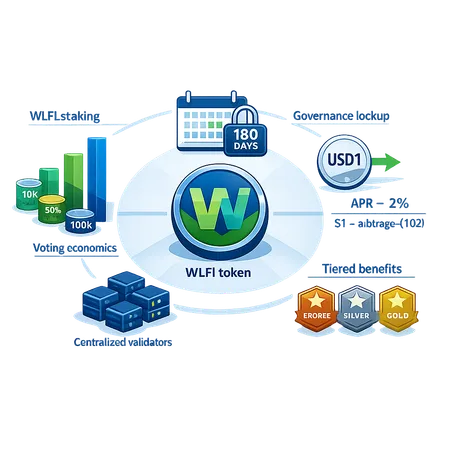
WLFI’s model ties voting weight to the amount of WLFI an address locks for 180 days. Typically these systems use a time‑weighted multiplier: longer lockups equal more effective voting tokens per underlying WLFI. The proposal also tiers non‑voting benefits (fee rebates, fee share, or stablecoin redemption priority) to the same locked stakes — an approach covered in reporting on the WLFI governance proposal.
The combination does two things simultaneously: (1) reduces circulating supply for the duration of the lock (supporting price stability), and (2) concentrates governance influence with those willing to accept illiquidity. The stated APR (~2%) is the nominal on‑chain return paid to lockers, which we unpack next.
The math behind ~2% APR (simple model)
To evaluate whether ~2% APR is compelling, you need assumptions about reward emissions and total locked capital. A simple formula:
- Annual reward pool (R) denominated in WLFI per year.
- Total WLFI locked (L).
- APR ≈ R / L (assuming rewards split proportionally among lockers).
Example: if R = 2,000,000 WLFI annually and L = 100,000,000 WLFI locked, APR = 2,000,000 / 100,000,000 = 0.02 => 2%.
Two practical notes:
- If lockers are fewer and L is smaller, APR rises; if lockers flood the program, APR compresses.
- Protocols sometimes guarantee a target APR by adjusting emissions or adding seigniorage/reserve top‑ups; otherwise APR is endogenous and variable.
A 2% nominal APR expressed in WLFI terms also has a USD value risk: if WLFI price changes, the USD‑denominated yield changes. For treasurers benchmarking yields against fiat yields, that volatility matters.
How the USD1 stablecoin peg factors into incentives
A core rationale WLFI offers is that staking alignment helps protect a linked USD1 stablecoin peg: lockers become both long WLFI and economically motivated to defend the peg.
Two mechanisms of alignment:
- Direct: tiered benefits (priority redemptions, arbitrage fee shares) economically reward participants who help stabilize USD1 flows.
- Indirect: removing WLFI from circulation increases scarcity and theoretically reduces sell pressure during peg stress.
But peg maintenance is active work. Arbitrageurs profit when stablecoins deviate; those profits can dwarf a 2% APR unless lockers capture them or are otherwise compensated. WLFI’s proposal mentions alignment with USD1 arbitrage and a low APR — see the reporting that connects 180‑day staking, ~2% APR, and peg incentives in coverage of the governance plan (WLFI’s proposal and analysis pieces like the one at BeinCrypto covering tiered benefits).
If arbitrage opportunities generate significantly more than 2% annually, rational capital will flow to arbitrage desks rather than into 180‑day locks unless lockers are given a clear path to capture a share of arbitrage rents (e.g., fee splits, protocol buybacks, redemption priority). That’s why the exact structure of the tiered benefits matters.
Tiered benefits: incentives or concentration levers?
Tiered benefits are attractive because they let protocols allocate scarce privileges (higher voting weight, stablecoin redemptions, fee rebates) to committed actors. But they can also entrench large players:
- If voting power scales nonlinearly with locked amount or lock duration, whales extract disproportionate governance control.
- If fee‑sharing or redemption priority is the primary economic benefit, lockers with capital and access to off‑chain liquidity can arbitrage the tier thresholds, turning governance rights into a revenue stream.
Compare to models in DeFi like time‑weighted voting escrow systems which intentionally reward long locks, but often add caps, diminishing returns, or delegation to limit centralization. WLFI’s design must be explicit on diminishing marginal returns and caps or it risks replicating existing concentration problems.
Governance centralization risks and voting economics
Lock‑based voting shifts power toward those who can afford to lock capital for months. Key risks:
- Vote concentration: large holders lock and control proposals, steering emissions and treasury allocations to favor themselves.
- Liquidity capture: lock farms backed by institutional liquidity providers or CeFi desks can buy governance at scale.
- Short‑term exits masked as long‑term alignment: actors can coordinate lock timing to vote on favorable proposals then exit when locks expire.
Quantitatively, imagine a DAO with 10 holders that can each lock up to 20% of supply. If three holders coordinate to lock 40% each, they can pass proposals unopposed — regardless of the remaining community. That’s why cap rules, time‑weighted windows, and quorum thresholds matter as much as APR.
Likely gaming vectors (what to model and monitor)
- Vote leasing and marketplaces: lockers rent voting power to those running proposals. This undermines the intent of time‑locks.
- Flash governance via coordinated short windows: even 180‑day locks can be scheduled to align with a proposal snapshot for maximal impact.
- Stablecoin manipulation: if tiered benefits reward peg defenders, adversaries may attempt to manipulate on‑chain prices or oracle feeds to trigger benefits or punish challengers.
- Bribing and bribe‑compatible tooling: external bribe markets (like bribe aggregators) can still pay lockers off‑chain for favorable votes.
- Liquidity provider pools that stake on behalf of many retail holders (effectively pooling governance) — this can centralize through custodial providers.
Each vector changes the effective returns to lockers and can make a 2% APR negligible compared with bribe or arbitrage returns.
Comparing WLFI’s design to similar governance models
Time‑locked governance isn’t new. Voting escrow (ve) tokens popularized by a number of DeFi projects reward longer locks with higher multipliers. Successful patterns and anti‑patterns include:
- Successful: Diminishing marginal returns for large stakes, delegation options, and capped voting weights to limit concentration.
- Unsuccessful: Linear multipliers without caps, predictable lock windows, and opaque tier benefits that can be gamed.
WLFI can borrow mitigations from these examples: introduce vote caps, require a minimum distribution period for treasury outputs, and publish a transparent schedule for tiered benefits.
Recommendations for validators, stakers, and DAO treasurers
For validators and stakers considering WLFI staking or for treasurers evaluating allocation of protocol reserves, here are practical steps:
- Model scenarios, not just point estimates. Run sensitivity on L (locked supply) and R (emissions) so you can see APR ranges from 0.5% to 10% depending on participation. Include price volatility in USD terms.
- Demand explicit anti‑capture rules. Ask for caps on single‑address voting power, diminishing returns for large locks, and delegation primitives with accountability.
- Seek clear arbitrage revenue sharing. If peg defense creates local arbitrage income, request a transparent mechanism for distributing a portion of that income to lockers; otherwise arbitrage desks will outcompete lockers. The public reporting on WLFI’s proposal flags USD1 alignment and tiered benefits; treasurers should ask how those benefits translate into captured rent vs. lobbyable privileges (BeinCrypto coverage).
- Use snapshot timing and staggered locks. Treasuries should avoid synchronized lock expiries that open governance windows to takeover. Staggered locks spread influence and reduce single‑point attack windows.
- Monitor off‑chain collusion. Track on‑chain concentration but also look for custodial or OTC arrangements that could centralize governance despite distributed wallet ownership.
- Consider short‑sleep penalties and cooldowns. Require a cooldown period for previously locked tokens to re‑enter voting pools, or implement slashing for malicious proposals if feasible.
If you use treasury management tools or platforms, model these variables; protocol treasurers using services like Bitlet.app will want to simulate liquidity impacts and lockup schedules before committing.
Final assessment — does a 180‑day lock strengthen or weaken long‑term alignment?
A 180‑day governance lock can strengthen alignment if and only if the protocol pairs transparent, enforceable anti‑capture rules with clear economic pathways for lockers to share peg defense revenue. A low nominal APR (~2%) is not itself a problem if tiered benefits or revenue shares compensate for the illiquidity; however, without that, lockers bear downside risk while arbitrageurs and bribe markets capture outsized rents.
The crucial tests for WLFI are: will lockers capture a meaningful portion of peg‑maintenance rents, are voting multipliers subject to caps or diminishing returns, and does the system resist off‑chain pooling and vote leasing? Absent those features, the 180‑day lock risks concentrating governance among liquidity providers and institutional players who can underwrite the opportunity cost of locking.
Practical checklist for protocol actors
- Run APR sensitivity and USD volatility scenarios.
- Insist on vote caps and diminishing multipliers.
- Require transparent revenue sharing for peg‑related arbitrage.
- Stagger lock expiries and use cool‑down windows.
- Monitor and define policies for delegation, custodial staking, and vote leasing.
If these conditions are met, WLFI staking with a 180‑day lock can be a tool for genuine long‑term alignment. If not, it may simply formalize a transfer of governance from a broad community to a smaller set of capitalized actors.
Conclusion
WLFI’s 180‑day lock proposal sits at the intersection of voting economics, stablecoin peg defense, and classic governance tradeoffs. The advertised ~2% APR is achievable under reasonable emission assumptions, but it is only one part of a larger incentive picture that includes peg arbitrage, bribe markets, and off‑chain capital. DAO treasurers and governance participants should insist on concrete anti‑capture measures, transparent revenue distribution tied to peg maintenance, and practical guardrails before endorsing a time‑locked governance system.
Sources
- WLFI eyes 180‑day staking to reshape governance power (Crypto.News): https://crypto.news/wlfi-eyes-180-day-staking-to-reshape-governance-power/
- WLFI governance staking system proposal — BeinCrypto: https://beincrypto.com/wlfi-governance-staking-system-proposal-february/