Privacy Coin Shakeup: Why Monero Overtook Zcash and What CashZ Means for the Market
Summary
Executive snapshot
Privacy coins are back in the headlines — but not all for the same reasons. In recent weeks Monero (XMR) has overtaken Zcash (ZEC) in market standing, a shift driven as much by sentiment and governance as by code. This piece breaks down why XMR is ascendant, how a developer exodus and governance dispute have hurt Zcash, what the CashZ wallet means for users and migration, and the broader implications for exchanges, regulators and privacy adoption.
How XMR edged ahead: fundamentals, narrative, and liquidity
Monero’s rise is not a sudden accident. It’s the product of several reinforcing dynamics: a coherent privacy-first narrative, steady development focused on protocol-level privacy, and sustained adoption among privacy-conscious users. XMR’s architecture — mandatory ring signatures, stealth addresses and confidential transaction elements — avoids opt-in confusion. That predictability matters for users and service providers who prize reliable privacy properties.
At the same time, liquidity flows and market perception amplified XMR’s gains. Traders looking for pure privacy exposure gravitated to Monero as ZEC’s story grew murky. For many traders, Bitcoin remains the primary bellwether, but within the submarket of privacy coins XMR’s steady on-chain activity and clearer upgrade path made it an easier choice for custodians and OTC desks.
Finally, macro attention to privacy features — from P2P marketplaces to privacy tools integrated into wallets and infrastructure — increased demand for a privacy coin with proven, consistent behavior. That helped XMR overtake ZEC in ranking and market capitalization in the short term.
Zcash turmoil: governance dispute and developer exodus
Zcash’s challenges are not merely price-based. Developer activity has been unusually low compared to past years, and governance disagreements have intensified scrutiny. Reporting on Zcash notes developer activity reached its lowest level since 2021 amid governance disputes, a signal that coordination problems at the protocol level are real and consequential for ecosystem confidence (Cointelegraph report).
When core contributors leave, the impact is twofold: a slowdown in protocol upgrades and the perception that critical expertise is concentrated or disappearing. That perception feeds market behavior. Users and listing teams notice when active contributors shift away; liquidity providers and custodians factor that risk into their decisions.
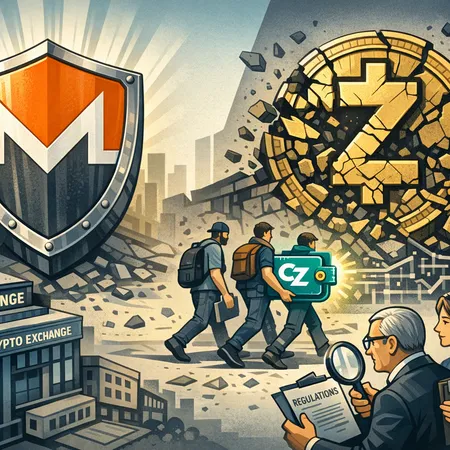
The developer exodus is not abstract. Recent departures culminated in former Zcash developers building alternative tooling and wallets, a practical demonstration that talent can be redeployed elsewhere rather than retained under the ZEC umbrella.
CashZ wallet: product, people, and migration signals
Out of those departures came CashZ — a wallet project unveiled by former Zcash developers. The launch is noteworthy for several reasons. First, it demonstrates that experienced privacy developers are not leaving the space; they are redirecting their efforts into new, user-focused tooling. Second, CashZ can act as a soft migration path for users who feel uneasy about Zcash’s governance or future upgrades.
The CashZ announcement from former ZEC developers frames the project as a post-exit move focused on user experience and independent stewardship (Coinspeaker coverage). For users, a familiar team shipping a wallet reduces switching friction: private key formats, UX patterns and privacy primitives can be reused or improved without waiting for contentious on-chain governance votes.
That said, a new wallet is not a full protocol migration — it’s a tool. CashZ could increase user mobility and interoperability between privacy-focused protocols, and it might catalyze a cohort of users to shift holdings or routing habits away from ZEC-enabled services toward XMR-native flows or custodians that support multiple privacy coin standards.
Why governance and visible contributor activity matter for privacy coins
Privacy coins are judged not only by cryptography but by the social layer around upgrades, audits and support. Governance disputes are especially impactful because they can delay security patches, fork decisions or consensus-driven privacy enhancements. When governance falters, the resulting uncertainty affects listing teams, compliance officers and even wallet integrators.
In Zcash’s case, the governance dispute and reduced developer output created a credibility gap. Market participants worry about stalled upgrades and the possibility of contentious forks that split liquidity. That worry manifests as delistings, reduced market-making commitments, and slower integration from services that need a predictable roadmap.
Compare that to Monero, where a relatively consistent development cadence and community governance culture reduce the likelihood of abrupt strategic shifts. That consistency is appealing to infrastructure providers who must plan for custody, compliance, and technical integration.
Implications for exchanges and listing teams
Exchanges evaluate tokens on technical maturity, custodian support, legal risk and community stability. Privacy coins sit at a tricky intersection: high user demand on one side; elevated compliance and delisting risk on the other.
The ZEC situation highlights how governance turbulence can prompt exchanges to rethink listing status or risk parameters. Some exchanges may increase due diligence, demand clearer upgrade roadmaps, or adjust fees and deposit/withdrawal deltas to hedge coordination risk. Others might deprioritize ZEC for new listings in favor of coins where development and governance signals are stronger.
For teams considering XMR, the calculus is different but still complex: XMR’s privacy guarantees make custody and compliance more challenging, but its active developer base and stable roadmap present a more predictable operational profile. Exchanges that list XMR must decide whether to build internal compliance controls, work with analytics providers, or restrict certain services depending on jurisdictional rules.
Regulatory pressure and policy observer takeaways
Regulators are watching privacy coins closely. Some jurisdictions treat privacy-preserving transfers as high-risk, prompting enhanced AML/KYC scrutiny or outright restrictions. The shifting fortunes of ZEC and XMR will inform policy debates in two ways:
- A weakened Zcash could be used by regulators to point to instability and governance opacity in privacy coin projects, arguing for stricter oversight.
- Conversely, Monero’s growing prominence will keep the spotlight on how private transactions can be audited (or not), and whether privacy needs must be balanced against law enforcement and AML objectives.
Policy observers should note that technical fixes and protocol transparency matter: projects that demonstrate strong governance, frequent audits and clear upgrade pathways make regulators and exchanges more comfortable than those riven by internal disputes.
Privacy adoption, infrastructure, and developer talent flows
The CashZ wallet episode illustrates a broader phenomenon: developer talent is portable and often the first mover in ecosystem change. When established contributors depart a flagship project, they rarely vanish; they either start new tools or join adjacent efforts. That reallocation can increase competition on UX, interoperability and custody solutions — and it can accelerate privacy adoption even as it fragments the ecosystem.
Infrastructure providers — block explorers, analytics firms, custody vendors — must adapt. Some will double down on supporting Monero-style privacy primitives; others will invest in better heuristics for ZEC-like opt-in privacy transactions. Bitlet.app and similar platforms that offer custody or payment rails should weigh integrations across both model types and ensure compliant workflows where possible.
Interoperability also becomes central. Wallets like CashZ that emphasize user experience could help bridge user flows across multiple privacy protocols, making privacy adoption more about tooling than about a single token.
Practical advice for different stakeholders
Privacy-focused users: Assess risk not only by cryptography but by governance. If you prize continuous development and a predictable upgrade path, XMR currently offers that. If you hold ZEC, watch CashZ and other tools for migration options and maintain good key hygiene.
Exchange listing teams: Re-evaluate due diligence matrices to include governance health and contributor retention as material factors. Consider conditional listings or staged custody support when developer activity is uncertain.
Policy observers and compliance teams: Engagement beats assumption. Distinguish between protocol designs (mandatory vs. opt-in privacy) and between governance models. Encourage transparent upgrade roadmaps and audits to reduce regulatory friction.
Looking ahead: fragmentation or maturation?
The immediate effect of Zcash turmoil and CashZ’s arrival is fragmentation of talent and tooling. But fragmentation is not necessarily negative. It can yield better wallets, clearer governance experiments, and stronger interoperability. The long-term outcome depends on whether projects convert short-term churn into sustainable product differentiation and whether exchanges and regulators create consistent standards for privacy coin handling.
Monero’s ascent signals that, in this stage of the market, clarity of purpose and steady development attract both users and infrastructure. Zcash’s story is a cautionary tale about governance friction. CashZ shows how developer exits can quickly turn into new on-ramps for users.
For anyone tracking privacy adoption — from wallets to policymakers — the lesson is practical: follow the code, follow the contributors, and don’t ignore tooling. A new wallet can change flows even if it doesn’t change the underlying consensus.
Conclusion
Monero’s climb past Zcash reflects a mix of technical reliability, active developer engagement, and market confidence. Zcash’s governance dispute and developer departures created an opening that XMR filled. CashZ’s release underscores how talent migration spawns new user pathways and compounds the strategic choices exchanges and regulators must make.
Privacy coins will continue to evolve at the intersection of cryptography, governance and policy. Monitoring developer activity, wallet ecosystems like CashZ, and how exchanges respond will be essential for anyone evaluating privacy coin risk and opportunity.