Solana’s Infrastructure Sprint: Firedancer, Dedicated Fiber, and JPMorgan’s On‑Chain Commercial Paper
Summary
Executive overview
Solana’s recent infrastructure moves are more than incremental upgrades — they read like a coordinated pitch to institutions. In the last year we’ve seen the Firedancer validator client land on mainnet, a push to build dedicated fiber dubbed an “internet rail,” and a bank‑grade commercial paper issuance settled in USDC on Solana. Together these developments address different pieces of the same problem: how to make a high‑throughput blockchain behave more like a predictable, low‑latency settlement rail for institutional flows.
This article breaks down what each layer delivers technically, how JPMorgan’s $50M issuance functions as a real‑world case study, and the residual risks institutions and CTOs must evaluate when considering Solana as an institutional settlement option.
Firedancer: what the new validator client brings
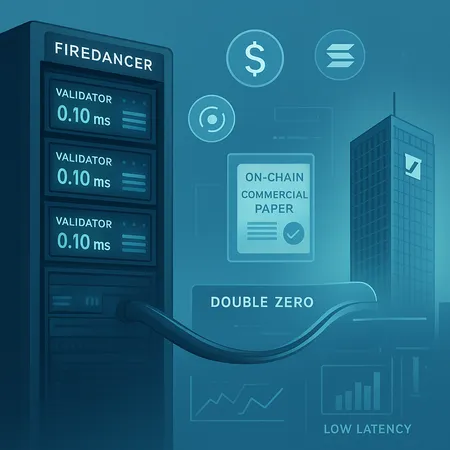
Firedancer — a validator client originally developed by Jump Crypto — recently launched a full validator client on Solana mainnet, a milestone that targets the plumbing of consensus and block propagation. The mainnet release is not just a marketing tick; it’s an attempt to remove long‑standing bottlenecks in how validators process and exchange messages.
A few operational benefits to highlight:
- Lower latency and faster block propagation. Firedancer is optimized for I/O and parallel processing so validators can validate more transactions with fewer scheduling delays. That matters for settlement where every millisecond of end‑to‑end latency translates to capital efficiency.
- Resource efficiency. By reducing CPU and networking overhead, Firedancer can lower the marginal cost of running a validator node. For institutional setups this can mean fewer resources devoted to tuning and more predictable node performance under load.
- Diversity in client implementations. Multiple validator clients reduce systemic risk tied to a single codebase — provided operator diversity follows. More clients mean fewer shared vulnerabilities.
Those outcomes are why many CTOs will look closely at the Firedancer launch as a precondition for institutional adoption. The mainnet rollout is covered in detail in the announcement from Cryptopolitan, which documents the launch and expected operational benefits (see the Firedancer announcement).
Why dedicated fiber (Double Zero) matters for high‑throughput chains
Blockchains don’t live in a vacuum — they rely on physical networks. Double Zero’s plan to build a dedicated fiber “internet rail” for Solana is a notable pivot: instead of squeezing performance from software alone, this approach invests in the physical layer to guarantee deterministic latency and lower jitter.
Dedicated fiber helps in three concrete ways:
- Reduced variability in packet delivery. Public internet paths are subject to congestion, routing changes, and variable hops. For Solana-like architectures that expect fast leader rotation and tightly timed messages, jitter can cause missed votes or stalled propagation.
- Higher consistent throughput. A private optical path can sustain bursty traffic patterns without TIP‑increases in retransmissions or packet loss, which otherwise reduce effective throughput and increase confirmation times.
- Operational control and SLAs. Institutions demand service‑level assurances. Dedicated fiber makes it possible to define and measure SLAs for latency and availability — a familiar framework for banks and exchanges.
Double Zero’s initiative to lay physical fiber for Solana is an example of moving beyond software optimization into what I’ll call infrastructure verticalization; it treats the blockchain as a latency‑sensitive application stack that benefits from bespoke networking. AltcoinBuzz covers Double Zero’s ambitions and why fiber is being framed as an ‘internet rail’ to speed Solana traffic.
JPMorgan’s $50M on‑chain commercial paper: a case study
A practical test of this stack came when JPMorgan issued and managed a $50M commercial paper issuance on Solana, settled in USDC. That event is notable for several reasons:
- Institutional participants and custody. The issuance was fully managed by a major banking entity, demonstrating a pathway where a regulated bank can originate short‑term debt and use tokenized dollar‑denominated stablecoins for settlement. The Cointribune write‑up captures the issuance mechanics and framing.
- Settlement mechanics. Using USDC as the settlement medium allowed near‑instantaneous finality on transfers between market participants once on‑chain settlement completed. That contrasts with traditional settlement cycles that can span hours or days and require reconciliation.
- Operational implications. For the issuer and investors, using an on‑chain ledger reduces reconciliation overhead, provides auditable transaction history, and can allow atomic delivery versus payment patterns when integrated with custody and execution systems.
However, the JPMorgan proof‑point is not a blanket endorsement. It is a controlled experiment that shows the potential for tokenized cash to serve as a settlement rail when supported by bank controls, custody, and compliance workflows.
How these pieces fit together for institutional settlement
Combine Firedancer’s validator performance improvements with dedicated fiber and a live institutional issuance and you get a layered value proposition:
- Software reduces transient processing bottlenecks.
- Physical networking reduces variance and increases predictability.
- Real‑world issuance demonstrates integration with compliance and treasury flows.
For CTOs and strategists, that layered approach matters. Institutions need deterministic settlement latency, measurable availability, and clear custody/operational controls. The Solana stack — plus third‑party infrastructure and on‑chain USDC rails — can deliver that in narrow, well‑engineered workflows.
Risks and tradeoffs: reliability, centralization, and regulation
No architecture is without tradeoffs. Below are the key risk categories to weigh.
Network reliability and historical outages
Solana has a history of episodic network instability. Even with Firedancer and improved throughput, fundamental software bugs, consensus edge cases, or DDoS vectors can still cause interruptions. Ambcrypto’s analysis of Solana’s recent struggles and the narrative pivot toward real‑world assets (RWAs) underscores that technical upgrades are necessary but not sufficient to guarantee continuous availability.
Centralization concerns
Dedicated fiber and specialized validator clients can increase the performance floor, but they can also concentrate capability among operators who can afford the stack. If a small set of entities control the high‑performance paths or run the majority of optimized validators, the network’s decentralization assumptions weaken. That has implications for governance, censorship resistance, and resilience.
Regulatory and custodial complexity
On‑chain commercial paper brings regulatory attention. A bank using tokenized USDC as settlement layers must reconcile KYC/AML, custody requirements, and securities/commercial paper regulations in relevant jurisdictions. Regulators may demand additional disclosure, custody segregation, or even limit how tokenized short‑term instruments are distributed. JPMorgan’s issuance is an important early test, but regulators will be watching.
Operational coupling and single‑chain risk
Institutional adoption implies operational coupling: if an organization routes significant treasury settlement through Solana, outages become business‑critical events. Institutions must model fallback paths, liquidity fragmentation, and the cost of chain unavailability.
Practical evaluation checklist for CTOs and crypto strategists
Before committing settlement flows to Solana, evaluate these items:
- Performance testing under realistic load: run end‑to‑end tests that include smart contract execution, cross‑RPC latency, and validator failovers.
- Network path guarantees: can you get an SLA from network providers (or a partner like Double Zero) for specific latency/jitter bounds?
- Custody and settlement controls: ensure USDC custody, reconciliation, and adverse event procedures meet your compliance standards.
- Diversity of validator clients and nodes: run or contract nodes across clients (including Firedancer) and geographies to avoid single points of failure.
- Regulatory mapping: engage legal teams to map on‑chain instruments to existing securities, money‑market, and banking regimes.
Platforms that offer token settlement or P2P exchange services, such as Bitlet.app, will closely monitor these dimensions as they design product flows that rely on on‑chain rails.
Bottom line
Firedancer, Double Zero’s dedicated fiber plans, and JPMorgan’s USDC‑settled commercial paper together form a credible, layered case for Solana as an institutional settlement option — but not yet a turnkey replacement for traditional rails. The technical upgrades materially improve performance predictability, and the JPMorgan issuance proves real‑world viability. Still, the stack introduces tradeoffs around centralization and regulatory exposure that institutions must explicitly manage.
For institutions: view Solana today as an attractive experimental settlement lane for well‑scoped use cases (e.g., interbank liquidity transfers, tokenized short‑term instruments) where the benefits of speed and atomic settlement outweigh the operational and regulatory complexity. Keep contingency plans ready, and demand SLAs and diversity across both software clients and physical network paths.
Sources
- Firedancer mainnet launch announcement: Firedancer upgrade on Solana main net
- Double Zero dedicated fiber plans: Double Zero races to build a faster internet rail
- JPMorgan issuance on Solana: JPMorgan launches a $50M issuance on Solana settled in USDC
- Critical view and risk context: Solana sinks 27% YTD — RWA pivot analysis
For broader context on digital asset market signaling, see discussions on Bitcoin and infrastructure trends on DeFi.