Post‑mortem: Step Finance Treasury Breach and Hardening Solana DeFi Treasuries
Summary
Executive summary
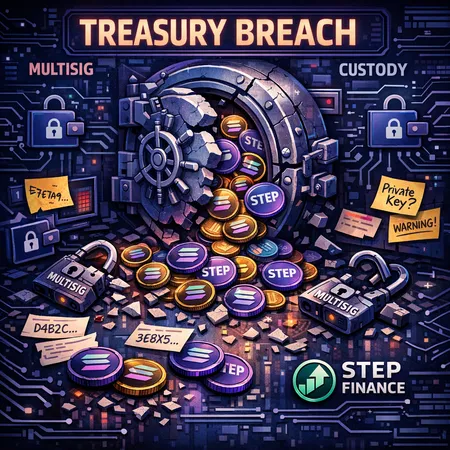
On the morning of the Step Finance breach, several treasury wallets controlled by the protocol were emptied of SOL — industry reporting put the loss between $27M and $30M. The attacker’s moves were surgical: multiple treasury wallets were drained rather than a single exploited contract. Markets reacted quickly; the STEP token plunged roughly 90% as on‑chain observers and market makers priced in governance paralysis, fundraising uncertainty, and capital flight.
This post‑mortem examines the timeline, the mechanics behind how multiple wallets were compromised, why the token collapse was so severe, common treasury control failures observed across DeFi, and a concrete hardening checklist for DAOs and projects building on Solana and other chains. For teams operating in the DeFi space — and specifically on Solana — these are practical controls you should implement immediately.
Timeline and mechanics: what happened (concise reconstruction)
Initial reporting by Cointelegraph and follow‑ups from the crypto press indicate the breach unfolded as follows: early on the attack day, an adversary moved progressively through multiple treasury wallets associated with Step Finance, sweeping out SOL and a small number of SPL assets. Cointelegraph reported that Step Finance disclosed a treasury wallet breach, and later coverage quantified the loss in the ~$27–30M range in SOL stolen and broader ecosystem exploit totals (Cointelegraph report; CryptoNews follow‑up).
Mechanically, this was not a classic smart‑contract exploit on Solana (no zero‑day in a program was reported). Instead, the attacker gained signing capability over multiple treasury accounts. Possible vectors consistent with the observed pattern include one or more of: exported private keys on developer machines, compromised off‑chain multisig co‑signers, leaked key backups, or a compromised signatory device used across different wallets. Because Solana accounts rely on private keys for authority, any exposed key—even if it’s only used as one key in a multisig pattern—can be sufficient if the attacker can meet the signing threshold or isolate wallets where a single key controls authority.
How multiple treasury wallets were compromised
Three operational failure modes explain compromises that span several wallets:
Shared key material across wallets. Teams sometimes reuse a single signer (or seed phrase) across multiple treasury accounts for convenience during early development or when migrating funds. That pattern creates a single point of failure.
Single‑key multisig or low threshold multisig. A “multisig” that is actually a single private key walking like a multisig (or a 2‑of‑3 where two keys are centrally controlled) offers little protection. If an attacker obtains a single key and other keys are weakly protected, they can aggregate authority.
Off‑chain exposure through third parties. Many teams use remote signers, cloud machines, or custodial services with insufficient isolation. If those off‑chain systems are compromised, an attacker can sign transactions for any wallet that delegates that signer.
Step’s breach pattern — several wallets drained in sequence — lines up with a scenario where the attacker either obtained a highly privileged signatory used across treasuries, or breached multiple signers via the same operational vulnerability. Reporting does not attribute this to a Solana protocol flaw; rather, it reads as a custody/operational failure that allowed private keys or signing authority to be stolen (Cointelegraph).
Why the STEP token crashed ~90%
Three forces combined to produce the catastrophic price action for STEP:
Immediate loss of treasury value and runway. The treasury often underwrites grants, liquidity pools, and market‑making. Losing tens of millions of dollars signals a sudden degradation of the protocol’s capacity to support markets and incentives.
Governance paralysis and fear of rug/exit. Investors and holders fear that governance keys or timelocks could also be compromised; if the treasury can’t be trusted, token utility and governance credibility collapse.
Panic selling and liquidity shock. Automated market makers and off‑chain market makers pulled bids. When a large proportion of circulating tokens are associated with a project’s treasury or team wallets, uncertainty triggers mass selling and cascading price declines.
Put together, these elements explain why STEP’s market cap and liquidity evaporated almost instantly after public disclosure: the market chose to price in worst‑case scenarios while on‑chain evidence and a mitigation plan were awaited.
Common treasury control failures (observed and proven)
Below are recurring weaknesses we see in DAO/DeFi treasury setups that make breaches like Step’s possible:
Single‑key control masquerading as multisig. Sometimes a multisig is nominal: the practical control is concentrated in a single seed phrase or a small set of co‑located keys.
Low‑threshold or poorly distributed signers. 2‑of‑3 with all keys held by the same team, vendor, or infrastructure provider is weak. Thresholds must match threat models and organizational distribution.
Off‑chain key exposure. Seed phrases stored in plaintext, keys on laptops, backups in cloud storage, or shared via insecure channels (Slack, email) remain a major vector.
No timelock or emergency delay. Immediate, irreversible spend authority without a cooldown window prevents community intervention when suspicious activity happens.
Poor monitoring and alerting. Teams without real‑time treasury monitoring will miss the first signs of exfiltration and lose time responding.
Dependency on a single custodian or signer service. Entrusting all authority to one third party creates concentration risk.
These failure modes are not theoretical. The Step incident aligns with operational compromise rather than a cryptographic flaw, making these control failures especially relevant.
Practical hardening checklist for DAOs and DeFi projects
This checklist is ordered roughly by the cost‑to‑implement vs. security benefit for most teams. Apply it immediately and adapt to your threat model.
1) Design the right multisig and key distribution
- Use threshold multisigs with independent, geographically and institutionally separated signers (e.g., 3‑of‑5 or 4‑of‑7 depending on treasury size).
- Ensure signers are owned/operated by different people or entities: some by core contributors, some by board members, some by trusted custodians or legal entities.
- Avoid using the same private key across multiple wallets. Each critical wallet should have its own unique signer set.
2) Prefer hardware‑backed signers and secure custody
- Require hardware wallets (Ledger, Trezor, or FIPS‑level HSMs) for all signers. For high‑value treasuries, use dedicated HSM/MPC solutions with attestation.
- If using custodians, split custody: no single custodian should control all treasury access.
- Consider MPC (multi‑party computation) for institutional setups to remove single seed backup risks.
3) Add on‑chain governance safeguards
- Implement time delays (timelocks) for treasury spends above defined thresholds. A 24–72 hour delay gives the community time to react to rogue transactions.
- Require multisig confirmation on any change to signer sets or governance parameters, with higher thresholds for signer rotation.
4) Operational hygiene and secret management
- Do not store seed phrases or private keys in plaintext or cloud storage. Use secure backups (air‑gapped, encrypted, split secrets) with documented custody procedures.
- Enforce least privilege: keep the majority of funds in cold vaults; only operational amounts live in hot wallets.
- Rotate keys and rotate signers on a scheduled cadence; have a secure process and test it on low‑value wallets first.
5) Monitoring, detection, and automation
- Deploy continuous watch scripts and on‑chain alerting for anomalous outbound transfers, signatory changes, or large balance swings.
- Integrate with block explorers, wallet‑monitoring dashboards, and services that can front‑run token approvals or pause operations when suspicious patterns appear.
- Automate emergency governance notifications to token holders and market makers.
6) Incident playbook and economic mitigation
- Predefine an incident response playbook: triage steps, blacklists, contact lists (exchanges, market makers, custodians), legal counsel, and insurers.
- Maintain liquidity buffers and market‑making commitments to reduce immediate price shock if a treasury compromise occurs.
- Consider insurance (cyber or smart‑contract cover) and know your policy's scope before you need it.
7) Red team and third‑party audits
- Regularly commission operational security audits focused on key management and operational practices, not just code audits.
- Simulate key compromise with tabletop exercises and red‑team operations to validate response procedures.
Implementing these controls involves tradeoffs between usability and security. For early projects, prioritize simple, high‑impact controls: hardware wallets, separation of signers, timelocks, and monitoring.
Incident response: steps Step Finance and others should follow post‑breach
A fast, transparent, and organized response reduces uncertainty and can prevent a total market collapse.
- Public incident disclosure. Provide a timeline of what is known, what is unknown, and immediate mitigations (done by Step Finance per press disclosures).
- Freeze and isolate. Identify non‑compromised keys and isolate operational wallets. Rotate unaffected signers.
- Forensic collaboration. Work with chain analytics teams and law enforcement to trace flows; publish addresses to aid exchanges and on‑chain monitors in blacklisting stolen funds.
- Community governance. Convene emergency governance votes for timelocks, temporary caps, or rescues only when safe and legally vetted.
- Longer term governance hardening. Replace any compromised signers, increase thresholds, and publish a remediation roadmap.
During the early hours after the Step disclosure, a lack of immediate, concrete mitigation plans likely fed the STEP sell‑off. Having a playbook and pre‑approved emergency measures would have allowed for quicker stabilizing actions.
Broader lessons for the Solana ecosystem and DeFi builders
- Operational security matters more than chain‑level security. Solana’s runtime may be secure, but private key management is the human layer that fails.
- Token economics and treasury architecture should assume that treasury funds are a target; design to limit blast radius and preserve governance integrity under compromise.
- Market reaction to breaches is reflexive and severe. Maintain communication channels with market makers and exchanges to dampen panic when incidents occur.
Tools and platforms such as Bitlet.app can be part of a broader custody and treasury strategy, but teams must vet integrations, custody SLAs, and key‑separation guarantees rather than outsourcing trust implicitly.
Closing thoughts
The Step Finance breach is a stark reminder that DeFi security is operational as much as it is cryptographic. Losing $27–30M in SOL is not just a line item — it erodes trust, governance, and market function. For founders, auditors, and security teams, the concrete actions above — stronger multisig design, hardware/MPC custody, timelocks, monitoring, and rehearsed incident response — convert abstract risk into manageable controls.
Security is iterative. After implementing hardening steps, test them often, update your threat model, and make key management a core product feature, not an afterthought.
Sources
- Cointelegraph — Step Finance discloses a treasury wallet breach and STEP crash: https://cointelegraph.com/news/step-finance-treasury-breach-solana-step-token-crash?utm_source=rss_feed&utm_medium=rss&utm_campaign=rss_partner_inbound
- CryptoNews — Follow‑up: ~$30M stolen as Step Finance treasury wallets were compromised: https://cryptonews.com/news/30m-stolen-as-step-finance-treasury-wallets-compromised/