Why Celo and Ethereum L2s Are Turning ZK Tech Into a Payments Advantage
Summary
Executive snapshot
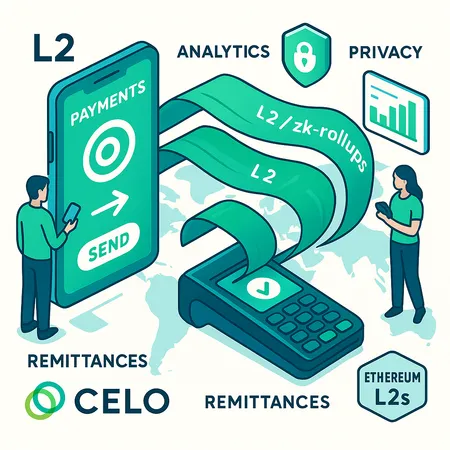
Payments teams evaluating blockchain rails should pay attention: privacy is now a competitive feature, not just a niche for privacy maximalists. Lower L2 fees and growing zk tooling let startups offer private, fast, and inexpensive remittances that feel like conventional rails but with blockchain-native benefits — settlement transparency, programmable money, and composable liquidity. For many builders these days, the important questions are not if zk can be used, but how to integrate it so merchants, regulators, and end users all win.
Why privacy-first on-chain payments matter in emerging markets
Emerging markets present a unique mix of high remittance volume, expensive intermediaries, and mobile-first users. Two trends have made on-chain private payments feasible now:
- Capacity and cost improvements on Ethereum L2s. With Ethereum fees dropping and L2 throughput rising, payment flows can be batched and settled cheaply — a prerequisite for micropayments and remittance rails (see the analysis of Ethereum fees and L2 capacity for context) (CryptoSlate analysis).
- Maturing zero-knowledge tech and integration pathways. ZK primitives are no longer purely academic; they are used to prove statements about transactions without revealing details, which is attractive where users want privacy from peers, local banks, or bad-faith intermediaries but still need compliance assurances.
In practice this means corridors with large remittance flows (ASEAN, Latin America, parts of Africa) can reduce costs and improve speed while offering optional privacy — a real product differentiator.
Two design patterns: Celo’s payments-first model vs. typical Ethereum L2 zk-rollups
Both Celo and zk-rollups use cryptography and on-chain settlement, but their product and technical choices differ in ways that matter for payments teams.
Celo’s payments-oriented approach
Celo was built from day one for mobile users and payments. Its stack emphasizes:
- Mobile-first UX and account abstraction (smart accounts): onboarding and transaction signing are optimized for phones and simplified key management. That lowers acquisition friction in emerging markets.
- Native stablecoins & gas economics: Celo’s focus on stable assets (cUSD, others) and flexible gas models reduces exposure to volatility for merchants and remitters. This is a big UX win when users expect fiat-like behavior.
- Active push to integrate zk/privacy into payments: Celo is positioning itself to combine these mobile and token-economics advantages with zk primitives to provide privacy at the transaction layer (see the argument that Celo is leading the shift toward zk in payments) (CoinGape coverage).
Put simply: Celo is product-first. It treats privacy as a payments feature to be stitched into onboarding, fiat rails, and merchant UX.
Ethereum L2 zk-rollups — scaling plus native zk proofs
Most emerging L2s on Ethereum use zk-rollup designs to compress many L1 transactions into a single validity proof on Ethereum. Key properties:
- Aggregated settlement with validity proofs: transactions are batched off-chain and a succinct zk proof attests to their correctness before an L1 state root is published. This drives throughput and cost reduction.
- EVM-compatibility trade-offs: many zk-rollups aim for EVM equivalence to ease developer porting, but that can complicate native privacy primitives — most zk-rollups prioritize scaling and finality over default transaction confidentiality.
- Privacy is possible but not default: zk proofs are the underlying technology of many privacy schemes, yet most public zk-rollups keep transactions transparent for auditing and composability. To add privacy, teams must layer shielded pools, confidential transfers, or privacy-focused zk primitives.
So, Ethereum L2s give capacity and cheap settlement (a necessary condition); Celo provides a payments-oriented surface area to make zk privacy usable for end customers (a sufficient condition when combined).
How zk privacy models differ in practice
There are two common ways privacy shows up on-chain:
- Shielded pools / confidential transfers: transactions are private inside a pool; you reveal only necessary metadata. This model gives strong receiver/payor privacy but can fragment liquidity unless bridges are built.
- Selective disclosure via zk-credentials: prove attributes (e.g., KYC/AML status, residency) without revealing identities. This is the bridge between privacy and compliance — particularly useful for regulated remittances.
For payment products, selective disclosure is often more practical: merchants and regulators get assurances they need, while senders/recipients keep transaction details private from the public.
Real-world remittance and tokenization use cases
Practical pilots and deployments are already showing how on-chain rails can be used:
- Stablecoin remittances with privacy toggles: corridor transfers where users send stablecoins (e.g., cUSD on Celo) and recipients cash out locally; privacy toggles reduce leak risk on public ledgers.
- Tokenized real-world assets as settlement rails: tokenization projects — like Bhutan’s gold-backed token on Solana — illustrate how on-chain assets can be used for trust and settlement where local fiat rails are thin (Bitcoin.com coverage). For remittances, asset-backed tokens can act as an on-chain reserve or collateral, reducing FX frictions.
- Merchant payouts and payroll in stablecoins: businesses paying local vendors or gig workers can use private on-chain transfers to preserve employee privacy and simplify cross-border payroll.
These models succeed where there is good fiat on/off-ramp coverage, liquidity, and merchant acceptance.
Regulatory trade-offs: privacy vs AML/KYC
Privacy on payments rails triggers scrutiny. Product teams need pragmatic approaches:
- Don’t confuse privacy with illicitness. Privacy is a user-right and financial hygiene feature for many people. That said, full anonymity conflicts with AML regimes.
- Design for accountable privacy. Use selective-disclosure zk credentials so users can prove compliance properties (e.g., AML-cleared, not on sanctions list) without exposing full transaction graphs. This satisfies many regulator concerns while preserving user privacy.
- Auditability and court-access mechanics. Build processes (multi-party key shares, escrowed view-keys under court order) to allow legal access in exceptional cases. This hybrid design reduces regulatory pushback.
Balancing privacy and compliance will be a major product and policy challenge — and also an opportunity. Protocols that offer controlled privacy will find better merchant and regulator acceptance than those promoting absolute anonymity.
Merchant adoption barriers and how to overcome them
Merchants care about predictability, settlement speed, accounting, and chargeback risk. Common barriers to on-chain private payments:
- Volatility and settlement risk. Use native stablecoins and/or instant fiat settlement rails.
- UX friction (keys, wallets, onboarding). Account abstraction and social or custodial key recovery reduce churn. This is why Celo’s mobile-first UX is relevant.
- Liquidity fragmentation from shielded pools. Provide routing and automated market maker (AMM) liquidity adapters between private pools and public liquidity to avoid poor exchange rates.
- Regulatory uncertainty. Implement zk-credential-based onboarding and partner with regulated fiat on/offramps.
Practical fixes include: fee sponsorship (merchant pays gas), meta-transactions (relayers submit TXs on behalf of users), and SDKs that abstract away cryptography for merchants.
Token economics and UX levers that make private payments mainstream
Technical privacy alone won’t scale adoption. You need token and UX levers that reduce frictions:
- Fee sponsorship and gas abstraction. Let merchants or the app sponsor transaction fees so users don’t need native token balances. Celo’s gas model already makes this practical.
- Stablecoin-first settlement. Price stability reduces conversion headaches and simplifies bookkeeping for merchants.
- Incentive alignments for liquidity providers. Use targeted LP incentives to ensure private pools have tight spreads with public liquidity.
- Simple recovery and custody options. Social recovery and custodial-interchange options widen the user base beyond crypto natives.
- Pilots focused on concrete pain points. Start with corridors that have poor banking infrastructure and high remittance costs.
Good token economics reduces cognitive load for users and merchants, turning privacy from a philosophical feature into a tangible product benefit.
Practical roadmap for product and growth leads
If you’re evaluating rails and want to pilot privacy-enabled remittances, consider this sequence:
- Corridor selection: pick a high-volume, high-fee corridor with mobile users and fiat on/offramps.
- Choose technology pillars: stablecoin rails, account abstraction, and a zk-privacy layer that supports selective disclosure. Celo is designed for this mix; Ethereum L2s bring scale — consider hybrid architectures.
- Compliance design: integrate zk-credential providers and partner with KYC/fiat-rail vendors to enable legal settlement.
- Merchant SDK & gas strategy: build an SDK that hides keys, sponsors gas for first-time users, and offers instant settlement options.
- Pilot metrics: measure cost per remittance, time-to-settlement, outflow to fiat, merchant acceptance rate, and disputes. Iterate quickly.
Startups like Bitlet.app evaluating rails should pilot with a handful of merchants and measure real redemption rates and customer support overhead before scaling.
Conclusion: privacy as a competitive moat — when done right
ZK technology finally gives payments teams a way to offer privacy with accountability. Celo’s payments-first architecture plus the scaling capacity of Ethereum L2 zk-rollups create a realistic path to private, fast, and cheap remittances. The product challenge is integration: stablecoins, fiat on/offramps, selective disclosure, and merchant-friendly UX must be stitched together.
For product managers and growth leads, the opportunity is clear: deliver privacy as a user-centric feature — not as a compliance problem — and you can capture corridors where incumbents charge high fees and offer poor UX.
Sources
- Celo pushing zk/privacy into payments: https://coingape.com/block-of-fame/pulse/ethereum-l2s-are-pushing-zk-into-payments-celo-leads-the-shift/
- Ethereum fees and L2 capacity context: https://cryptoslate.com/ethereum-fees-just-hit-7-year-low-as-it-finally-outperforms-bitcoin-one-hidden-data-point-proves-rally-is-sustainable/
- Bhutan gold-backed token example (tokenization): https://news.bitcoin.com/bhutan-launches-gold-backed-digital-token-on-solana-blockchain/