Macro-Liquidity Explainer: Token Unlocks, MSCI Risk, Funding Gaps and Options Expiry
Summary
Executive overview
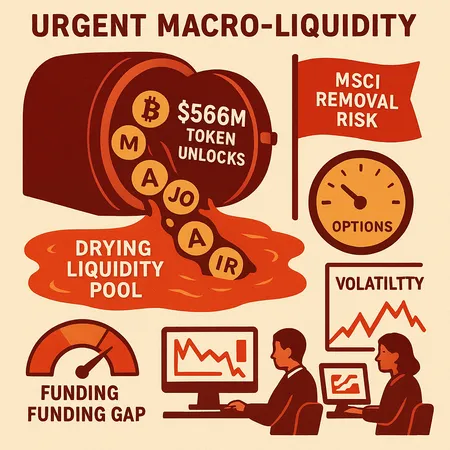
Short-term liquidity shocks are rarely caused by a single headline. This week the market faces four overlapping stressors: roughly $566 million in scheduled token unlocks, a high-profile institutional warning that a Bitcoin strategy could face MSCI removal, a widening funding gap for Bitcoin strategies that raises margin and redemption risk, and a concentrated $13.3 billion monthly options expiry that can focus market moves around so-called "max pain" levels. Together, these events increase the odds of sudden volatility and create concentrated sell pressure that can cascade across order books and OTC desks. For many traders, Bitcoin remains the primary bellwether; but vulnerabilities in token markets and institutional products now matter for portfolio-wide liquidity.
Token unlocks: why $566M matters
Token unlocks are scheduled releases of previously locked or vested tokens to insiders, founders, or early investors. They matter because many of these recipients sell into spot and derivative markets to realize gains or manage tax/liquidity needs. Crypto.News reports this week's pipeline of unlocks at about $566M, a non-trivial number relative to average on-chain spot volumes for many mid-cap tokens and to risk-bearing capacity in correlated derivative markets (source: Crypto.News).
When unlocks are concentrated in a few addresses or tokens, selling pressure can hit thin order books and force price dislocations. Even if the unlocked tokens are not BTC, the liquidity shock can transmit via margin calls, portfolio rebalancing, and increased demand for USD or stablecoins — especially during periods when funding liquidity is already stretched.
Institutional product stress: MSCI removal risk and outflows
A separate but related channel is institutional product risk. JPMorgan warned that a Strategy fund with bitcoin holdings could face removal from the MSCI index, which would trigger automated passive outflows from funds tracking that benchmark (source: Blockonomi — JPMorgan warns Strategy stock faces MSCI index removal over Bitcoin holdings). Index removal is not just a PR problem: it creates forced selling from index funds, ETFs, and mandates that must rebalance immediately or face tracking error, amplifying liquidity needs over a compressed time window.
The mechanics are simple but brutal: index reconstitution deadlines prompt large block trades, which, in a stressed environment, execute at worse fills. That stress can cascade into derivative markets as managers hedge exposures, increasing pressure on delta hedges in BTC and related instruments.
Funding gap: why liquidity buffers are shrinking
Compounding index risks, some research and reporting point to a widening funding gap in Bitcoin strategies — the difference between liabilities (redemptions, margin calls) and available liquid assets (cash, stablecoins, short-term funding). Blockonomi outlines how this gap has grown, pressuring strategy holdings and creating potential liquidity stress if redemptions accelerate (source: Blockonomi — Strategy Bitcoin holdings face new pressure as funding gap widens).
A funding gap forces managers into two bad choices: sell core crypto holdings into thin markets or source expensive short-term funding that increases carrying costs and forces further deleveraging. Either path increases realized supply into the market precisely when token unlocks and index-driven flows may be adding supply.
Options expiry: concentrated risk around price levels
Options expiries concentrate risk because large open interest at particular strikes creates mechanical supply/demand dynamics near expiry. Coindesk reports a $13.3B monthly BTC options expiry, and when open interest is clustered the settlement process can nudge the underlying price toward the so-called max pain level — the strike where option writers suffer the least net loss (source: Coindesk — Bitcoin faces usd13.3b monthly options expiry).
Options dealers dynamically hedge delta exposure by buying or selling the underlying as prices move. During a large expiry, this hedging can amplify moves: a drop triggers dealer buys or sells that worsen the price move, creating feedback loops between derivatives and spot liquidity. When combined with unlocking tokens and forced institutional outflows, options expiry becomes an amplifier rather than an isolated event.
How these forces interact to create a liquidity crunch
Think of the market as several pipes feeding a single pool: token unlocks add one pipe of potential supply, MSCI index-driven outflows add a second sudden pipe, a widening funding gap narrows the pool's capacity to absorb supply, and options expiry acts like a valve that can abruptly change flow direction. The result is a higher chance of a liquidity crunch where market depth evaporates, spreads widen, and slippage multiplies. Correlation effects matter: stablecoin demand for redemptions, margin calls across brokers, and reduced dealer balance sheet capacity can move otherwise unrelated assets.
A useful way to model this is to stress-test three scenarios: (1) orderly absorption — unlocks sold gradually into normal volumes; (2) concentrated liquidation — large blocks hit mid-book and trigger options hedging and forced institutional selling; (3) compounded cascade — unlocks plus forced outflows coincide with an adverse options gamma squeeze. Scenario (2) is the tail most managers should prepare for; scenario (3) is rarer but can create intraday price dislocations of 5–20% in less liquid tokens and meaningful moves in BTC.
Practical hedging and liquidity-monitoring tactics
Below is an operational checklist for traders, fund managers, and risk officers to anticipate and navigate short-term liquidity-driven shocks.
Pre-event positioning (24–72 hours out)
- Reduce directional leverage where possible; prefer funding cost over liquidation risk. Smaller positions are easier to hedge and cheaper to unwind.
- Build a liquidity buffer in safe, fungible instruments (USD, USDC/USDT) sized to cover a credible redemption stress test (e.g., 5–10% of AUM depending on fund profile).
- Identify high-risk assets by unlock schedule and concentration: review token vesting calendars (this week: $566M in scheduled unlocks) and mark tokens with large insider allocations. Treat these as higher probability sell pressure.
Execution tactics during stress
- Use OTC routers and block desks for large sizes to avoid crossing the open-book slippage; stagger executions over multiple counterparties and time windows.
- Prefer limit or TWAP/VWAP execution algorithms over market orders for sizeable spot trades; if liquidity is evaporating, consider small, rapid auctions to test depth rather than a single aggressive fill.
- For derivatives hedges, use a combination of listed options and OTC products to smooth gamma exposure. Avoid pulling delta hedges in the same venue and instrument that you’re liquidating — this compounds market impact.
Options-specific hedges
- If concerned about expiry pinning or gamma squeezes, buy protective options (puts or call spreads) to cap downside while preserving upside. Protective options are insurance and will cost premium — trade-off is worth it when funding liquidity is scarce.
- Consider variance swaps or structured products to hedge realized volatility exposure if available through your prime broker.
- Coordinate hedging cadence: options desks can provide block fills; try to execute large option buys off-book to avoid moving the implied volatility frontier.
Margin, funding and redemption management
- Recalculate the funding gap daily and stress-test funding runs across 3-day and 7-day windows. Identify the minimum liquidity reserve to avoid forced selling.
- Negotiate emergency credit lines or committed facilities with prime brokers in advance; these are crisis options that cost money but preserve optionality.
- Communicate with index providers, counterparties, and key investors if you suspect a possible reconstitution or MSCI removal scenario — transparency can buy time.
Monitoring dashboard: what to watch in real time
- Order book depth and spread at top 5 levels on major venues for BTC and any correlated tokens (e.g., MAJOR if it’s among unlocks).
- On-chain flows: large outflows to exchanges, stablecoin mint/redemption spikes, and concentration of newly unlocked tokens in single addresses.
- Derivatives metrics: open interest by strike, gamma exposure, and funding rates across perpetual swaps. High clustered open interest around a strike plus steep funding is a red flag.
- OTC indicators: block trade prints, dealer inventory signals, and quoted sizes from principal desks.
Operational checklist for funds and risk teams
- Predefine liquidation ladders (size buckets, venues, OTC counterparties) and rehearse them quarterly.
- Institute a trading-capacity metric combining average daily volume, book depth, and expected slippage for each asset.
- Add scenario-based limits tied to funding gap thresholds. When a funding gap exceeds a trigger, automatically reduce net exposures and raise liquidity buffers.
- Maintain a contact matrix for quick price discovery across exchanges and OTC desks; in crisis minutes matter.
Final thoughts
Liquidity risk is often underestimated because it’s nonlinear: small shocks can be absorbed, but overlapping stressors — token unlocks, MSCI-driven outflows, widening funding gaps, and concentrated options expiries — can suddenly move markets from benign to brittle. The best defense is a combination of forward-looking stress testing, conservative leverage, diversified execution channels, and active monitoring of the specific indicators described above. Tools and platforms like Bitlet.app can help institutional users track token schedules and flows, but the human decisions — sizing, timing, and venue choice — remain decisive.
Sources
- Crypto.News — Major token unlocks hit $566M, setting stage for volatile week: https://crypto.news/major-token-unlocks-hit-566m-setting-stage-for-volatile-week/
- Blockonomi — JPMorgan warns Strategy stock faces MSCI index removal over Bitcoin holdings: https://blockonomi.com/jpmorgan-warns-strategy-stock-faces-msci-index-removal-over-bitcoin-holdings/
- Blockonomi — Strategy Bitcoin holdings face new pressure as funding gap widens: https://blockonomi.com/strategy-bitcoin-holdings-face-new-pressure-as-funding-gap-widens/
- Coindesk — Bitcoin faces USD13.3B monthly options expiry as BTC trades well below max pain: https://www.coindesk.com/markets/2025/11/25/bitcoin-faces-usd13-3b-monthly-options-expiry-as-btc-trades-well-below-max-pain