The XRPC Paradox: Why a Record XRP ETF Debut Failed to Halt a Price Crash
Summary
The paradox at a glance
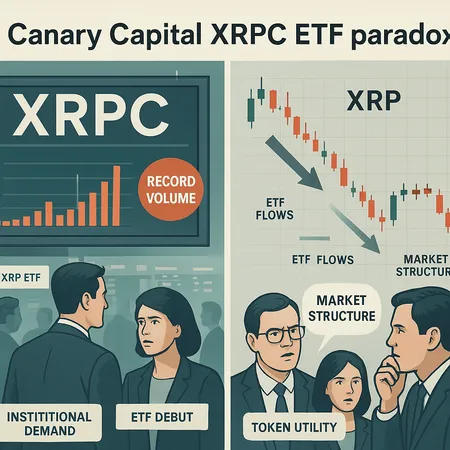
Canary Capital’s spot XRP ETF, XRPC, posted a standout debut: roughly $58 million in first-day volume — the largest opening-day tally among 2025 ETF launches. That raw number reads as a clear signal of institutional interest. Yet, paradoxically, XRP’s market price plunged in the same period, with reporting showing a drop of around 7.3% amid a broader selloff in risk assets.
This divergence — strong ETF volume on launch but no immediate price support — matters for investors who expected spot ETFs to act like direct demand engines for their underlying tokens. Below I unpack the anatomy of the XRPC debut, why inflows didn’t translate into price stability, how debates over XRP’s utility weighed in, and what allocators should watch when evaluating altcoin ETFs going forward.
XRPC’s debut: raw demand versus context
Canary’s XRPC recorded a headline-grabbing start. Coindesk reported that XRPC topped 2025 ETF debuts with about $58 million in day-one volume, a figure echoed by other outlets that cited Bloomberg-sourced trading data. These volumes suggest genuine institutional interest: allocators and trading desks were willing to take exposure through an exchange-listed vehicle on day one rather than wait for secondary-market liquidity to develop.
That said, headline volume alone doesn’t tell the whole story. ETF volume comprises secondary-market trading, creation/redemption activity facilitated by Authorized Participants (APs), and hedging flows. Some of the first-day trades were likely driven by traders rotating capital into a newly listed product, rather than long-duration accumulation of XRP on-chain.
Why ETF demand didn’t equal price support
There are several mechanics and market-structure reasons inflows into XRPC didn’t stop XRP’s price decline. These interplay with macro drivers — notably a contemporaneous bitcoin-led selloff — and bespoke behaviors from exchanges, APs, and OTC desks.
1) The macro backdrop: BTC correlation and a broader risk-off
Altcoins frequently move with Bitcoin. The day XRPC launched coincided with a notable selloff in BTC and broad crypto risk assets. The same Coindesk coverage that tallied XRPC’s volume also documented XRP’s slide amid a market-wide downturn. In such sessions, ETF inflows can be overwhelmed by redemptions, liquidations and rotation out of risky positions, producing net downward price pressure despite localized buying into the ETF.
2) ETF flows can be orthogonal to on-chain demand
A spot ETF like XRPC is designed to be backed by the underlying token, but the route by which the ETF operator acquires XRP matters. APs and custodians often source inventory through institutional liquidity providers and OTC desks rather than routing buy orders through public exchange order books or on-chain markets. That means ETF accumulation can be satisfied by sellers in dark pools or large-block OTC trades, leaving retail-visible order books thin and prices vulnerable.
In other words, ETF buys do not always equal visible buy pressure on spot exchanges. This dynamic was highlighted in contemporaneous analyses that noted surging ETF inflows even as XRP’s spot price weakened. Analysts pointed to an important distinction: the ETF’s demand can be absorbed off-exchange, muting the effect on the displayed market price.
3) Arbitrage, hedging and AP mechanics
Authorized Participants exist to keep ETF prices aligned with NAV. When they create shares, APs deliver the underlying token (or cash) to the custodian; when they redeem, the reverse happens. But APs also hedge exposure using derivatives, shorting the spot or using swaps. In a volatile, risk-off environment, APs may execute hedges that momentarily increase selling pressure on the underlying asset.
Moreover, if APs can source XRP cheaply in OTC markets, they may avoid buying in lit order books, again leaving public prices disconnected from the ETF’s nominal demand. The net result: a product can see healthy creation or trade volumes while the token itself weakens on visible venues.
4) Short-term positioning and profit-taking
New ETFs are natural targets for short-term traders and arbitrageurs. Some participants buy ETF shares anticipating a short-lived ‘ETF pop’ or improved liquidity, then quickly rotate to cash or other token exposures when volatility rises. This churn inflates first-day volumes without implying durable balance-sheet accumulation of XRP.
The token-utility debate: why some allocators remain skeptical
Beyond plumbing and flows, there’s a conversation about XRP’s utility and long-term value proposition. Public remarks from asset-management professionals and ETF-research executives expressed skepticism about XRP’s economic role as a settlement token relative to narrative-driven valuations for other assets. Coverage capturing a VanEck research executive’s questioning of XRP’s utility illustrates that some institutional allocators are not buying the token because of network adoption metrics — they’re buying a tradable instrument that offers regulated, listed exposure.
That nuance matters. An ETF can attract demand from price-focused allocators who prioritize regulated access and custody, without changing the underlying fundamentals that drive long-term appreciation: real-world adoption, on-chain activity, payment flows, developer ecosystem and regulatory clarity. If those fundamentals are weak or contested, ETF-driven demand may be transitory.
What XRPC reveals about future single-asset altcoin ETFs
The XRPC episode provides a pragmatic lesson set for allocators evaluating single-asset ETFs for altcoins:
- Institutional demand can be strong, but it may be structurally different from retail on-chain demand. High ETF volumes don't guarantee price support.
- Market-structure plumbing (AP behavior, OTC sourcing, custody arrangements) can blunt or delay price effects.
- Token utility still matters for long-term returns. If utility narratives are weak or disputed, ETFs may serve mostly as trading vehicles rather than engines of organic adoption.
- Correlation with Bitcoin and macro risk appetite will continue to dominate short-term price movements after a launch.
Analyses published the day of launch noted precisely this tension: surging XRPC inflows coincided with price headwinds, and deeper commentary attempted to explain why flows and spot prices divorced. Those writeups are useful reading for allocators building a framework for altcoin ETF evaluation.
A practical checklist for allocators
If you’re deciding whether to allocate to an altcoin ETF, consider these signals beyond headline volume:
- Creation/redemption transparency: Is the issuer publishing timely NAV and creation reports? Frequent creations tied to inflows are more meaningful than secondary-market churn.
- AP and custody concentration: Are a handful of APs or custodians handling most flows? Counterparty concentration raises execution risk.
- Liquidity sourcing: Are ETF acquisitions happening on public order books or via OTC desks? On-chain exchange flows and custodial statements can help here.
- Basis behavior: Track the ETF’s price vs. reported NAV. Persistent premia/discounts can indicate structural demand/supply imbalances.
- Token utility metrics: Developer activity, settlement volumes, active accounts and real-world integrations matter for multi-year outcomes.
- Correlation analysis: Measure how tightly the token follows BTC and broader risk indicators — single-asset ETFs won’t be immune to contagion.
For allocators who want to combine on-chain signals with regulatory comfort, tools and platforms such as Bitlet.app can help synthesize fund-flow data and trading metrics alongside on-chain indicators.
Final thoughts: temper enthusiasm with structure
XRPC’s debut shows that institutional appetite for regulated, exchange-traded altcoin exposure is real — but it also underlines a cautionary truth: ETF listings are not a guaranteed pass-through to higher token prices. Market structure, hedging activity, OTC liquidity and macro risk can all conspire to mute the price impact of large institutional flows. The debate over XRP’s utility adds another layer: if an asset lacks clear, expanding use cases, ETFs may simply provide a more efficient way to trade that token rather than to build a durable price floor.
For ETF-focused crypto investors and asset allocators, the right posture is skeptical curiosity. Study flows, understand the custody and AP mechanics, track on-chain metrics and treat first-day volume as a data point — not proof of long-term demand. The XRPC paradox is not a failure of the ETF model; it’s a reminder that capital markets and token markets speak different dialects of liquidity.
Sources and further reading
- Coindesk coverage of XRPC’s day-one volume and market move: Canary’s XRPC tops 2025 debuts with USD58M day-one volume.
- Alternative reporting on the first-day volume: XRPC posts biggest first-day volume of 2025.
- Reporting on the price reaction and BTC-related selloff: XRP ETF fails to bump bulls as Ripple-linked token plunges 7.3% amid BTC selloff.
- Analysis of the paradox of rising ETF inflows and a falling token price: Here’s why the XRP price is crashing as XRPC ETF inflows soar.
- Commentary capturing asset-manager skepticism on utility: VanEck exec questions XRP’s utility.