Why Purpose‑Built Ethereum Layer‑2 Markets Matter: The RISEx Repositioning and Macro On‑Chain Signals
Summary
The thesis: purpose‑built L2 markets meet healthier on‑chain capital
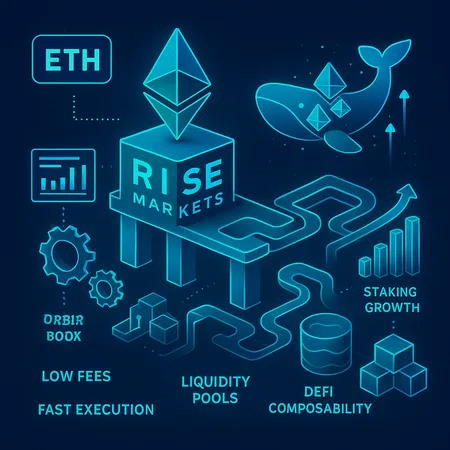
As on‑chain markets mature, the substrate they run on starts to matter as much as the products themselves. RISEx and RISE Markets are repositioning toward a simple but powerful idea: rather than shoehorning order‑book trading and advanced market primitives into general‑purpose L2s and rollups, build a Layer‑2 optimized for markets. The result is not just lower fees and faster fills — it’s a stack that aligns execution, settlement and composability in ways AMM‑first designs struggle to match.
This infrastructure shift arrives at an interesting macro juncture. Two on‑chain health indicators — staking growth and whale accumulation of ETH — are changing the supply dynamics that underlie liquidity. More ETH locked in staking and held by long‑term whales reduces immediate sell pressure, making it easier for nascent order‑books and market makers on L2 to source depth without being overwhelmed by short‑term outflows.
In plain terms: a markets‑focused L2 plus a healthier ETH supply picture can materially lower the cost of executing large trades on‑chain.
What RISEx and RISE Markets are building
RISEx and RISE Markets are positioning as a two‑layered approach: a market‑centric execution layer (RISEx) and a set of smart contract primitives and clearing/finality rails (RISE Markets) for on‑chain market infrastructure. The stack prioritizes deterministic settlement, compressed calldata for order batches, and primitives that make order‑books first‑class citizens — limit orders, matching engines, native margin and cross‑asset clearing.
That combination is meaningful because traditional rollups were designed primarily for generic smart contracts or token transfers. By contrast, a market L2 explicitly optimizes for:
- Throughput for order messages and offchain matching proofs — reducing gas per trade and enabling sub‑cent fees for small ticket execution.
- Atomic settlement primitives — so trade legs, margin adjustments and collateral transfers clear in one on‑chain transaction.
- MEV‑aware batching and auctioning — to reduce adverse selection and front‑running around large orders.
For protocol builders this means easier primitives to plug into: exchanges, lending desks, liquidators and portfolio managers can call standardized market APIs rather than re‑inventing order‑book logic atop a general rollup.
Technical differentiation: order‑book and market primitives
Order‑book markets require different tradeoffs from AMMs. Liquidity providers in AMMs accept continuous curve risk and concentrated liquidity; an order‑book model requires fast matching, rich order types (limit, IOC, stop), and ways to protect against frontrunning and latency arbitrage. RISEx addresses these by pairing an off‑chain or on‑sequencer matching model with on‑chain, verifiable settlement and compressed proof submission to the rollup. That keeps the expensive work off L1 while preserving on‑chain finality and auditability.
Key technical differentiators include:
- Batching and compression: Aggregate many matched trades into a single calldata footprint to minimize gas costs per fill. This lets exchanges offer competitive per‑trade fees compared to L1 or naive L2 implementations.
- MEV mitigation at the rollup level: Sequencer policies and commitment schemes (commit‑reveal or periodic sealed epochs) can reduce extractable value for sandwichers, improving execution quality for traders and market makers.
- Native margin and clearing primitives: Instead of composing margin across multiple contracts, RISE Markets exposes cleared positions and cross‑margin rules at the protocol layer, lowering counterparty risk and enabling atomic liquidations.
These are not hypothetical descriptions; they change the economics of market making on‑chain. With lower gas and predictable settlement, market makers can post tighter spreads and compete with off‑chain venues for smaller tickets.
Why staking growth and whale accumulation matter for market L2s
On‑chain execution quality is not just a technical problem — it’s economic. A key constraint for nascent on‑chain markets has always been liquidity depth vs. sell pressure. Two macro on‑chain trends shift that balance.
First, staking growth. As more ETH is staked (whether directly in the Beacon Chain or via liquid staking protocols), the free float of ETH available for immediate sale declines. That does a few things:
- Reduces baseline sell pressure following rallies, because a material portion of supply is time‑locked.
- Incentivizes longer holding horizons; stakers and validator operators are more likely to tolerate short‑term drawdowns because rewards compound over time.
- Interfaces via LSDs: liquid staking derivatives (LSDs) recycle staking exposure into tradable tokens, which can supply liquidity to markets while preserving staking economics — a perfect fit for an L2 that wants yield‑aware liquidity providers.
Second, whale accumulation: concentration of ETH in large, long‑horizon addresses can be a stabilizing force. When whales accumulate, two outcomes are possible for market L2s:
- Greater available capital for OTC and on‑chain market making. Whales with long horizons are natural counterparties for strategic liquidity provisioning, especially if they can route trades or custody across L2s.
- Lower propensity to panic‑sell. If key holders are staking or otherwise locked, large orders become more deliberate, allowing market makers to price depth without fearing a cascade of stop‑loss events.
Together, higher staking ratios and whale accumulation make it economically easier for order‑book markets to bootstrap depth. For DeFi investors and builders, that’s the environment where spreads compress, slippage falls, and on‑chain execution becomes competitive with centralized venues.
Fees, execution and DeFi composability on a markets L2
A dedicated markets L2 changes the fee and execution picture in three practical ways:
Lower per‑trade fees through batching and optimized calldata — which benefits retail and high‑frequency strategies alike because the relative cost of on‑chain settlement drops.
Faster, deterministic execution and atomic settlement — trades, collateral moves and margin calls can clear in a single atomic transaction. That removes many off‑chain reconciliation problems and reduces counterparty risk that often plagues cross‑protocol DeFi setups.
Tighter DeFi composability — when market primitives live at the protocol layer, they become building blocks for lending (using on‑chain order prices for oracle‑free liquidations), derivatives (native on‑chain clearing), and structured products. Protocols can compose with confidence because settlement semantics are standardized.
For market makers, the economics become favorable: lower fees plus predictable settlement supports market‑making algorithms that previously required centralized custody. For builders, it means simpler primitives and fewer integration footguns.
Design tradeoffs and risks to watch
No design is free. Purpose‑built market L2s trade broad generality for specialization. Potential risks include:
- Liquidity fragmentation across multiple L2 marketplaces if capital does not concentrate. Bridges and cross‑L2 liquidity routing are essential to avoid thin books.
- Sequencer centralization and policy risk. Builders must design clear MEV and sequencing policies to preserve fair execution.
- Dependency on ETH staking dynamics and LSDs. If liquid staking derivatives become decoupled or face regulatory pressure, the supply dynamics that supported early depth could change.
Protocol teams should design for interoperability and resilient liquidity routing (e.g., shared liquidity pools, aggregated order relays) to mitigate fragmentation.
Signals builders and investors should monitor
If you’re evaluating where execution and liquidity will migrate, watch these on‑chain metrics and qualitative signals closely:
- Staking ratio: the share of ETH locked in staking vs circulating supply. A rising ratio reduces free float.
- Large‑wallet balance trends: accumulation in top addresses over varying horizons signals whale conviction.
- On‑L2 liquidity and order‑book depth: number and size of live limit orders, spread metrics and cancellation rates.
- MEV and auction activity: high extractable value indicates execution quality risks for order‑book primitives.
- LSD supply dynamics: growth in liquid staking tokens that can be posted as collateral or delegated to market makers.
These help you infer whether a markets L2 will have sustainable depth or remain dependent on episodic capital injections.
Conclusion: a practical view for protocol builders and DeFi investors
Purpose‑built Ethereum layer‑2 markets like RISEx and RISE Markets represent a focused attempt to make on‑chain execution competitive with traditional venues. By optimizing order‑book and clearing primitives, reducing per‑trade costs and offering atomic settlement, they provide a more hospitable environment for market makers and complex DeFi products.
Crucially, the macro on‑chain backdrop — rising ETH staking and whale accumulation — can materially change the economics. Less circulating ETH and deeper long‑term capital reduce sell pressure and give market L2s the breathing room to bootstrap liquidity. Builders should design for interop and MEV resistance; investors should monitor staking and whale on‑chain signals as leading indicators of where liquidity and execution will migrate.
For teams integrating with market L2s or evaluating where to route order flow, consider these propositions together: a specialized L2 lowers the technical cost of markets, while healthier on‑chain capital dynamics lower the economic cost. That pairing is what will likely drive the next wave of on‑chain execution.
For further reading and to track the ecosystem shifts, keep an eye on on‑chain staking stats and emerging market L2 deployments — and, if you’re exploring integrations, check how standardized primitives on RISE Markets can simplify composable builds. Bitlet.app is already watching these rails as they evolve.