TRUMP, DOGE, SHIB: How Social Rumors, Whale Moves and Broken Support Drive Weekend Meme Token Volatility
Summary
Weekend meme-token theater: what actually moves price
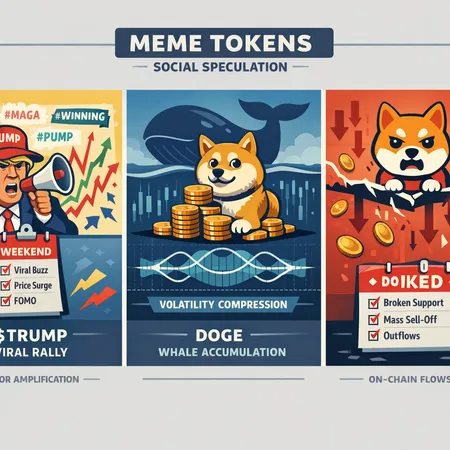
The weekend has become a prime testing ground for meme tokens and social-driven assets. With thinner liquidity and heavier retail social engagement, a single rumor, whale transfer or support break can become amplified into a multi-hour spike or cascade. In this article we compare three archetypes playing out recently: the $TRUMP social-rumor pump, DOGE’s whale accumulation amid volatility compression, and SHIB’s structural support invalidation — then build a pragmatic framework traders and community managers can use to separate social noise from durable on-chain signals.
Anatomy of the $TRUMP meme-rally: rumor, velocity, and social amplification
The $TRUMP move over a recent weekend illustrates how social speculation can produce sharp, short-lived rallies. Reports tied to a sudden health rumor triggered rapid buying; as the rumor circulated on social channels, momentum traders and bots piled in. Coverage of the event captured the pattern: increased chatter → fast inflows → spike → profit-taking once mainstream outlets clarified facts (report on TRUMP jump).
What to notice in real time:
- Exchange orderbooks show sudden, concentrated taker buys rather than slow accumulation. That’s classic retail-driven rush.
- Social velocity metrics (mentions, sentiment spikes) lead price by minutes to hours.
- Liquidity dries up quickly: slippage on DEX swaps and ballooning gas costs during the spike.
Why many such rallies are short-lived: the narrative has no economic anchor. There’s no token sink, utility increase, or sustained on-chain demand prior to the move. When factual clarity arrives, profit-taking and stop-hunts often erase much of the gains within a trading session.
DOGE: whale accumulation and volatility compression as a prelude to a major move
Dogecoin’s weekend pattern looks different. Analysts flagged large-scale accumulation by whale addresses — on the order of hundreds of millions of DOGE — paired with volatility compression, a technical setup that can precede a sustained directional move. Blockonomi’s coverage highlights how whale accumulation and compressed volatility create a market where a breakout has outsized impact (Dogecoin whale accumulation analysis).
Key signals that distinguished DOGE’s setup from pure social pumps:
- Net inflows into large wallets over days to weeks, not minutes.
- Reduced daily range (volatility compression) accompanied by steadily rising on-chain balances in non-exchange wallets — implying accumulation for holding, not immediate flipping.
- Lower exchange sell pressure: if whales move balances off exchanges into self-custody or liquidity pools, available supply for panic selling shrinks.
This pattern can produce either a sustainable rally if accumulation coincides with renewed retail interest and liquidity growth, or a sharp crash if whales decide to distribute into a re-lit social pump. The difference is visible in subsequent on-chain flows and whether liquidity providers add depth rather than withdraw it.
SHIB’s support invalidation: on-chain flows point to deeper downside
Shiba Inu recently invalidated a key 213 billion SHIB support level, a structural break that on-chain watchers interpreted as a bearish signal. Coverage from U.Today and APED captured the same theme: the loss of that support coincided with bearish flows and weakened defensive accumulation (SHIB support invalidation analysis 1, SHIB support flow coverage).
Why support invalidation matters here:
- A support level like 213B is often built on layered buy orders and habitual buy-the-dip retail behavior; once it fails, stop-loss cascades and algorithmic sell triggers accelerate outflows.
- On-chain evidence of stress: higher exchange inflows, rising active-address selling, and decreased holder tenure — all signs that the token is moving from long-term holders into shorter-term hands.
- Liquidity fragmentation: larger sellers tend to route through multiple pools, increasing slippage and widening spreads — which compounds downside when panic sets in.
For SHIB, these flows suggested a higher probability of continued downside until a new accumulation band forms and exchange outflows stabilize.
Reading on-chain flows: practical signals that matter
To distinguish a social pump from a legitimate recovery, focus on these on-chain and market signals together rather than in isolation:
1) Exchange flows and reserve changes
- Net exchange inflows rising = potential sell pressure; net outflows = reduced immediate supply.
- Time the moves: sustained outflows over days imply building buy-side conviction; single-day outflows tied to a rumor are less meaningful.
2) Whale accumulation vs distribution
- Track large transfers to non-exchange addresses and between wallets. Accumulation into self-custody or long-term staking pools indicates buy-and-hold intent.
- Watch for balance concentration increases: more supply in fewer addresses can be bullish if those wallets are dormant; bearish if they begin frequent distributions.
3) Volatility compression and liquidity depth
- Volatility compression (narrowing range, lower ATR) with rising off-exchange balances can presage a big directional move — but not its direction.
- Confirm with on-chain liquidity metrics: are DEX pools deepening or thinning? Is slippage reducing?
4) Active addresses and holder tenure
- Growth in unique active addresses and longer average holder age are healthier signs for a recovery.
- Falling holder tenure and rising exchange balance point toward selling pressure and potential further downside.
5) Narrative vs. fundamentals cross-check
- Social volume spikes should be cross-checked against the above metrics. Rumor-led surges with zero change in liquidity, exchange flows, or whale behavior are typically transient.
A concise trader framework: how to separate pumps from durable recoveries
Apply a simple rule-based checklist before assuming a weekend move is “the start”:
- Confirm directional conviction across at least two on-chain signals within 24–72 hours (exchange outflows + whale accumulation OR rising active addresses + liquidity deepening).
- Check volatility context: if volatility is compressed and whales are accumulating, prepare for a larger move; set entries with stop-sizing for whipsaws.
- Use time-based confirmation: wait for a close above/below a relevant range on the next active session (not just during the weekend’s thin liquidity window).
- Size positions using liquidity: allocate smaller on DEX-only breakouts; scale in only after orderbook depth improves or exchange canonical liquidity increases.
- Event risk hedge: identify the narrative driver (rumor, tweet, news) and plan exit rules tied to narrative correction — e.g., trim if social sentiment reverses by >40% within 48 hours.
Applied to the three cases:
- $TRUMP: most signals pointed to a rumor-driven pump — short size, tight stops, and don’t hold through the next news cycle.
- DOGE: whale accumulation + volatility compression warranted a watch-and-prepare stance; position only after confirmation (exchange outflows or growing DEX liquidity).
- SHIB: after a support invalidation, bias to the downside until new on-chain accumulation appears; avoid averaging down into structural breaks.
Guidance for community managers: how to foster durable recoveries
Community actions matter. If your goal is to reduce volatility and prevent pure social pumps, focus on these constructive steps:
- Encourage liquidity provisioning and incentives that create genuine depth, not just ephemeral AMM farming.
- Promote long-term utility narratives (integrations, NFT/DeFi hooks) and share measurable progress publicly.
- Monitor whale behavior and communicate transparently: clarify when large transfers are treasury moves vs. unknown accumulations.
- Build durable holder incentives (staking, burns, bonding curves) rather than only social-driven hype cycles.
These moves won’t stop rumors, but they change the market’s reaction when a rumor hits: deeper liquidity and genuine on-chain demand blunt sharp selloffs.
Practical takeaways
- Social speculation can move price fast; the deciding question is whether on-chain indicators confirm or contradict the narrative.
- Whale accumulation plus volatility compression (as with DOGE) is materially different from minute-by-minute social pumps (as with $TRUMP).
- Support invalidation (as with SHIB’s 213B level) usually signals structural risk until on-chain flows show renewed accumulation and falling exchange reserves.
Retail traders should combine social monitoring with concrete on-chain checks before committing sizeable capital; community managers should invest in liquidity and utility to shorten the distance between social interest and sustainable token demand. For retail traders using platforms and services, Bitlet.app is one of several tools that can help manage positions across volatile meme markets.
Sources
- https://aped.ai/news/trump-coin-jumps-on-trump-health-rumors?utm_source=snapi
- https://blockonomi.com/dogecoin-doge-whale-buyers-accumulate-500m-coins-as-volatility-compression-points-to-major-move/
- https://u.today/shiba-inu-invalidates-key-price-level-at-213-billion-shib-potential-for-deeper-dive?utm_source=snapi
- https://aped.ai/news/shiba-inu-loses-213b-shib-support?utm_source=snapi
For many traders, Bitcoin remains the primary market bellwether; for token teams, watching trends on DeFi rails often reveals whether a social surge has genuine structural backing.