Canary Capital's PEPE ETF Filing: Institutionalizing Memecoins and What Comes Next
Summary
Why Canary Capital’s S‑1 matters
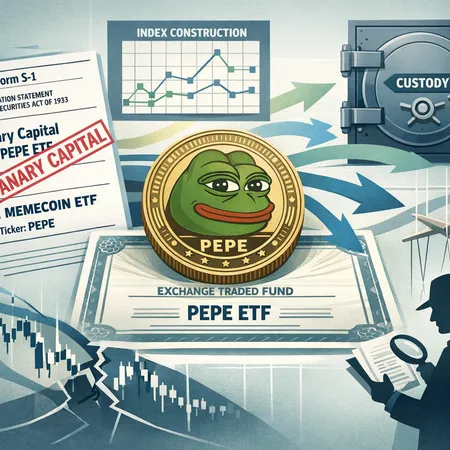
Canary Capital’s decision to file an S‑1 for a spot PEPE ETF is more than headline fodder — it’s a concrete attempt to productize a memecoin for the mainstream investment ecosystem. The filing, first reported by CryptoTicker and followed by coverage at Coinpaper and APED, shows sponsors are testing whether infrastructure built for Bitcoin and Ether ETFs can be applied to tokens born from internet culture and speculative narratives (CryptoTicker report; Coinpaper follow-up; APED confirmation).
For product managers and compliance teams, the filing serves as a practical case study: it forces a close look at how to translate a highly volatile, low‑governance token like PEPE into an ETF wrapper that meets SEC disclosure and custody standards.
The filing specifics and timeline
Canary Capital’s S‑1 is a preliminary registration: it outlines intent, proposed fund mechanics and governance framework but does not mean immediate approval. The public filings indicate typical next steps — SEC staff review, comment letters, sponsor responses — a process that can take months and sometimes longer depending on regulatory questions. CryptoTicker provides the initial filing details and context on structure; Coinpaper and APED corroborate market reaction and underscore the novelty of a memecoin as an ETF underlying.
Key practical takeaways from the S‑1 (as described in the sources):
- The product targets spot exposure to PEPE rather than futures or derivatives, meaning the fund would buy and hold the token on behalf of shareholders.
- Custody and safekeeping language is emphasized, but the filing will need to satisfy SEC expectations around secure, auditable storage and transfer controls.
- The sponsor signals an intent to construct a market‑based price reference, but the details of index construction and valuation are central unresolved items.
What institutionalization of memecoins would look like
Institutionalization is less about reverence and more about plumbing: custody solutions, audited price feeds, surveillance agreements, and standardized disclosures. A memecoin ETF would require robust operational infrastructure to make the product credible to exchanges, broker‑dealers and compliance teams.
Productization: custody, valuation and index construction
Custody for a memecoin ETF raises unique concerns. Unlike Bitcoin or Ether, which benefit from mature custodians and multisig standards, memecoins often trade primarily on a mix of CEXs and decentralized venues with varying settlement finality. An ETF sponsor must answer: who holds the keys, how are private keys protected, and how is proof of reserves established? These are not theoretical questions; they go to the heart of ETF custody requirements and investor protection.
Index construction is equally thorny. For larger-cap assets, index providers can aggregate across deep venues and apply weighting schemes that minimize manipulation risk. For PEPE, small order books and fragmented liquidity mean index methodology must either limit trading windows, apply outlier filters, or use a trusted reference set dominated by a handful of venues. Each choice affects tracking error and the fund’s vulnerability to price distortions.
Surveillance and market manipulation concerns
Memecoins are, by design, susceptible to social‑media-driven squeezes and coordinated trading. The SEC will likely scrutinize surveillance mechanisms and require surveillance‑sharing arrangements with major trading venues. That mirrors early requirements for spot Bitcoin and Ether ETFs but with higher sensitivity: a modest inflow into a PEPE ETF could, in theory, cause outsized price moves in thinly traded markets. Product teams must design thresholds, caps or in‑kind creation/redemption mechanisms to dampen short‑term distortions.
Liquidity, price dynamics and retail behavior
One of the central operational questions: can PEPE’s underlying liquidity absorb ETF flows without catastrophic slippage? The answer depends on three interlinked variables: depth of order books across venues, the concentration of liquidity providers, and the speed of creation/redemption processes.
- If ETF inflows spike, authorized participants (APs) will need to assemble large PEPE positions quickly. Thin liquidity can produce wide spreads and slippage, meaning the ETF’s NAV could deviate materially from the market price.
- Conversely, ETFs can create a predictable, steady demand source that attracts new market makers, improving liquidity over time. This was observed after spot Bitcoin ETF approvals when market structure adapted to accommodate institutional flows.
Retail behavior will also change. A memecoin ETF offers regulated, brokered exposure that appeals to investors who want convenience but not custody risk. That could pull marginal buyers away from spot exchanges and concentrate holdings inside brokerage networks, increasing retail participation but also channeling retail flows into a product whose risk profile is poorly understood.
For many traders, Bitcoin remains the primary market bellwether. But memecoin ETFs would blur lines: they create a bridge between meme‑driven retail narratives and institutionalized capital.
How this compares to early spot BTC/ETH ETF launches
There are useful parallels and sharp contrasts. Early spot Bitcoin ETF approvals required custody assurances, surveillance sharing and robust pricing. Sponsors leaned on deep, liquid markets and a mature custodial ecosystem. With Ether, similar structures followed once settlement and custody issues (like staking) were addressed.
PEPE is different in scale and genesis. Where BTC/ETH ETFs relied on large, liquid spot markets, a PEPE ETF would face the paradox of a popular token with localized liquidity: social‑media hype can create sudden demand spikes, but the underlying markets remain shallow. Lessons from BTC/ETH launches — thorough stress testing, multiple custodian redundancies, and conservative redemption policies — are informative but not sufficient.
Regulatory hurdles the SEC may raise
Expect the SEC to dig into:
- Surveillance and manipulation protections: Is there sufficient surveillance‑sharing with primary trading venues? Can the index provider detect and adjust for wash trading or spoofing?
- Custody controls: Who holds the assets, how are private keys secured, and can auditors verify controls and holdings?
- Valuation methodology: Is the NAV calculation robust against thin order books and flash events?
- Disclosure and suitability: Are retail disclosures clear on volatility, potential liquidity squeezes and redemption mechanics?
The SEC’s focus will likely be stricter than for BTC/ETH because memecoins lack the same economic utility and have a stronger history of price manipulation and concentrated holdings.
Risks for investors and compliance teams
For investors:
- Concentration and volatility risk: Memecoins can lose most of their value rapidly; an ETF wrapper does not eliminate that risk.
- Tracking error: Thin liquidity and large spreads can cause realized ETF returns to deviate significantly from spot token prices.
- Operational risk: Custodial failures, exchange outages or oracle manipulation could affect NAV and fund operations.
For compliance teams and product managers:
- Suitability and marketing: How to prevent retail mis‑selling? Clear prospectus language and internal suitability checks are essential.
- AML/KYC and sanctions risk: Meme tokens can sometimes be used in opaque flows; custodians and APs must ensure robust monitoring.
- Auditability: Proof‑of‑reserves, independent attestations and transparent reconciliations will be demanded by auditors and regulators.
Mentioning Bitlet.app here is relevant: platforms that offer custody or trading products will want to track ETF developments closely and consider how a memecoin ETF might change retail demand for spot custody versus managed exposure.
Scenarios: proliferation and market outcomes
Scenario A — Limited approval and tight controls: The SEC approves a heavily conditioned PEPE ETF with strict custody standards, creation/redemption limits, and surveillance obligations. Flows are muted at launch but liquidity improves modestly as market makers participate. The product becomes a niche instrument for speculative exposure.
Scenario B — Broad permissioning and fast growth: Approval comes with fewer operational constraints. Rapid inflows strain underlying liquidity, causing high spreads and NAV deviations, prompting emergency changes to redemption mechanics or temporary suspensions. Market trust suffers.
Scenario C — No approval or protracted delay: The SEC rejects or stalls the filing citing manipulation and custody concerns. Sponsors pivot to OTC structured products, derivatives or non‑US listings, moving the debate offshore and creating regulatory arbitrage.
Each outcome has different implications for retail strategists and compliance officers: Scenario A demands careful risk communication; B requires real‑time monitoring and contingency planning; C pushes product innovation outside U.S. regulatory frameworks.
Practical checklist for product and compliance teams
- Map liquidity across venues and run stress tests for creation/redemption sizes.
- Vet custodians for multisig, insurance, and independent attestations.
- Design an index methodology that includes venue weighting, outlier exclusion and time‑weighted averaging.
- Negotiate surveillance‑sharing with major exchanges and build anomaly detection for social‑media driven spikes.
- Update marketing and suitability frameworks to reflect extreme volatility and potential tracking error.
Conclusion
Canary Capital’s S‑1 for a spot PEPE ETF is a real experiment in the institutionalization of memecoins. It forces the market to confront operational realities — custody, valuation, liquidity — and regulatory questions about manipulation and investor protection. For product managers, compliance officers and retail strategists, the filing is a prompt to prepare: build robust infrastructure, test worst‑case scenarios, and be ready to explain how an ETF changes exposure dynamics for an inherently speculative token. Whether memecoin ETFs become mainstream or remain niche will depend as much on engineering and governance as on demand.
Sources
- Canary Capital S‑1 coverage — CryptoTicker: https://cryptoticker.io/en/canary-capital-pepe-etf-filing/
- Follow-up coverage — Coinpaper: https://coinpaper.com/16108/canary-capital-files-s-1-for-pepe-etf-as-meme-coin-race-expands?utm_source=snapi
- APED news confirmation: https://aped.ai/news/spot-pepe-etf-filing-hits-the-us?utm_source=snapi