April 1 Spot Bitcoin ETF Flows: Grayscale Mini Trust Inflows Amid $173.7M Outflows
Summary
Executive snapshot
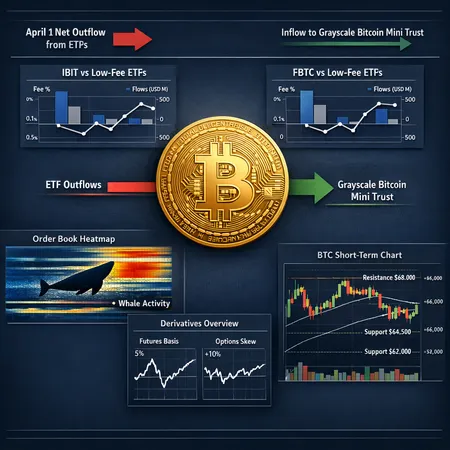
On April 1, U.S. spot Bitcoin ETF complexes reported a combined net outflow of about $173.73 million across 12 spot products, a figure corroborated by multiple flow trackers. At the same time, fee-structured vehicles such as the Grayscale Bitcoin Mini Trust attracted net inflows, an important contrast that reveals how product design and buyer type can diverge from headline ETF flow numbers. For institutional readers, the key questions are: how do these flows transmit into spot liquidity and derivatives pricing, and what execution and hedging tactics minimize slippage and basis risk?
For many market participants, Bitcoin ETF flows have become a near-real-time gauge of institutional demand. But the mechanics behind those numbers — creations, redemptions, share discounts/premiums, and AP behavior — matter more than the headline alone.
April 1 flow snapshot: the data and what it implies
Multiple independent trackers recorded the same April 1 net outflow figure. Crypto Economy reported the -$173.73M aggregate outflow while noting inflows to specific fee-structured trusts, and TokenPost published a corroborating flow report showing the same total across 12 spot ETFs. These sources give us both confidence in the number and a starting point for causal analysis (Crypto Economy, TokenPost).
Price action that day also matters: Bitcoin was testing major technical resistance levels, which frames whether flows were absorptive or additive to price pressure — a point explored in technical commentary from CoinPaper that links flow-driven liquidity to short-term price tests (CoinPaper).
How ETF flow mechanics translate to spot liquidity
Understanding creation/redemption mechanics is essential for institutions interpreting ETF flows:
- Authorized Participants (APs) create ETF shares by delivering spot BTC (or cash, depending on the product) to the issuer, or redeem shares in exchange for BTC. The net of these actions is the source or sink of actual spot BTC demand.
- When there are net creations, APs must buy spot BTC — supporting spot liquidity and tightening the basis between spot and ETF markets. Net redemptions, conversely, lead to APs selling BTC, pressuring spot liquidity.
- Not all ETF flows equal immediate spot flows. Some APs source inventory through OTC desks or previously hedged positions rather than stepping into the open market, and many ETF structures allow cash creations/redemptions that route execution differently.
Crucially, product structure determines execution flow: low-fee, physical spot ETFs typically operate as straightforward spot-for-share creations, whereas legacy or fee-structured trusts can trade at discounts/premiums, prompting arbitrage paths that don't always involve immediate spot transactions.
Why fee-structured products like the Grayscale Mini Trust still saw inflows
On the face of it, higher-fee products should be at a disadvantage versus low-fee spot ETFs like IBIT or FBTC. But inflows into the Grayscale Bitcoin Mini Trust on April 1 highlight several nuanced drivers:
- Buyer profile: fee-insensitive buyers (tax-motivated sellers, smaller allocators, or certain OTC counterparties) may prioritize immediate exposure size or settlement terms over fee drag.
- Structural arbitrage: legacy trusts can trade at a discount/premium to NAV. Some investors buy the trust when they expect the discount to narrow (a pure instrument-level trade), rather than buying spot BTC itself.
- Access and routing: certain platforms and custodians still offer easier routing into legacy trusts for retail or specific institutional programs, creating pockets of demand even while mainstream ETFs see outflows.
These dynamics mean that inflows into the Grayscale Mini Trust are not a contradiction to ETF outflows — they are a different channel of demand, often reflecting product-specific intent rather than broad market conviction.
Short-term tactical implications for spot liquidity and derivatives
ETF outflows of the April 1 magnitude are meaningful for short-term liquidity, but the transmission depends on who executes the redemptions and where they source liquidity.
- Spot liquidity: if APs fulfill redemptions by selling into exchanges, expect increased spread widening and slippage for block-sizes. If they use OTC desks or existing inventory, the market impact may be muted.
- Futures and perpetuals basis: net selling into spot tends to widen the negative basis (spot below futures) if liquidity is absorbed unevenly. Conversely, inflows supportive of spot tighten basis and can force shorts to cover.
- Funding rates and options skew: sustained outflows that increase spot supply pressure can create negative funding in perpetual swaps and push option implied vols higher on the downside. Rapid, concentrated redemptions by a few large holders (whales) can spike short-term vega and gamma demand from options market makers.
So, for allocators watching ETF flow prints, it’s as important to read who is moving (APs, retail, whales) and how they execute as to the absolute dollar figure.
Comparative analysis: IBIT/FBTC vs low-fee alternatives
IBIT and FBTC became reference names for low-fee, ETF-native spot products. The trade-offs versus fee-structured trusts:
- Fee drag: IBIT/FBTC typically offer lower ongoing fees, advantaging long-horizon allocators from a total-cost-of-ownership perspective.
- Liquidity sourcing: large block demand into IBIT/FBTC is more likely to be matched with creation/redemption mechanics that involve spot buys/sells — cleaner transmission to spot markets. Fee-structured trusts can attract flows that are more instrument-specific and routed through secondary-market trades.
- Execution risk: low-fee ETFs may concentrate AP activity across fewer counterparties initially, creating temporary execution bottlenecks at moments of stress. Legacy trusts, trading active secondary market volume, can sometimes absorb large retail flows with less direct spot footprint — but they also carry discount/premium risk.
Net: IBIT/FBTC-style products are generally better for large, passive allocations seeking minimal basis complexity. Fee-structured trusts can suit tactical, shorter-term, or structure-driven trades, but carry additional execution and NAV mismatch risk.
Trading strategies for institutions and allocators facing outflows
Here are actionable approaches to manage exposure, minimize cost, and hedge execution risk when ETF flows show outflows:
- Pre-trade analysis: monitor ETF AP inventory signals, exchange holdings, and flow trackers. If flows point to potential spot selling, schedule execution windows outside thin market hours.
- Execution tactics: use VWAP/TWAP algos, slice large blocks, and leverage crossing networks or committed liquidity providers to reduce market impact. For very large tickets, coordinate with APs or use block trades routed via venues that settle into ETF creation/redemption chains.
- Hedging via futures/perpetuals: short futures or use perp contracts to neutralize interim directional exposure until you can execute a low-cost spot trade. Watch the basis — covering hedges too quickly can realize slippage.
- Options to manage convexity: buy puts or put spreads to cap downside while maintaining upside participation if you expect ephemeral outflows to pressure spot but not change long-term allocation views.
- Use OTC desks selectively: when ETF redemptions are large, OTC liquidity pools can provide anonymity and reduce signalling risk, though they come with counterparty and protocol risk that must be managed.
Institutions should also consider the operational path: custody, settlement timelines, and whether a product supports in-kind redemptions — these details materially affect execution cost.
Scenarios and risk-aware trade ideas
- Scenario A — transient outflow: outflows driven by short-term profit-taking create temporary spot pressure. Tactical idea: buy downside protection (puts) and layer buys into increased volatility via algos.
- Scenario B — structural weakness: sustained outflows tied to macro stress widen basis and create attractive carry in futures. Tactical idea: build exposure via cheap long-dated futures or structured note, avoid large outright spot buys until funding normalizes.
- Scenario C — concentrated whale selling: localized liquidity holes. Tactical idea: use OTC block trades coordinated with APs to source liquidity without moving spot order books.
Conclusion: read flows, then read structure
ETF flow headlines like the April 1 -$173.73M print are useful market telemetry, but they’re only half the story. Product mechanics, AP behavior, and who executes — not just the dollar figure — determine whether flows translate into spot selling, basis moves, or merely instrument-level repositioning. Fee-structured vehicles such as the Grayscale Bitcoin Mini Trust can attract buyers for reasons orthogonal to low-fee ETF demand, and that segmentation creates both opportunities and execution risks for allocators.
For institutions, the playbook is clear: combine flow monitoring with pre-trade liquidity analysis, selective use of derivatives for interim hedging, and execution strategies (OTC, block trades, algos) tuned to the product structure. These are the tools that turn raw ETF flow data into actionable trade decisions.
Bitlet.app users tracking institutional demand and execution cost will find that marrying flow data to execution strategy is the most reliable way to convert headlines into better performance.
Sources
- Grayscale Bitcoin Mini Trust leads ETF inflows (Crypto Economy): https://crypto-economy.com/grayscale-bitcoin-mini-trust-leads-etf-inflows/
- Independent flow report corroborating -$173.73M (TokenPost): https://www.tokenpost.com/news/insights/19527
- Technical take on BTC testing major resistance (CoinPaper): https://coinpaper.com/15938/bitcoin-price-prediction-btc-tests-major-resistance-as-support-holds-below?utm_source=snapi