How Aster’s 97% Emission Cut Rewrites DEX Tokenomics: Staking, Liquidity, and What Comes Next
Summary
Why Aster’s cut matters now
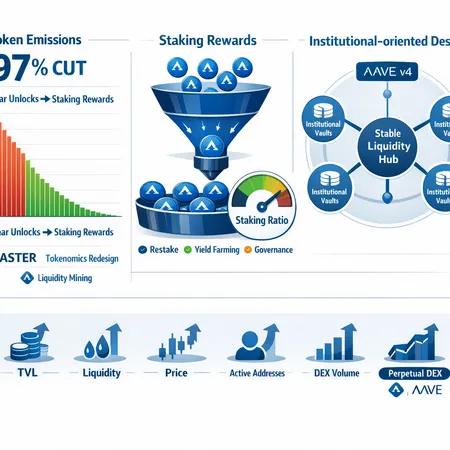
In late March 2026 Aster announced a dramatic policy shift: a roughly 97% reduction in monthly token emissions and a pivot from a linear unlock schedule toward a staking-based reward model. That magnitude of cut is rare in live DeFi token systems and serves as a natural experiment in how combatting token emissions and reshaping staking rewards impacts a perpetual DEX’s economics.
This article unpacks the mechanics of Aster’s change, models the on-chain effects you should expect on liquidity, TVL, and price, and contrasts Aster’s incentive-first playbook with institutional-minded architectures like Aave v4’s hub-and-spoke. It finishes with concrete strategies for token holders and a monitoring framework product teams can use to evaluate success.
The mechanics: from linear unlocks to staking rewards
Before the redesign, Aster distributed tokens on a relatively steady cadence: linear unlocks and active liquidity mining programs that funneled newly minted ASTER into pools to bootstrap volume and market-making. Those allocations created predictable, recurring sell-side pressure as recipients sold or rebalanced.
Under the new model, summarized in reporting on the change, monthly emissions are cut by ~97% and the protocol redirects a material share of remaining emissions into staking-based rewards that are claimable only by locked/staked ASTER holders. The public rationale: slow supply inflation, reduce immediate selling, and create an incentive for long-duration capital to support order books and perpetual liquidity.
Mechanically this involves a few shifts:
- Supply-side shock: monthly newly-minted ASTER drops sharply, reducing the flow of fresh tokens reaching exchanges.
- Time-value reorientation: rewards are now conditioned on lockups/staking — shorter-term arbitrage is less attractive relative to committed staking yields.
- Governance coupling: staking becomes the primary on-chain signal for governance weight, increasing the power of committed holders and tying protocol direction to long-term participants.
For readers who want the contemporary reporting, see the coverage of the emission cut and staking shift here: Aster cuts token emissions by ~97% and moves to staking rewards.
Expected on-chain effects: liquidity, TVL, and price (short and medium term)
Short-term dynamics (0–6 weeks)
- Volatility spike around the announcement. Large holders will rebalance; some will sell. But because future emissions are lower, the persistent downward pressure should ease quickly.
- Temporary liquidity migration. If mining rewards were a material component of AMM or orderbook incentives, some liquidity providers (LPs) may withdraw while they re-evaluate returns.
Medium-term dynamics (1–6 months)
- Rising staking ratio. As staking rewards become the dominant yield source, rational actors seeking protocol rewards will stake, raising the staked supply / circulating supply ratio — a key metric to watch.
- TVL reconfiguration. Total Value Locked may fall initially as marginal LPs exit, then stabilize or grow if the remaining liquidity is deeper and less transient. TVL quality arguably improves: more committed liquidity and narrower effective free-float.
- Price discovery changes. With materially lower issuance, supply-driven sell pressure softens and price tends to be more sensitive to demand-side drivers (trading volume, derivatives usage, and protocol revenue).
Long-term dynamics (>6 months)
- Healthier tokenomics if staking yields are sustainable. When emissions are scarce, the protocol can offer higher real yields to compliant stakers without printing supply — if rewards are funded by protocol revenue (trading fees, funding payments) a virtuous cycle can emerge.
- Governance consolidation risk. If staking rewards favor large lockups, governance could centralize. Product teams must balance incentives to avoid plutocracy.
Across these horizons, metrics like active addresses, DEX volume per locked ASTER, and net token flow to exchanges will tell the story faster than headline TVL alone.
How Aster’s redesign compares with institutional architectures like Aave v4
Aster’s change targets growth-first tokenomics — high emissions to bootstrap activity, then a sharp cut to convert that activity into committed capital. Contrast that with the institutional-minded design Aave is formalizing with its v4 hub-and-spoke model, which optimizes for stable, composable liquidity across chains and counterparty-safe flows.
- Aster: emission-driven user acquisition, liquidity mining to bootstrap orderbooks, then staking to retain committed liquidity.
- AAVE (Aave v4): architected as a hub-and-spoke to route institutional liquidity, prioritizing custodial integrations, capital efficiency, and predictable liquidity provisioning rather than aggressive token incentives.
For product teams the distinction is clear: aggressive emissions accelerate network effects and acquisition, but at the cost of cyclical sell pressure and unstable TVL. Institutional designs like Aave v4 trade faster organic growth for higher liquidity quality and predictable counterparties, which can be more attractive to large capital allocators. (See analysis of Aave v4’s hub-and-spoke architecture here: Aave v4 launch — hub-and-spoke, institutional DeFi liquidity.)
Both approaches are defensible; they simply target different user segments and timelines. Aster is betting that a near-term emission shock followed by sustained staking rewards will flip marginal, short-term users into committed liquidity providers. Aave is designing for institutional rails that value stability over rapid token-driven expansion.
Token-holder playbook: restaking, yield farming, and governance tactics
For ASTER holders and DeFi investors, the change opens explicit strategy paths — each with trade-offs.
- Stake for yield and governance weight
- Primary move: stake ASTER to access the new staking rewards. With emissions slashed, reward rates per staked token could be attractive if fewer holders stake.
- Governance leverage: staking ties voting power to committed capital. Active governance participation can help defend against undesirable parameter changes.
- Restake and liquidity double-dipping (selective)
- Look for sanctioned dual-reward strategies (stake + LP) if the protocol supports vesting or boosted rewards for LP-stakers. These can increase effective yields but add impermanent loss risk on AMMs and counterparty risk on orderbooks.
- Yield farming across ecosystems
- With lower native emissions, cross-protocol yield chasing may return: holders might shift to farms that offer boosted ASTER rewards or synthetics. Product teams should watch for TVL leakage to third-party farms.
- Short-term traders vs long-term holders
- Traders seeking immediate alpha will be less rewarded as emissions fall; the new regime favors longer time horizons. That changes the holder composition and can improve price stability.
Risk management reminders
- Evaluate lockup durations versus expected reward APY. Long lockups give governance power but reduce liquidity optionality.
- Monitor centralization signals: if a small cohort accrues disproportionate staking rewards, the governance risk rises.
Metrics to track post-cut: what matters and how to measure it
Product managers and token investors should instrument both supply-side and demand-side KPIs. Key metrics include:
- Staking ratio (staked ASTER / circulating supply): a rising ratio indicates decreased free-float and increased commitment.
- Active unique addresses interacting with the DEX: measure retention and new-user flows.
- DEX Volume and fee revenue: are trades and fee capture standing on their own without emissions-induced volume?
- Net flows to exchanges (on-chain exchange inflows minus outflows): persistent inflows post-cut signal unresolved sell pressure.
- TVL composition: percent of TVL from staked ASTER, AMM pools, and margin/funding collateral.
- Average staking duration and unstake requests: early signs of unstaking waves.
- Price/realized issuance correlation: track how much price moves per unit of net new supply.
Operational thresholds (example):
- If staking ratio falls below X% while exchange inflows exceed Y tokens/day for two consecutive weeks, consider tactical reintroduction of temporary boosts or revenue-sharing to stabilize.
- If DEX fee revenue covers >Z% of previously paid emissions for stakers, the model approaches sustainability.
Visual dashboards should correlate staking ratio with DEX volume, TVL split, and exchange inflows to surface causal relationships quickly.
Practical governance and product moves to smooth the transition
- Introduce staged boosts: small, time-limited staking boosts can reduce sell pressure while testing long-term parameters.
- Revenue routing: consider diverting a portion of protocol fees to stakers to reduce reliance on minted emissions.
- Anti-sybil measures: tiered rewards or minimum lock durations can prevent short-term actors from farming the staking program.
- Transparency and communication: publish expected emission curves and reward math; uncertainty is a liquidity killer.
Takeaways for DeFi managers and investors
- Radical emission cuts like Aster’s are a blunt but effective lever to reduce sell pressure and force a transition from growth-by-inflation to growth-by-utility.
- Expect short-term turbulence, but watch the staking ratio and exchange flows: these will signal whether the redesign is being internalized by the market.
- Compare designs to your goals: if you want stable, institutional liquidity, the hub-and-spoke model exemplified by Aave v4 is instructive; if you want to convert user growth into committed capital quickly, emission shocks plus staking can work, but governance and centralization risk rises.
For product teams building or managing perpetual DEXes, this is a live case study in balancing acquisition and durability. Investors should monitor the KPIs above and consider restaking and governance engagement as primary levers. And for those building tools and dashboards, integrate signals from staking contracts, exchange flows, and fee revenue into an early-warning system.
Bitlet.app users and other ecosystem participants will find the evolving ASTER experiment instructive when designing tokenomics or evaluating perpetual DEX exposures.
Sources
- Aster cuts token emissions by ~97% and moves to staking rewards: https://invezz.com/news/2026/03/31/aster-cuts-token-emissions-by-97-can-aster-price-rally-next/?utm_source=snapi
- Aave v4 launch — hub-and-spoke, institutional DeFi liquidity: https://dailycoin.com/aave-v4-launch-ethereum-hub-spoke-institutional-defi-lending/