BlackRock’s Aggressive ETH Staking: Risks, Rewards, and What ETHB Means for Investors
Summary
Why BlackRock’s ETHB stance matters
BlackRock’s move to keep most ETH staked inside an ETHB-style wrapper is more than product design — it’s a structural shift in how institutional capital will farm staking rewards. Unlike a passive spot ETF that simply holds liquid ETH, a staking ETF turns on yield as a core feature. That can be attractive: staking rewards are effectively additional yield on top of price appreciation for ETH holders. But it also creates an opaque middle layer between the investor and the underlying asset.
For many traders and allocators, Ethereum remains the primary smart-contract market bellwether. When a large custodian elects to stake at scale, it changes the supply dynamics and governance exposure of the network in measurable ways.
Mechanics: custody vs staking, ETHB issuance and unbonding timing
At a basic level there are two custody models: custodial spot custody (holding liquid ETH) and custodial staking (locking ETH into validators or a staking pool). A staking ETF using ETHB-like instruments typically keeps ETH in validator sets or derivative-wrappers while issuing a transferable share representing stake exposure.
Key practical mechanics investors must understand:
- Custody vs staking: With custodial staking, the asset manager (and its custodian) controls validator keys or delegates to a staking provider; investors hold ETF shares rather than direct validator keys. That is different from running your own node or using a self-custody staking service.
- ETHB wrapper behavior: ETHB acts as a liquid staking claim on staked ETH. It accrues value from staking rewards, but it can carry frictions on redemption. BlackRock’s plan to keep most ETH staked means ETF units will largely reflect staked exposure rather than immediately redeemable ETH Cryptoslate analysis of the product shows an aggressive staking posture.
- Unbonding / exit timelines: When you unstake ETH on-chain, there’s an unbonding delay (the unbonding queue and protocol timing). For large institutional products, exits can take weeks depending on queueing and product design. Reporting suggests ETHB exits could take weeks and are not instantaneous, which matters for ETF liquidity and redemption mechanics BlackRock and Coinbase to skim portion of staking rewards, and ETHB exits could take weeks.
The fee economics: the announced Coinbase/BlackRock split and the ~18% skim
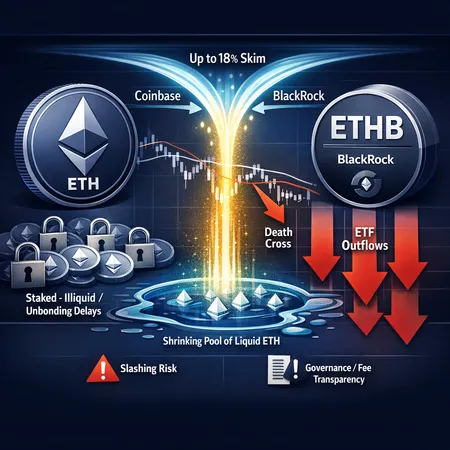
One of the headline items is the announced reward split between BlackRock and Coinbase. According to reporting, the product structure would allow service providers to capture a portion of staking rewards — a figure that could be roughly 18% in aggregate under certain terms. That changes straightforward yield math: instead of receiving gross staking yields, ETF investors receive net yield after platform and service fees are deducted.
Think of it this way: gross staking rewards might be X% annually, but after an 18% service share and any management fee, the net to the investor could be materially lower. For institutions that price investments based on net yield and counterparty risk, an 18% skim is non-trivial and should be modeled explicitly when forecasting returns Cryptoslate reported the potential split and timing concerns.
Concentrated staking, ETF liquidity and visible market effects
When large ETFs concentrate staking, two linked risks need attention:
- Reduced liquid supply: Staked ETH is less immediately available in spot markets, which can amplify price moves when large sellers need liquidity. A concentrated staking book held by a few custodians effectively reduces circulating float.
- Redemption friction: ETF redemption requests that translate into on-chain unstakes can create lags, which markets price in as liquidity risk. If many holders rush to redeem simultaneously, exits may be queued and executed over weeks, causing price dislocations.
The net effect: concentrated staking can make ETH price action more sensitive to flows. If ETF inflows add to staking demand, that can tighten available spot supply and support price. Conversely, ETF outflows — especially in a market already under pressure — could force delayed unstakes and cause cascaded selling once liquidity becomes available.
Technical market context: death cross, ETF outflows and options positioning
From a price-technical angle, Ethereum has shown vulnerabilities recently. A weekly death cross (where the shorter-term moving average crosses below the longer-term one) is a bearish signal noted in market coverage and coincides with extended ETF outflows in recent months — a combination that compounds downside risk as sentiment weakens and liquidity leaves the market Crypto.news covered the death cross amid ETF outflows.
Options and derivatives positioning matter too. Traders eyeing critical option strikes — for example near $1,500 — may create asymmetric payoff structures that amplify volatility around those levels. Analysts have pointed out that rebounds can stall at psychological and technical barriers (near $1,990 in one forecast), while downside options interest near $1,500 can act as a magnet for volatility if price tests those zones Coinpaper discusses ETH price behavior and options positioning.
For institutional-grade allocations, the interaction between product-driven staking flows and market technicals means position sizing and liquidity planning must account for both gradual unbonding and abrupt market stress.
Slashing risk, governance exposure and transparency concerns
Staking is not just yield — it carries protocol-level risks.
- Slashing risk: Validators can be penalized for double-signing or extended downtime. When staking is managed by custodians, slashing exposure is typically pooled and may be insured or absorbed by the provider, but that’s not guaranteed. Investors need clear contract terms about who bears slashing losses and how they are provisioned.
- Governance rights: Holding an ETF share rarely confers direct governance voting. Large custodial staking pools that aggregate voting power can shape protocol decisions indirectly. Concentration of stake across a few custodians changes the effective governance landscape of Ethereum; investors should understand whether their product passes votes through or reclaims them.
- Fee and reward transparency: An 18% split highlights the need for transparent reward accounting — gross vs net yields, timing of accruals, and the mechanics of how rewards are distributed or used to cover service fees.
Investor hygiene checklist for staking ETFs
Before allocating to a staking ETF, institutions and advanced retail should demand answers and model scenarios. Ask for:
- Clear net yield projections: Show gross staking yield, all service/management fees, and the investor’s net yield under base and stressed scenarios.
- Redemption mechanics: Explain how redemptions map to on-chain unstakes, estimated timing under normal and stressed outflows, and whether in-kind redemptions are possible.
- Slashing and operational risk allocation: Who eats slashing losses? Is there an insurance buffer? How are downtime events handled?
- Governance policy: Does the ETF vote? If so, how are voting decisions made and who sets policy?
- Fee waterfall transparency: Provide historical or modeled examples of reward splits (e.g., the announced Coinbase/BlackRock split) and how they were applied.
These are practical, portfolio-level concerns. A product that poorly discloses any of the above should be treated cautiously.
Bottom line: a yield-forward product, not a pure spot play
Staking ETFs — particularly ones structured to keep most ETH staked via ETHB — are hybrid instruments. They combine custody, yield farming and limited liquidity. That can be attractive for allocators seeking yield-enhanced ETH exposure, but the trade-offs are real: fee skims (the reported ~18% example), delayed unbonding, slashing and governance concentration.
If you’re considering allocation, model net returns, stress-test liquidity timelines, and insist on contractual clarity. Remember that market technicals — like the recent death cross and ongoing ETF outflows — can magnify the liquidity premium or penalty associated with concentrated staking.
Finally, keep operational options open: self-custody staking on a node, diversified custodial providers, or a mix of spot ETH and staking ETFs can help balance immediate liquidity against yield. Platforms and marketplaces that facilitate fractional exposure — including services like Bitlet.app — may simplify execution, but they don’t replace the need for rigorous due diligence.
Sources
- Cryptoslate — BlackRock’s Ethereum ETF aims for aggressive staking: https://cryptoslate.com/blackrocks-ethereum-etf-aims-for-aggressive-staking/
- Cryptoslate — BlackRock and Coinbase to skim 18% of staked Ethereum ETF rewards and ETHB exits could take weeks: https://cryptoslate.com/blackrock-and-coinbase-to-skim-18-of-staked-ethereum-etf-rewards-and-ethb-exits-could-take-weeks/
- Crypto.news — Ethereum price forms death cross as ETF outflows extend into fourth month: https://crypto.news/ethereum-price-forms-death-cross-as-etf-outflows-extend-into-fourth-month-will-it-crash/
- Coinpaper — Ethereum price prediction; options strikes and rebound behavior: https://coinpaper.com/14709/ethereum-price-prediction-eth-rebound-stalls-near-1-990-as-bears-watch-1-500-options-strike?utm_source=snapi