Why Aave Is Folding Avara and Shutting Down the Family Wallet: Governance, MiCA, and DeFi Consolidation
Summary
Executive snapshot
Aave's move to wind down the Family wallet and fold the Avara brand into Aave Labs is a textbook example of how governance disputes and regulatory risk can push a protocol toward product consolidation. Public reporting framed the decision as both a reaction to internal governance strife and a pragmatic attempt to simplify the project's compliance and operational footprint—actions that will affect the project's product roadmap and how the market perceives AAVE. For DeFi product managers and governance participants, this is not just news: it's a practical case study in trade-offs between experimentation and institutional safety.
What happened: timeline and immediate decision
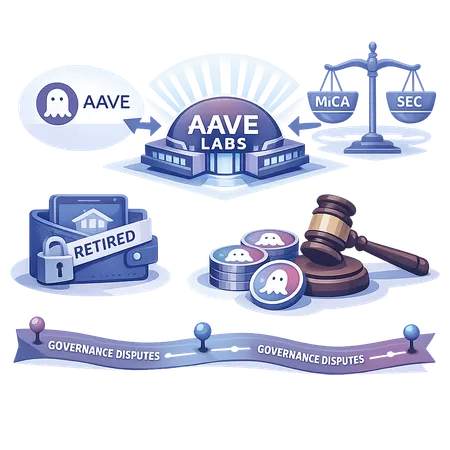
The public story is straightforward: Aave announced it will wind down the Family wallet and retire the Avara brand, bringing those efforts under the Aave Labs umbrella. Reports indicate this followed months of governance debates and mounting regulatory questions about how separate consumer-facing brands fit within the broader Aave ecosystem. The decision was framed as consolidation into a single, better-aligned operational and legal home.
From launch to wind-down — sequence and signals
- Avara and the Family wallet emerged as a consumer-facing product path that was intentionally distinct from the core Aave protocol and its governance. That separation can create space for consumer UX experiments but also for ambiguous accountability.
- Over time, a mixture of community governance pushback and regulatory concerns surfaced in public discussions and votes. Governance participants raised questions about the proper oversight, legal footprint, and risk exposure of a branded consumer wallet tied to the Aave ecosystem.
- Facing those friction points, Aave leadership and constituent stakeholders opted to fold Avara into Aave Labs and retire the Family wallet to reduce brand fragmentation and centralize decision-making and compliance. Crypto news outlets captured this development and its rationale in detail here and in follow-up analysis here.
The precise sequence included governance debates that highlighted differences in philosophy about how far the protocol should let separate teams diverge from core goals, and at what point legal clarity should trump product experiments.
Governance frictions: what the debates revealed
At its core, this episode was less about one product feature and more about governance mechanics and accountability.
Fragmented ownership creates ambiguity. When a product carries a separate brand or operates under a distinct legal wrapper, it can be unclear whether on-chain governance, off-chain teams, or independent entities are responsible for compliance, user protection, and incident response. That ambiguity invites dispute.
Token-holder expectations colliding with go-to-market choices. AAVE token holders and governance participants have different risk tolerances. Some want aggressive user-growth experiments; others prioritize protocol integrity and regulatory defensibility. Those differences played out in public governance conversations.
Signal-to-noise in on-chain governance. When votes and discussions focus on organizational identity as much as on technical upgrades, decision-making slows and factionalism can intensify. The Family wallet/Avara thread exposed how governance structures can be taxed by brand-proliferation questions.
For readers tracking protocol governance, this is a reminder that product launches are governance events: they reshape incentives, voting calculus, and community trust.
Regulatory context: why MiCA and the SEC matter here
Two regulatory realities framed the choice to consolidate: clearer, but still partial, EU rules (MiCA), and an active US enforcement environment led by the SEC.
MiCA (Markets in Crypto-Assets) gives EU-based projects a far clearer set of obligations for certain crypto services. That regulatory clarity is helpful, but compliance takes operational work: KYC/AML, custody rules, and consumer protections require concentrated legal responsibility, which is easier to manage when consumer brands are not scattered across multiple semi-autonomous entities.
The SEC's posture in the US remains enforcement-forward and uncertain for many tokenized services. Separate consumer-facing brands tied to a protocol can magnify regulatory scrutiny because they increase the number of touchpoints where a regulator can construe securities- or investment-contract-like behavior.
In short: fragmentation increases regulatory surface area. Consolidation under a single engineering and legal vehicle—Aave Labs—reduces ambiguous legal exposure and centralizes compliance workflows. Reporting on the shutdown specifically cited regulatory headwinds as part of the rationale for folding Avara into the central organization, reflecting how compliance calculations are now an integral part of product strategy in DeFi. See the reporting that covers the regulatory and governance aspects in tandem here and the announcement analysis here.
How consolidation reshapes Aave's product roadmap and DeFi positioning
Consolidation has concrete, near-term effects for product delivery, adoption, and how the market reads AAVE.
Faster integration and roadmap clarity. With Avara folded under Aave Labs, feature sets originally split between teams can be re-prioritized and integrated into a single roadmap with clearer dependencies. PMs can accelerate cross-cutting work (e.g., wallet integrations, lending UX improvements) without reconciling inconsistent brand promises.
Centralized accountability for compliance. Legal and compliance teams can set unified standards for KYC, user disclosures, and security practices across all consumer touchpoints. That reduces the probability of divergent implementations that might attract regulatory scrutiny.
Trade-offs on innovation. The downside is that consolidation often narrows the experimental sandbox. Separate brands can be useful safe-harbors for riskier UX experiments—folding them into the core risks conservative, compliance-first governance stances. The community will need deliberate guardrails to preserve a place for healthy experimentation inside the consolidated structure.
Market signaling for AAVE. Investors and counterparties interpret consolidation in different ways. For some, it reads as maturity: Aave is professionalizing. For others, it signals centralization and a potential retreat from bold product differentiation. Either way, the AAVE token's narrative will be shaped by how Aave Labs communicates roadmap wins and how governance maintains checks and balances.
This move mirrors a wider pattern in DeFi: projects are converging product lines into clearer operational homes rather than proliferating brands that complicate governance and compliance.
Lessons for other protocol teams on brand fragmentation
For product managers, governance councils, and legal teams, the Avara case surfaces practical lessons.
Map ownership early. Before launching a new brand or consumer product, document who holds legal responsibility, who controls operational security, and how on-chain governance interfaces with off-chain teams.
Align legal structure with governance expectations. If a product is consumer-facing, decide up front whether it operates as an integrated facet of the protocol, a distinct legal entity, or a third-party integration—and communicate that to token holders.
Treat launches as governance operations. Roadmaps, risk assessments, and contingency plans should be presented to governance with the same rigor as protocol upgrades.
Preserve an experimental runway without multiplying brands. Consider internal "labs" or time-boxed feature flags under the same brand instead of new consumer brands that grow into separate operating units.
Measure the regulatory surface area. Track where user data, fiat on-ramps, or custody responsibilities land; each of these increases regulatory exposure.
These are practical, actionable changes product teams can adopt immediately.
Practical checklist for product managers and governance participants
Before you launch a new brand or consumer product
- Define legal home: which entity will be liable and who signs contracts?
- Create a governance interface plan: how will proposals, emergency response, and upgrades be handled on-chain?
- Run a regulatory surface-area assessment: KYC, custody, payments, and data flows.
- Draft a communications plan for governance stakeholders and token holders.
If you’re consolidating or retiring a brand
- Publish a clear migration plan and timelines for users.
- Audit dependencies (smart contracts, UX flows, third-party services).
- Update governance docs to reflect the new structure and authority.
- Maintain a dedicated channel for community feedback during the transition.
Conclusion: balancing experimentation and institutional safety
Aave's consolidation of Avara and the Family wallet into Aave Labs illustrates a broader tension in DeFi: how to innovate rapidly while keeping accountability and regulatory risk manageable. The result will likely be a tighter, more compliant product roadmap and clearer lines of responsibility—but the community must guard against losing the experimental spirit that fuels DeFi's rapid progress. For product managers and governance participants, the takeaway is simple: think like engineers and lawyers at the same time. Map ownership, measure risk, and keep stakeholders informed.
Bitlet.app users and other DeFi practitioners will watch how Aave balances these trade-offs, because the playbook developed here will shape how other protocols approach brand proliferation and regulatory alignment.