Layer‑3 Perpetual Infrastructure: How Orbs + Gryps’ Perpetual Hub Ultra Changes On‑Chain Derivatives
Summary
Executive summary
The Orbs–Gryps deployment of Perpetual Hub Ultra on Sei is an early, concrete example of how Layer‑3 infrastructure can host low‑latency, institutional‑grade perpetual futures. By combining an L3 execution/matching surface with Symmio smart contracts for settlement and margining, projects can deliver near off‑chain performance while preserving on‑chain finality and composability with L1/L2 ecosystems. This piece breaks down the architecture, the technical stack, market implications for liquidity providers and custodians, and how this setup compares to other high‑throughput perpetual venues such as Hyperliquid (a recent example of strong on‑chain perpetual demand). Bitlet.app users evaluating trade venues will find the tradeoffs and engineering primitives most relevant to integration and risk assessment.
Why Layer‑3s matter for institutional perpetual futures
Institutional derivatives trading demands microsecond to low‑millisecond order matching, deterministic margining, tight funding calculations and rapid liquidation mechanics. Public L1s and many L2s were not built for that level of near‑real‑time throughput — they prioritize decentralization and censorship resistance over matching latency. Layer‑3 designs create an intermediate trust and execution layer that can be optimized specifically for derivatives workloads: faster consensus or sequencer arrangements, specialized mempools, and deterministic off‑chain order aggregation while keeping final settlement on more decentralized layers.
From an engineering perspective, the gains are straightforward: move the latency‑sensitive components (matching engine, risk engine, short‑lived state) out of the congested, high‑variance L1/L2 environment and into a purpose‑built L3. That reduces round‑trip times for market participants and improves execution quality — a critical metric for high‑frequency proprietary desks and institutional market‑makers. For many desks, Sei has been attractive because it already focuses on exchange primitives; layering an L3 tailored for perpetuals amplifies those strengths.
Layer‑3 architecture: how it reduces latency and raises throughput
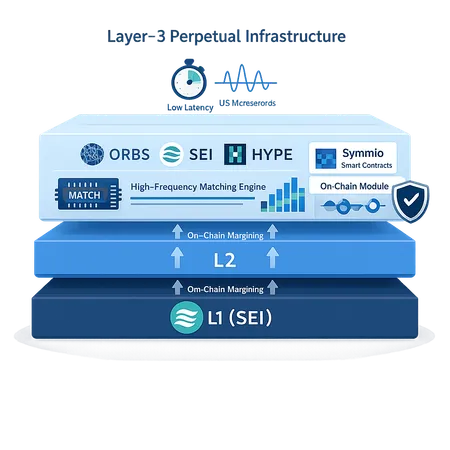
A canonical Layer‑3 perpetual architecture splits responsibilities across three zones:
- Execution surface: a low‑latency matching engine and order router that may rely on faster consensus or a trusted sequencer cluster. This is where fills, cancellations and off‑chain matching happen.
- On‑chain settlement module: smart contracts (e.g., Symmio modules) that hold collateral, enforce margin rules, calculate funding, and finalize trade settlements to the underlying L1/L2.
- Bridge and proof layer: mechanisms that checkpoint or prove L3 state transitions back to the L2/L1 to inherit security (for finality or dispute resolution).
That separation gives three practical advantages: latency (orders don’t wait for L1 inclusion), determinism (a single matching engine enforces a canonical orderbook), and scalability (the L3 can size consensus to the workload). For derivatives specifically, the ability to compute and apply cross‑margin in near real time matters: risk engines can maintain per‑account net exposures and liquidate or rebalance instantly without waiting for slow block times.
Symmio smart contracts: the on‑chain risk and settlement primitives
In the Perpetual Hub Ultra stack, Symmio smart contracts act as the canonical on‑chain truth for collateral balances, margin requirements, funding rates, and liquidation rules. The typical pattern is:
- Execution results (fills, P&L deltas) are reported from the L3 matching layer to the Symmio contracts through a sequenced relay.
- Symmio enforces state transitions: updating collateral, recording unrealized P&L, and triggering on‑chain liquidations when thresholds are crossed.
- Final settlement and optional withdrawal operations are processed on the L2/L1, providing cryptographic auditability.
Designing Symmio modules requires balancing on‑chain verifiability with practical performance. You want compact, deterministic state transitions so proofs or checkpoints are cheap to verify when they are committed to underlying layers. In practice that means using succinct state diffs, canonical accounting (per‑account margin ledgers) and tight invariants to make dispute resolution straightforward.
The Orbs–Gryps integration on Sei: what changed
Gryps’ integration of Orbs’ Layer‑3 technology to host Perpetual Hub Ultra on Sei is a clear instantiation of the architecture above. Orbs provides an L3 execution fabric that sits above Sei, enabling Gryps to run a perpetual matching and settlement stack with reduced latency while anchoring final settlement back to Sei’s order execution semantics and replay protection.
A useful write‑up of the integration notes how the collaboration leverages Orbs’ L3 primitives to power perpetual futures on Sei; the practical result is a testable path for on‑chain perpetuals that need lower latency than a pure L1/L2 deployment can provide. See the integration details reported by news.Bitcoin.com for specifics on the partnership and design choices (Orbs integrates Orbs Layer‑3 tech to power perpetual futures on Sei).
Perpetual Hub Ultra operationally exposes the following elements to traders and market‑makers:
- A low‑latency matching engine that supports limit/market and conditional orders with sub‑second routing.
- Symmio‑based on‑chain modules that hold collateral and enforce risk parameters.
- A bridge/checkpointing mechanism that posts succinct summaries of L3 state to Sei so that finality and dispute recovery are rooted in the L2/L1 security model.
Liquidity providers and market makers: altered economics and capital efficiency
Layer‑3 perpetual venues change the math for liquidity providers (LPs) and market‑makers in several ways:
- Capital efficiency rises when cross‑margining is implemented at the L3 level with tight state sync to Symmio contracts; LPs can net positions across multiple markets faster and reduce idle capital.
- Execution quality improves because fills happen on a single matching plane rather than being mediated by block inclusion — this reduces adverse selection and slippage for passive liquidity providers.
- Fee and funding models can be more dynamic: with lower latency, funding can be settled more frequently or even amortized across different liquidity providers using on‑chain accounting, allowing finer funding granularity.
However, LPs must also price new vectors: the operational risk of the L3 sequencer, bridge latency during settlement, and conditional trust assumptions embedded in the L3 governance and dispute mechanisms. In that sense, the liquidity premium will bifurcate — some LPs will accept slightly higher protocol/trust risk for better trading economics, while others will wait for auditability and stronger cross‑layer cryptographic assurances.
On‑chain margining and custodial risk: what changes
On‑chain margining via Symmio smart contracts preserves the transparency and auditability advantages of public blockchains while enabling faster, more deterministic margin calls when combined with an L3 execution layer. But custodial and operational risk shifts:
- Custody model: collateral can remain in self‑custody via Symmio contracts, reducing reliance on centralized custodians. Yet the L3 operator still mediates execution; reconciliation and withdrawal windows must be clearly defined to avoid temporary fund access issues.
- Bridging risk: checkpointing from L3 back to Sei introduces an availability/trust surface. If the bridge stalls, traders may face delays in final settlement or withdrawals. Protocols mitigate this with dispute windows and on‑chain fallbacks.
- Liquidation dynamics: faster liquidations reduce delinquencies but can exacerbate market impact if too aggressive. Symmio modules must therefore include fine‑tuned auction/settlement mechanics and protected oracle feeds to prevent flash‑crash cascades.
These tradeoffs are not theoretical. The Orbs–Gryps deployment aims to keep collateral on‑chain under Symmio while using L3 speed for matching — a practical compromise that shortens execution latency without fully abandoning on‑chain settlement guarantees.
Market appetite: comparing to Hyperliquid and the evidence of demand
Recent market developments show clear demand for on‑chain perpetuals with improved UX and throughput. Hyperliquid’s surge in perpetuals volume is a useful comparator: coverage by BeInCrypto highlights how elevated volumes signaled trader appetite for low‑friction on‑chain perpetual venues (Hyperliquid's perpetuals volume surge).
Hyperliquid achieved noteworthy throughput and product‑market fit by focusing on ultra‑fast perpetuals and order routing; Orbs–Gryps are now attempting a complementary technical approach using Layer‑3 primitives anchored to Sei. The difference is that a Layer‑3 model is explicitly designed to be a reusable infrastructure layer that other perpetual protocols could adopt, instead of a single vertically integrated exchange.
As an example of market sentiment, think of tickers like HYPE capturing speculative interest in the category while ORBS and SEI represent the protocol rails enabling the stacks. The implication: demand exists (HYPE and Hyperliquid’s volumes), and there’s momentum toward infrastructure that can handle institutional throughput (ORBS L3 tooling, SEI order primitives).
Engineering considerations for adoption
For engineers evaluating integration or running LP infrastructure, key checkpoints are:
- Sequencer/consensus guarantees: how are reorgs, front‑running protections and MEV mitigations handled at the L3?
- State checkpointing design: are checkpoints succinct, verifiable and economical to post to the L2/L1? Does Symmio expose a compact proof interface?
- Oracles and price feeds: low‑latency venues still need robust, tamper‑resistant price inputs for margining — decentralized aggregation with slippage protections is essential.
- Withdrawal and dispute windows: what are guaranteed finality timelines, and how do they interact with institutional settlement needs?
Answering these will determine whether a particular Layer‑3 perpetual deployment is suitable for an institutional desk or an automated AMM strategy.
Regulatory and operational notes for institutional desks
Institutions will care about audit trails, custody controls, and clearly defined counterparty assumptions. Layer‑3s can improve auditability by keeping settlement on‑chain via Symmio, but institutions must perform due diligence on the L3 operator, governance, and the mechanism that posts state to the underlying chain. Policies for emergency withdrawal, multisig upgrades and KYC/AML compliance on entrustment services remain important.
Where this is headed: composability and cross‑layer liquidity
If Layer‑3 perpetuals prove reliable, we should expect:
- More pervasive composability between L3 trading rails and L1/L2 DeFi primitives — e.g., cross‑margining with lending vaults or automated hedging strategies that execute within the L3 and settle to L2/L1.
- Shared L3 liquidity fabrics that allow LPs to expose inventory across several perpetual venues with a single collateral pool via Symmio accounting primitives.
- Faster innovation cycles: new derivatives products can be prototyped at L3 and then hardened for wider settlement on L1/L2.
That evolution will be iterative: trust assumptions must be tightened, proofs and checkpointing must become cheaper, and tooling for auditors and custodians will need to mature. But the direction is clear — Layer‑3s are a pragmatic bridge between exchange‑grade performance and public ledger security.
Practical takeaway for engineers and traders
For derivatives engineers and desk heads: evaluate Layer‑3 perpetual deployments by focusing on sequencer guarantees, checkpoint proof mechanics, Symmio contract invariants and oracle resilience. From a trader standpoint, expect materially better fills and margin efficiency but also a new set of infrastructure risks tied to the L3 operator and bridging logic. Track activity in both infrastructure rails (ORBS, SEI) and market demand signals (HYPE, volume on Hyperliquid) to time integrations and market‑making strategies.
For more background reading on the Orbs–Gryps work and market demand signals from other perpetual venues, see the reporting by news.Bitcoin.com and BeInCrypto linked in the Sources below.
For teams building interfaces or monitoring liquidity footprints, Bitlet.app can be a place to map integration points between custody, settlement and trading rails while keeping an eye on evolving Layer‑3 ecosystems.
Sources
- news.Bitcoin.com — Gryps integrates Orbs Layer‑3 tech to power perpetual futures on Sei: https://news.bitcoin.com/gryps-integrates-orbs-layer-3-tech-to-power-perpetual-futures-on-sei/
- BeInCrypto — Hyperliquid's perpetuals volume surge and market appetite: https://beincrypto.com/hyperliquid-silver-perpetuals-volume-hype/