Ripple Treasury: How GTreasury Acquisition Rewires Corporate Cash and Cross‑Border Liquidity
Summary
The big picture: a treasury platform meets blockchain rails
Ripple Treasury is Ripple’s push to bring traditional enterprise treasury controls into a blockchain-native stack. By folding GTreasury’s mature cash‑management and hedging tooling into Ripple’s payments infrastructure, the product promises to eliminate many of the manual handoffs that slow corporate liquidity — and to do so while offering on‑chain settlement and tokenized disbursements that can be routed across Ripple’s rails.
Why this matters now: treasuries are under pressure to shorten working capital cycles, automate FX exposure and adopt digital money rails that move value globally in near real time. Ripple Treasury targets exactly that intersection: cash‑management controls plus faster settlement rails, intended to reduce counterparty and settlement risk while improving visibility across fiat and tokenized balances.
Why Ripple bought GTreasury
GTreasury brought to the table a well‑established enterprise ledger for cash, debt and FX operations — features familiar to treasury teams: multi‑entity cash visibility, hedge accounting, payment orchestration and AP/AR workflows. Ripple’s acquisition accelerates a product roadmap that would otherwise have required years of greenfield engineering to replicate.
Public coverage of the deal and the subsequent product launch frames the acquisition as a strategic shortcut to enterprise readiness: The Block covered Ripple’s move to introduce a treasury platform built atop GTreasury capabilities, highlighting the speed at which Ripple could offer enterprise features after the integration. CoinPaper summarized the all‑in‑one dashboard capabilities that come from this tie‑up, and U.Today reported the live rollout and some operational hires tied to the new treasury product. Together these writeups underline a clear logic: GTreasury supplies enterprise-grade controls; Ripple supplies rails and liquidity pathways. (See reporting from The Block, CoinPaper and U.Today.)
What Ripple Treasury actually does: features and mechanics
The platform combines incumbent‑grade treasury controls with blockchain primitives. Its core capabilities include:
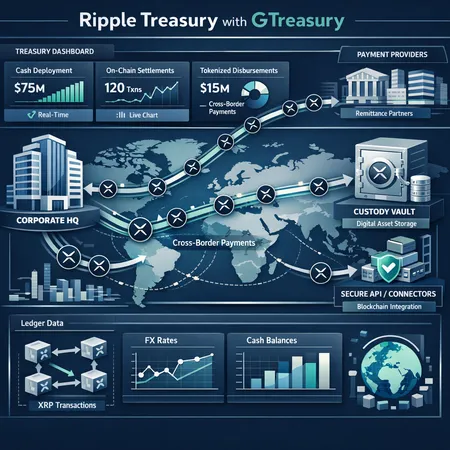
Real‑time cash deployment and multi‑currency visibility. Consolidated dashboards let treasurers see fiat and token balances across entities and corridors, and to deploy liquidity without waiting for legacy batch payment cycles.
On‑chain settlement orchestration. Payments can be routed through Ripple’s settlement rails to execute cross‑border moves with shorter windows compared with correspondent banking, while preserving reconciliation hooks back to the enterprise ledger.
Tokenized disbursements and programmable payouts. Payroll, supplier payments or conditional disbursements can be tokenized and executed with business rules (e.g., staged releases, clawbacks, escrow) that are harder to implement using bank pipes alone.
Integrated FX and hedging workflows. GTreasury’s hedge accounting and FX risk modules allow treasurers to combine execution and instruments (forwards, options) with on‑chain and off‑chain settlement logic, tightening the feedback loop between execution and accounting.
Custody and settlement choices. Organizations can opt for custodial arrangements for tokenized positions or keep custody in-house where regulation and policy require it; the platform is designed to interface with multiple custody vendors and to record custody metadata in the enterprise ledger.
These elements collectively reduce manual reconciliation, compression of settlement times, and the latency that currently forces treasuries to hold larger pre‑funded balances in multiple currencies.
Integration with Ripple rails and custody options
A defining attribute of Ripple Treasury is that it doesn’t merely show token balances — it routes liquidity. By integrating with Ripple’s payment rails, treasuries can choose paths that include on‑chain settlement via XRP or tokenized fiat corridors, or off‑chain settlement where appropriate. That routing layer is what lets treasuries optimize for cost, speed or regulatory constraints on a per‑transaction basis.
Custody is treated as a configurable policy: some clients may prefer custodial solutions offered by regulated custodians for fiat tokenization and crypto holdings; others will want direct control. The platform’s design supports multiple custody endpoints and captures proof‑of‑holdings and settlement events back into the GTreasury ledger, preserving audit trails required by SOX and other controls.
Use cases: corporates, banks and payment providers
The platform maps to a range of practical scenarios:
Corporates: centralized treasury teams can net intercompany flows, execute FX hedges close to settlement, and push vendor payments as tokenized disbursements that clear faster and reduce days payable outstanding.
Banks and custodians: banks can offer a wrapped product to corporate clients — combining custody, tokenization, and traditional treasury services — while reducing correspondent banking reliance for certain corridors.
Payment providers and PSPs: tokenized payouts enable instant merchant settlement, fewer chargeback windows and more predictable float management. Payment facilitators can also route liquidity dynamically based on cost or counterparty risk.
In each case, the value proposition is similar: lower funding needs, reduced FX slippage, and better traceability through reconciliation automation. For teams exploring on‑chain treasury tooling, monitoring activity on DeFi rails is instructive, but Ripple Treasury targets enterprise controls first, then chains next.
How Ripple Treasury affects institutional demand for XRP (versus other Ripple products)
There are three channels to consider: settlement demand, utility demand, and product adoption.
Settlement demand: if corporates use XRP as a settlement bridge in corridors where liquidity is deep and regulatory clarity exists, this raises transactional demand for XRP to facilitate near‑instant settlement. The platform makes it easier to route payments through XRP rails when that makes economic sense.
Utility demand: tokenized disbursements and programmability can require layered token mechanics. Treasuries may prefer stablecoins in some scenarios (predictable value) and XRP in others (low‑cost, high‑speed bridge). Ripple Treasury’s orchestration lets firms choose dynamically, which could increase on‑chain activity across asset types.
Product differentiation: Ripple’s broader suite includes stablecoins and custody services. By integrating GTreasury, Ripple can pitch a full stack — treasury controls plus on‑chain settlement — making XRP one of several rails rather than the only offering. That means institutional demand for XRP will likely grow where XRP’s cost/time profile beats stablecoins or where a bridge asset is necessary to complete a corridor.
In short: Ripple Treasury increases institutional optionality. It doesn’t force XRP adoption universally, but it lowers the friction to try XRP for specific corridors and workflows, which over time can create pockets of sustained demand where economics and regulation align. For treasurers weighing macro allocations, it's still important to compare cash exposures alongside holdings like Bitcoin and stablecoins when defining policy.
Regulatory considerations after the GTreasury acquisition
Enterprise adoption depends on legal and regulatory clarity. The GTreasury acquisition moves a seasoned enterprise vendor into a crypto‑native company, which raises several points treasurers must evaluate:
Accounting and audit: integrating tokenized balances with hedge accounting requires clear rules for recognition, measurement and disclosure. GTreasury’s hedge modules help, but corporate auditors will need to be comfortable with the controls over on‑chain events, custody attestations and reconciliations.
Custody and KYC/AML: choices about custodial arrangements and counterparty risk are front‑and‑center. The platform supports multiple custody options, but treasuries must ensure any custodial counterparties meet regulatory standards in the jurisdictions they operate.
Securities and payments law: using XRP or tokenized fiat as a settlement medium invites scrutiny. Corporates should coordinate with counsel and regulators, especially where cross‑border money transmission laws vary by corridor.
Vendor risk and governance: acquiring GTreasury means Ripple now manages more of the control plane. Enterprises should perform vendor due diligence, require SLAs and verify that the integrated product preserves segregation of duties and audit trails required under SOX, GDPR and local laws.
Regulatory frameworks are still evolving. The GTreasury acquisition may help — because GTreasury brings enterprise governance patterns — but it also places more enterprise functions under Ripple’s umbrella, which some clients will want to evaluate carefully.
Practical steps for treasury decision‑makers
If you’re evaluating Ripple Treasury against other blockchain‑native treasury stacks, consider these steps:
- Map your corridors: identify where settlement speed or FX cost reduction would materially improve working capital.
- Define custody policy: decide whether you require regulated custodians or will accept client‑hosted keys for certain flows.
- Pilot narrow workflows: start with a subset of payables or intercompany netting to measure operational gains and reconciliation effort.
- Validate accounting treatment: get buy‑in from auditors on hedge and token accounting before scaling.
For teams already experimenting with tokenization or watching on‑chain liquidity, Ripple Treasury provides an option to run enterprise controls atop blockchain settlement rails — a compelling bridge between incumbent treasury systems and the programmatic possibilities of tokenized money. Bitlet.app clients and other fintechs looking at treasury modernization should weigh both the operational gains and the governance implications before committing to a full migration.
Conclusion
Ripple Treasury is a strategic marriage of GTreasury’s enterprise treasury controls and Ripple’s payment rails. For corporates, banks and payment providers, the product reduces reconciliation overhead, shortens settlement windows and enables programmable, tokenized disbursements. Whether this translates into broad institutional demand for XRP depends on corridor economics and regulatory clarity, but Ripple Treasury clearly lowers the barrier for enterprises to experiment with blockchain settlement as part of a controlled, auditable treasury stack.
Sources
- Ripple officially launches its own treasury — U.Today: https://u.today/ripple-officially-launches-its-own-treasury-here-are-5-jobs-it-actually-does?utm_source=snapi
- Ripple launches all‑in‑one treasury dashboard — CoinPaper: https://coinpaper.com/14093/ripple-launches-all-in-one-treasury-dashboard-for-cash-crypto-and-cross-border-payments?utm_source=snapi
- Ripple introduces treasury platform after GTreasury deal — The Block: https://www.theblock.co/post/387357/ripple-introduces-treasury-platform