Why Bitcoin Is Lagging Gold & Silver — Macros That Could Flip the Trade
Summary
Executive snapshot
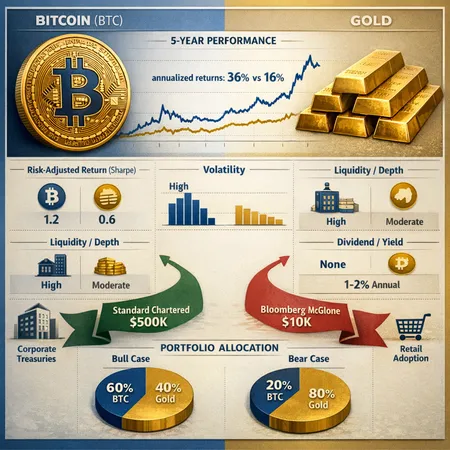
The recent spike in gold and especially silver has put precious metals in the spotlight and left many macro investors asking: why is Bitcoin lagging gold and silver right now, and what would it take to flip the narrative? This explainer lays out the evidence for capital rotation into precious metals, contrasts the key market-commentator views, and maps the macro and on-chain triggers that could restore BTC leadership. For many cross-asset allocators, the decision comes down to timing liquidity and convexity exposure between gold/silver and Bitcoin. (Note: Bitlet.app provides cross-asset tools that some portfolio managers use for execution and rebalancing.)
Evidence of capital rotation into precious metals
The flow data and market behavior over the latest weeks point to more than a simple headline-driven spike: we saw concentrated trading in silver and meaningful inflows into gold instruments. For example, reporting highlighted a dramatic silver session that captured outsized volumes relative to recent history, reinforcing a short-term precious metals FOMO narrative as traders chased performance rather than fundamentals. The pattern looks like classic rotation: risk-lite demand + short-term momentum chasing.
On the institutional side, futures positioning and ETF flows showed net buying in metals while many crypto products recorded muted inflows or even outflows. That mismatch indicates capital rebalancing across portfolios rather than a structural decoupling of BTC from macro liquidity. In plain terms: some dollars that might normally find their way into risk assets have instead been routed to gold and silver for a window.
What market commentators are saying — Pompliano vs Tom Lee
Anthony Pompliano has been vocal that gold and silver outperformance can be explained by a blend of macro expectations (rate path, dollar behavior) and investor psychology—investors often rotate into tangible assets when inflation uncertainty or geopolitical headlines spike. His view is consistent with flow evidence and retail attention metrics: precious metals can outpace crypto in short-term episodes when the safe-asset argument gains traction. See his breakdown and reasoning in the recent commentary linked here for context.
By contrast, Tom Lee of Fundstrat argues that precious metals rallies are often cyclical peaks for that trade and that crypto—especially BTC and ETH—tends to resume outperformance once the metals move tops out and liquidity conditions ease. Lee frames the dynamic as a cross-asset melt-up sequence: metals peak, rates/stress normalize, and risk assets reclaim momentum. The implication: patient allocators should watch for signs of a metals top as a contrarian buy signal for BTC.
(References: Pompliano's analysis on why gold and silver are outpacing BTC is summarized in the linked article; Tom Lee's view on a subsequent crypto breakout after precious metals peak is outlined here.)
Macro catalysts that could flip the narrative back to BTC
Several macro levers could reverse flows out of metals and back into risk-assets like BTC. The most important are:
Fed policy pivot / easing expectations. If the market begins to price a clear Fed pivot (rate cuts or even a prolonged pause with dovish forward guidance), liquidity would likely rotate back into risk assets. Easing expectations compress the equity/crypto risk premium and reduce the relative appeal of safe havens.
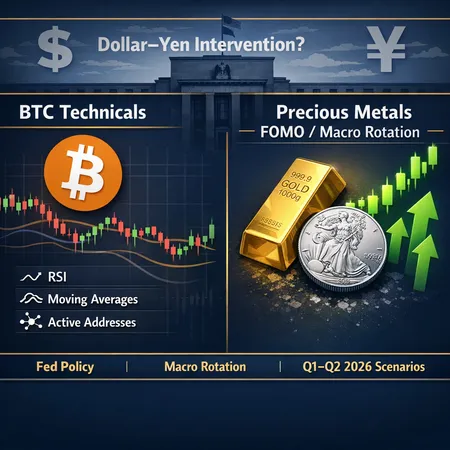
Dollar weakness, including dollar/yen interventions. Currency mechanics matter. Market notes on scenarios where the Fed or other actors engage in dollar/yen operations suggest that a sustained dollar sell-off—whether via FX intervention or coordinated policy—could be a big tailwind for BTC. A weakening dollar often boosts commodity and risk-asset inflows and can reverse precious metals FOMO into broader risk appetite.
Macro headlines that reduce tail risk premium. Lower geopolitical risk, stabilizing inflation prints, or improved growth signals can shift marginal capital back to higher-beta assets.
The dollar/yen dynamic deserves special attention: if a potential intervention or outright balance-sheet action reconfigures FX flows, that liquidity can cascade into cross-asset reallocation. Analysts have highlighted how central bank and FX interventions create macro regimes that favor either safe assets or risk assets—watch for official communications and FX reserve moves as early indicators. For a deeper read on the dollar/yen angle, see the macro note linked here.
BTC technicals and on-chain indicators that matter
From a market-timing and risk-management standpoint, combine classic technicals with on-chain evidence to judge the quality of any rotation back into BTC.
Technical levels to monitor
- Key resistance and support bands: watch multi-year moving averages and the highs where BTC previously stalled. A weekly close above those resistance zones would be a structural bullish signal. Conversely, a weekly break below established support could delay any narrative flip.
- Momentum indicators: RSI and MACD on daily/weekly timeframes help time entries; sustained divergence or a breakout in momentum usually precedes large moves.
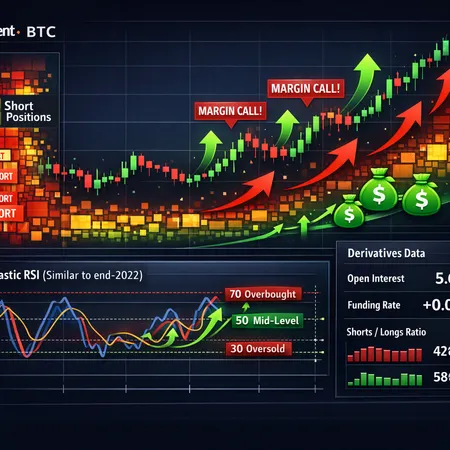
- Derivatives flows: futures open interest, options skew (put/call ratios), and funding rates reveal whether speculators are leaning long or short.
On-chain signals to watch
- Exchange net flows: sustained outflows to cold wallets are accumulation; heavy inflows to exchanges can presage selling pressure.
- SOPR and realized supply metrics: whether short-term holders are realizing profits or losses matters for near-term supply pressure.
- Whale accumulation and long-term holder behavior: growth in long-term holder supply typically supports higher structural valuations.
- Active addresses and DeFi interaction: rising on-chain activity—particularly when flows move from spot into derivatives, lending, or DeFi rails—indicates re-engagement from users, not just speculators.
When macro catalysts turn favorable, look for a confluence: bullish technical breakout + improving funding/futures structure + positive on-chain liquidity flows. That three-pronged confirmation reduces false starts.
Scenario planning: Q1–Q2 2026 outcomes
Below are scenario outlines with triggers, probabilities (illustrative), and implications for CIOs balancing BTC vs precious metals.
Scenario A — Base case: Metals cool, BTC grinds higher (Probability ~45%)
- Trigger: Fed rhetoric inches dovish, dollar softens modestly, precious metals stall after a parabolic move.
- Market response: Metals correct; some capital rotates back into risk assets. BTC rallies into resistance bands but with measured volatility.
- CIO action: Partial rebalancing into BTC, use scaling entries on technical-confirmation and watch options skew to hedge downside.
Scenario B — Flip to BTC breakout (Probability ~25%)
- Trigger: Clear Fed easing signals or concerted FX-induced dollar weakness (e.g., dollar/yen intervention), sustained liquidity injection.
- Market response: Strong risk-on flows; BTC breaks above key technical levels with deleveraging in shorts across futures/ETF products.
- CIO action: Increase BTC allocation for convex upside, tighten stop-limits, consider volatility overlays (options) to capture asymmetric upside.
Scenario C — Metals FOMO extends, BTC underperforms (Probability ~30%)
- Trigger: Persistent macro uncertainty keeps demand for tangible safe-havens high; Fed remains hawkish or dollar strengthens via safe-haven flows.
- Market response: Gold/silver rally further; BTC drifts or sells off on risk aversion and capital preservation moves.
- CIO action: Maintain or increase metal exposure, reduce BTC beta, preserve liquidity; revisit allocation if on-chain metrics show capitulation and accumulation by long-term holders.
These probabilities are directional and should be updated with real-time flow and on-chain data.
Practical checklist for CIOs and macro allocators
- Monitor Fed minutes, speakers, and rate-path swaps for signs of easing.
- Watch dollar/yen headlines and FX reserve chatter—any sign of coordinated intervention is a major macro trigger.
- Track real-time flows: ETF inflows/outflows for metals, BTC exchange net flows, futures open interest, and funding rates.
- Use a triage of signals before reallocating: technical confirmation, positive derivatives structure, and supportive on-chain accumulation.
- Consider execution tools and staggered rebalancing to manage timing risk; platforms like Bitlet.app are among the tools managers use for execution and rebalancing.
Takeaway
The recent precious metals surge is a bona fide rotation episode driven by macro expectations and momentum chasing. That doesn’t mean BTC’s longer-term thesis is invalid — historically, crypto has outperformed after metals peak and liquidity returns to risk assets. For CIOs weighing allocations between BTC and metals, the decision hinges on watching a small set of macro cues (Fed policy and FX dynamics like the dollar/yen story), derivatives posture, and on-chain indicators. Look for confirmation across macro, technical, and on-chain signals before shifting material allocation.