Explainer: Why Privacy Tokens on Solana Spiked — The GhostWareOS (GHOST) Rally
Summary
Quick snapshot: what happened
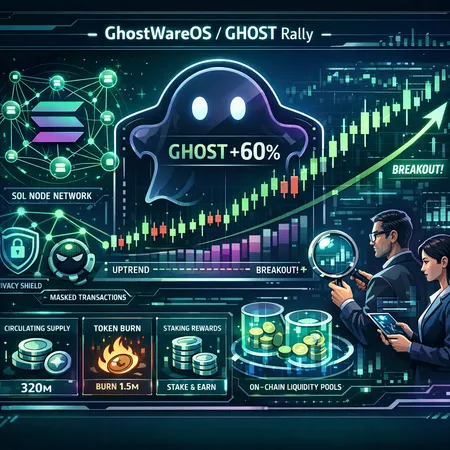
In mid-January a wave of speculative buying pushed the GHOST token—associated with GhostWareOS, a privacy tooling suite on Solana—higher by more than 60% inside a short window. Market commentary and reporting attribute the move largely to a major product expansion announcement by GhostWareOS, combined with thin on-chain liquidity and concentrated holder distributions that amplified price moves. Sources covering the event include a report on the product expansion and subsequent token rally published by BeinCrypto.
The immediate takeaway is straightforward: in a low-fee, high-throughput environment like Solana, discrete announcements can trigger outsized token moves if liquidity and tokenomics enable rapid price discovery.
What triggered the 60%+ GHOST move?
Three factors compounded to produce the rally:
Product expansion narrative — The GhostWareOS team announced a significant expansion in functionality for privacy tooling on Solana. Announcements like this create a clear, investable narrative for speculators who price in future adoption.
Liquidity and market structure — GHOST’s early pools had relatively low on-chain depth. When order books and Automated Market Maker (AMM) pools are shallow, modest buy pressure creates large price slippage and attracts momentum traders.
Speculative concentration and social amplification — Large holders and coordinated on-chain buys (or a few early market-makers stepping in) can amplify moves, and the subsequent social and on-chain signals (wallets moving funds, volume spikes) feed more buyers.
BeinCrypto’s coverage highlights the product announcement as the proximate catalyst, while on-chain snapshots show the structural conditions that allowed the move to be magnified.
Why Solana is fertile ground for privacy dApps
Solana’s technical profile creates both opportunities and constraints for privacy protocols:
Throughput and low fees: Solana’s Sealevel runtime and parallelized processing enable high transaction throughput at low cost, which is attractive for privacy protocols that may require many micro-interactions or frequent relays.
Account-based model and composability: Using the SPL token standard and composable programs, privacy tooling can plug into existing DeFi rails (AMMs, lending, oracles). That composability fuels faster experiment cycles.
Trade-offs in cryptography: Native, scalable zk-proof systems are not yet a built-in feature of Solana in the same way as some rollup architectures. Many privacy solutions on Solana therefore combine on-chain program logic with specialized cryptographic libraries or off-chain proving systems. That approach can deliver usable privacy quickly, but also increases dependency on correct off-chain components.
For builders and analysts, these properties explain why projects like GhostWareOS chose Solana. For many traders and researchers, the broader context of private tooling on DeFi matters too: privacy features interact with liquidity, compliance, and UX in ways that influence adoption curves.
Tokenomics and on-chain liquidity: what to inspect
When a token rallies on a narrative, its tokenomics and liquidity profile determine whether price gains can persist or face sharp reversals. Key areas to analyze:
Supply structure and emissions
- Total supply vs circulating supply: large locked allocations to founders or treasuries can become a latent source of sell pressure when cliffs/vesting periods end.
- Emission schedule and incentives: heavy inflationary emissions to bootstrap liquidity or rewards may lift short-term usage but degrade token scarcity.
Initial liquidity and pool mechanics
- Depth in major AMMs (Raydium, Orca) and order books on CEXes matters: low depth equals high slippage. Check token/USDC and token/SOL pools.
- Is liquidity provider (LP) liquidity protected by vesting or locks? Unlocked LP tokens can be withdrawn quickly which risks rug-like outcomes.
Holder concentration
- Top-10 and top-100 wallet concentration: if a few wallets control a large share, coordinated selling can crash price.
- Transfer patterns: are whales moving tokens to CEX deposit addresses? That’s an early red flag for potential dumps.
Audit, multisig, and governance controls
- Smart contract audits and public code repositories: absence of audits raises counterparty risk for funds deploying capital.
- Multisig setups and timelocks on treasury disbursements reduce tail risks.
Practical on-chain queries: inspect the token contract (SPL) for max supply and mint authority, view AMM pool reserves to compute price impact for hypothetical trade sizes, and use block explorers to track large transfers and CEX inflows.
On-chain signal checks for sustainability
To move beyond headline gains and judge whether a rally can mature into sustainable adoption, monitor a blend of supply-side and demand-side signals:
- Real utility flows: Are users interacting with GhostWareOS programs (tx counts, unique active addresses) rather than just trading the token?
- Stable liquidity growth: Look for consistent increases in LP depth originating from organic liquidity rather than one-off market-maker deposits.
- Diminishing sell-side pressure: Check whether big holders are reducing balances or moving tokens off-chain into custodial exchanges.
- Locked value and staking: Real staking or lock-up features that meaningfully reduce circulating supply help sustainability—but watch the terms.
- Development activity: GitHub commits, repo updates, and third-party audits are weakly correlated with long-term success.
These metrics help differentiate an event-driven spike from the start of a resilient network effect.
How GHOST’s rally fits into Solana’s SOL price outlook
Token-level rallies and chain-level price action are related but not isomorphic. Here’s how to think about the interaction:
Idiosyncratic vs systemic demand: If GHOST’s rally is driven mainly by token-level narrative and speculative rotation, it may have limited impact on SOL price. But if adoption of privacy tooling meaningfully increases on-chain activity—higher tx counts, more fees captured in SOL, rising TVL—then chain-level fundamentals could shift.
Macro context matters: Recent analysis highlighted continuing bearish pressure on SOL over short windows, a reminder that chain-level tokens are sensitive to macro and liquidity cycles (price commentary for SOL over the weekend).
Technical targets and analyst views: Some analysts are calling specific SOL technical targets in the near term, framing upside and downside scenarios that will shape risk appetite for speculative Solana assets generally (analyst price projection and technical targets).
Put simply: a healthy string of privacy dApp launches could be a constructive narrative for SOL over time, but short-term SOL momentum often follows macro flows and large-cap liquidity, not a single token rally.
Practical checklist for investors and DeFi analysts
If you’re evaluating GHOST or similar privacy-token rallies on Solana, use a checklist that mixes on-chain verification with tokenomics scrutiny:
- Confirm the product announcement and roadmap details; ask whether the announcement is verifiable (demo, testnet, audit).
- Measure immediate liquidity: compute price impact for trades sized at 1%, 5%, and 10% of pool depth.
- Inspect holder distribution and recent large transfers; flag CEX deposit flows.
- Review token emission schedule, vesting cliffs, and treasury control mechanics.
- Track real usage metrics (txs, DAU) for the associated programs to see if utility backs token demand.
- Verify audits, multisig, and timelock presence for critical contracts.
- Consider the macro SOL outlook: if SOL is under bearish pressure, speculative altcoins typically face higher correlation-driven drawdowns.
For those managing execution, low fees on Solana permit nimble position-scaling, but also mean traders can rotate capital in and out very fast—so risk management (limit orders, staged exposure) is key. Platforms including Bitlet.app make it easy to manage positions, but always align execution tools with a clear risk plan.
Final perspective: opportunity vs. fragility
GhostWareOS’s GHOST rally is a case study in how announcements, thin liquidity, and concentrated supply can create explosive price action on Solana. That same environment—fast, cheap, and composable—accelerates both innovation and sharp reversals.
For investors and analysts: treat such rallies as high-alpha, high-risk events. Use on-chain analytics to separate genuine adoption signals from purely narrative-driven speculation. If privacy tooling on Solana scales, that’s a positive for the ecosystem and could be a tailwind for SOL; if the moves are predominantly speculative, they will likely remain ephemeral and amplify downside when macro sentiment turns.