Regulatory Squeeze: How Whitebit’s Ban, Nigeria’s Sandbox Setback and UK Rules Are Fragmenting Exchange Liquidity
Summary
Executive snapshot
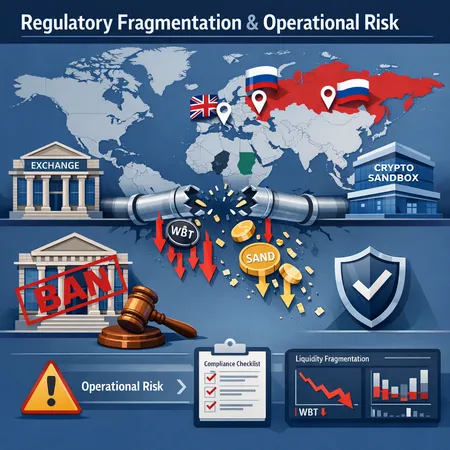
The past quarter exposed how quickly regulatory fragmentation can turn into market friction. Russia’s recent ban on the exchange Whitebit and reports tying it to alleged illicit transfers, a setback to Nigeria’s much‑needed crypto sandbox after a Quidax service halt, and the UK finalizing a wider regulatory consultation together form a three‑cornered case study in divergent policy responses. The immediate result: liquidity pools that used to be fungible across borders now look like a patchwork—higher spreads, regional price gaps, and elevated operational risk for exchanges and custodians.
For compliance officers and exchange operators this is not an academic issue. The mix of emergency enforcement, fragile regulatory pilots and formal regime building changes how trading books, custody and market‑making desks must be staffed and insured. For many traders, Bitcoin still signals macro sentiment, but at the venue level token prices can decouple sharply when access is restricted.
Three contrasting regulatory moves and what they mean
1) Russia and the Whitebit ban — enforcement by exclusion
In late 2025, Russian authorities moved to ban Whitebit inside the jurisdiction, citing alleged illegal transfers linked to military funding. The action is a hard example of enforcement by exclusion: authorities don't always need to seize an exchange to make it inoperable for local users. The immediate operational impact is straightforward—on‑chain inflows may continue, but fiat onramps, KYC verification for local accounts and fiat withdrawals are crippled for users in the affected jurisdiction. This can trigger rapid exits, withdrawal congestion and a flight-to-safety that depresses native tokens like WBT and strains an exchange’s hot/cold wallet architecture. See coverage of the ban for context: Russia bans Whitebit over alleged transfers.
2) Nigeria’s crypto sandbox setback — fragile pilots can create operational uncertainty
Developing markets often rely on regulated sandboxes to foster innovation while testing controls. Nigeria’s sandbox recently suffered a setback after Quidax halted certain services, illustrating how quickly a promising regulatory experiment can lose credibility and functionality. When a sandbox partner withdraws services, liquidity corridors that depended on them evaporate and users are left exposed. The resulting confidence hit reduces participation, and smaller tokens or locally listed markets thin out first. Read more: Nigeria’s crypto sandbox suffers setback.
3) UK regulation — progressive clarity with stricter standards
Contrast both with the UK, where regulators have been moving toward more formalized rules and recently finalized a consultation process. The UK’s approach isn't a ban; it's methodical. That progressive clarity encourages institutional participation but also raises the compliance bar—firms must upgrade controls, reporting and capital requirements or face access restrictions. The UK move is an example of fragmentation in regulatory intent: clearer, but often tougher, standards that make a single global compliance stack impractical. See reporting summarizing the consultation’s finalization: UK regulation consultation finalized.
How fragmentation translates into market and operational risk
Regulatory fragmentation affects exchanges and token markets along three channels:
- Liquidity fragmentation: when a jurisdiction removes an onramp or forces a delisting, order book depth vanishes locally. Cross‑border arbitrage temporarily widens spreads and increases settlement risk.
- Operational exposures: geofenced users create concentrated withdrawal windows; hot wallet traffic spikes and offline cold storage processes are stressed; KYC/AML backlogs grow.
- Reputation and legal risk: being on the wrong side of a sudden enforcement action can trigger fines, asset freezes, and long litigations.
Tokens closely associated with an affected venue or geo‑concentrated user base suffer first. WBT, the token commonly associated with Whitebit’s ecosystem, is an obvious example: trading volume tied to users inside the barred jurisdiction collapses, sell pressure rises and secondary venues may elect to delist to avoid contagion risk. More widely‑held tokens such as SAND (The Sandbox) are not immune—regional access restrictions can create temporary price differentials between venues, and market makers may widen quotes to offset the tail risk.
Practical mitigation: a compliance playbook for exchanges and operators
Below is a compact, operational playbook designed for exchange operators, compliance officers and counsel to reduce geo‑regulatory risk.
1) Jurisdictional mapping and concentration KPIs
- Maintain an up‑to‑date map of where users originate, fiat rails operate and where legal entities hold licenses. Measure concentration with KPIs: % trading volume per jurisdiction, withdrawal volume per fiat corridor, top N% of deposits by account location.
- Set hard thresholds that trigger pre‑defined actions (e.g., >15% of fiat withdrawal flow from a single jurisdiction → activate contingency liquidity channels).
2) Entity structure and legal containment
- Use ring‑fenced legal entities: separate local operation entities, custody entities and international trading platforms. If one entity is sanctioned or restricted, others may remain operational—though this is not failproof.
- Pre‑negotiate emergency cooperation clauses with counterparties and local counsel to shorten response time in enforcement events.
3) Geo‑controls and dynamic delisting policies
- Implement geofencing at account level and make it auditable. Where enforcement threat is high, reduce fiat onramp limits and require enhanced KYC for withdrawals.
- Maintain a transparent, pre‑published delisting and suspension policy that outlines how decisions are made and how users will be communicated with.
4) Liquidity contingency planning
- Keep cross‑venue liquidity lines and prime broker relationships to reallocate order flow quickly.
- Maintain market‑making reserves and line‑by‑line liquidity depth metrics for critical tokens. Consider automated routing to alternative venues if primary order books thin below a threshold.
5) Sanctions and AML integration
- Integrate real‑time sanctions lists and OFAC screening into onboarding and transaction monitoring. Rapidly update rules when new measures are announced.
- Run retrospective analytics to identify risky chains and counterparties so you can quarantine or slow suspicious flows without wholesale freezes.
6) Crisis communications and user protections
- Have a communications playbook and legal notice templates ready. Users panic first—transparent, timely updates reduce fraud and rushed withdrawals.
- Offer temporary withdrawal windows or staggered exits for large retail cohorts to avoid hot wallet exhaustion.
7) Insurance and contingency funds
- Maintain insurance for cyber and custody incidents and dedicate contingency reserves to manage liquidity squeezes. Insurance should be stress‑tested against scenarios like forced fiat freeze in a major corridor.
Compliance metrics and reporting for the board
Compliance officers should distill geo‑risk into board‑level metrics:
- Jurisdictional concentration ratio (top three countries’ share of volume)
- Time‑to‑freeze (average time to suspend deposits/withdrawals once a restriction is announced)
- Hot wallet depletion metric (peak withdrawal as % of hot liquidity)
- Legal exposure index (number of active enforcement investigations by jurisdiction)
These KPIs help boards make capital allocation, insurance and contingency decisions quickly.
What retail and institutional users should do now
The best defense for users is to assume that venue access can change overnight.
- Verify license and operational footprint: confirm where an exchange is registered, where fiat rails are domiciled and whether deposits are insured.
- Diversify custody: keep critical reserves spread across at least two custody solutions (one self‑custody plus one reputable custodial provider), and keep rollback/exit plans updated.
- Keep liquid exit corridors: maintain some holdings in highly liquid assets and a small fiat buffer to pay for on‑chain fees and off‑ramp costs.
- Institutional contracts: include force‑majeure, jurisdictional breach clauses and explicit settlement timelines in counterparty agreements. Negotiate representations about compliance and the ability to service clients in the event of local enforcement.
- Monitor announcements and set alerts for delisting or geoblocking notices. When a sandbox partner or a local service halts, act quickly to move funds or seek legal clarity.
Market behavior to expect and trade‑side implications
Short term, expect wider spreads, slower fills and spikes in funding rates for perpetuals linked to venues that lose access. Arbitrageurs will chase disparities between unrestricted venues and those with geofences, but that arbitrage is riskier: on‑chain settlement finality doesn't remove fiat corridor constraints.
In the medium term, well‑capitalized venues that adopt robust compliance programs and multi‑jurisdictional footprints will attract liquidity from weaker actors. That consolidation can restore depth but also concentrates systemic risk in fewer platforms.
Final thoughts for counsel and operational leads
Regulatory fragmentation is now an operational condition, not an exception. That requires a mindset shift: legal teams must become operational partners, not just gatekeepers. Build nimble legal playbooks, insist on real‑time compliance telemetry, and run tabletop exercises that simulate sudden jurisdictional bans or sandbox collapses. Practical tools—jurisdiction maps, contingency liquidity partners, pre‑negotiated legal letters—will blunt the damage when local policy changes at speed.
For those building or operating platforms, remember the balance: proactive engagement with regulators (including sandbox participants where appropriate) can buy political cover, but reliance on fragile pilot programs is not a substitute for robust global compliance.
Exchanges and custodians, and services like Bitlet.app, that invest in geo‑aware controls and clear communication will be better positioned to retain user trust when markets tighten.
Sources
- Blockonomi — Russia bans Whitebit over alleged transfers: https://blockonomi.com/russia-bans-whitebit-crypto-exchange-over-alleged-11m-ukraine-military-funding/
- Cryptopolitan — Nigeria’s crypto sandbox suffers setback: https://www.cryptopolitan.com/nigerias-crypto-sandbox-suffers-setback/
- Crypto.news — Weekly recap including UK regulation consultation finalization: https://crypto.news/gamestop-transfers-bitcoin-to-coinbase-senate-democrats-amend-crypto-bill-uk-finalizes-regulation-consultation-weekly-recap/