Bitcoin Stress Test: ETF Outflows, Glassnode’s Consolidation Warning, and $90k Whale Accumulation
Summary
Executive snapshot
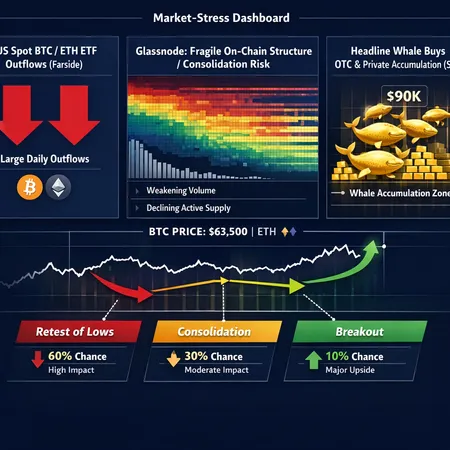
The market is undergoing what looks like a coordinated stress test: large daily outflows from US spot BTC/ETH ETFs, on-chain warnings that Bitcoin’s structure is fragile, and headline whale accumulation around the $90k mark. These are not mutually exclusive — they reflect different pockets of capital reacting to macro headlines, portfolio mandates, and selective buying opportunities.
For many institutional readers this matters because the net effect of visible ETF flows and invisible OTC accumulation will define short-term liquidity and where derivatives liquidation clusters form. For a quick reference, see the combined ETF outflow figures reported by Farside Investors via Invezz and the broader context around institutional buying detailed elsewhere in this note.
ETF outflows and what the numbers mean
On January 22, data compiled in market reporting showed roughly $1 billion in combined net outflows from US spot Bitcoin and Ether ETFs in a single day, a figure that grabbed headlines and triggered risk-reduction commentary across desks (see reporting on the flows). Those redemptions were framed by macro volatility: equity and rates moves often force allocators to reduce risk exposures quickly.
Why the headline matters for traders
- ETFs are visible, daily-marked products. Large outflows mean product managers either sold spot into the market or redeemed shares — both actions drain near-term liquidity.
- Even if redemptions are handled in-kind or settled through secondary market sells, the perception of outflows increases order-book fragility, making it easier for price moves to cascade during stressed moments.
But flows are noisy. Redemptions can be driven by short-term portfolio rebalancing or margin calls elsewhere, not a long-term view that BTC’s fundamentals are broken. Still, when ETF flows coincide with rising macro volatility they become an accelerant.
(For the underlying data and reporting on these ETF flows see the Invezz piece summarizing the Farside Investors numbers.)
On-chain health: Glassnode’s consolidation warning
Independent of ETF flows, on-chain analytics providers have been flagging structural risks. Glassnode’s analysis — summarized in market coverage — highlights patterns consistent with a fragile on-chain structure and the statistical risk of prolonged consolidation. That assessment leans on multiple on-chain lenses: reduced exchange outflows, flattening active address growth, and concentration of supply among holders who may be reluctant to spend.
What “fragile structure” implies for traders
- Price can hover in a range for longer than expected, as supply-demand mismatches prevent strong trending moves.
- Narrow liquidity corridors form; whenever price tests these corridors, moves can be volatile because order-book depth is thin.
- On-chain signals can predate visible price breakdowns: watch realized volatility, exchange netflows, and large transfer activity for early signs of redistribution.
Glassnode’s warning is not a prediction of collapse; it’s a caution that current on-chain conditions increase the odds of sideways price action or sharper retracements if a catalyst appears.
Whale accumulation at $90k and institutional appetite (OTC and corporate buys)
In contrast to the ETF redemptions, there are reports of large buyers buying BTC around $90,000. News coverage highlighted an apparent large-scale buyer soaking up BTC at that level, and separately, corporate and institutional maneuvers — such as Strive’s proposal for a $150 million preferred stock offering aimed in part at buying Bitcoin (SATA) — point to continued appetite from some corners.
Reconciling the two flows
- Visibility: ETF flows are public and timestamped; most OTC and corporate accumulation is opaque and only emerges through filings or reporting later (or through price microstructure anomalies).
- Counterparties: ETFs often transact with market makers and custodians who can source liquidity from exchanges. Large private buyers use OTC desks to avoid market impact. So, both can happen simultaneously — public products see outflows while private buyers quietly mop up supply off-exchange.
- Net effect: If OTC demand is sufficient it can soak up liquidity that ETFs (or exchange sellers) put into the market, softening price declines. But if OTC is not deep enough, visible selling can push price to test lower liquidity bands.
Strive’s SATA move is a good example of the evolving institutional playbook: rather than buying through an ETF, some firms prefer corporate capitalization changes or direct treasury accumulation to build exposure without day-to-day flow noise.
(See the Coindesk report on Strive’s proposed offering for context on SATA and corporate accumulation strategies, and the crypto.news coverage of headline whale activity around $90k.)
Flow dynamics: how liquidity and visibility interact
Think of liquidity as layered:
- Layer 1 — visible public flows: ETFs, exchange order books, and retail sell pressure.
- Layer 2 — semi-visible institutional activity: large fills reported by OTC desks, block trades, and fund-level rebalances.
- Layer 3 — strategic corporate buys and treasury allocations (e.g., SATA-style moves) that are planned and executed to minimize mark impact.
When Layer 1 is pulling out while Layers 2–3 accumulate, price can either: a) remain range-bound as buyers and sellers pin each other, b) gap lower if sellers overwhelm OTC liquidity, or c) rally if accumulation outpaces redemptions. The decisive factor is the speed and concentration of each flow. Rapid ETF outflows during a thin spot in Layer 2 liquidity are more dangerous than slow, steady redemptions that OTC desks can absorb.
Three plausible near-term scenarios (and what to watch)
Below are pragmatic scenario templates traders and institutional allocators can use. Assign probabilities based on your desk’s read of ETF cadence, OTC desk color, and on-chain metrics.
1) Continued consolidation (base case)
- Thesis: Glassnode’s structural diagnosis proves prescient. ETF outflows are meaningful but not overwhelming; whales buy selectively near $90k, creating a tug-of-war that produces a wider trading range.
- Price action: Sideways to mildly lower, chop between established support and resistance bands for weeks.
- Key signals to watch: sustained ETF outflows, flat/declining active address growth, neutral derivatives funding.
2) Retest of lower liquidity bands (risk-off)
- Thesis: A macro shock or a sudden spike in ETF redemptions overwhelms OTC desks and market makers, pushing price into low-liquidity zones and triggering stop clusters.
- Price action: Rapid move lower, local liquidity vacuum, followed by potential mean reversion as long-term buyers step in.
- Key signals to watch: surge in exchange inflows, a spike in on-chain transfers to exchanges, widening ETF outflows, and a surge in derivatives liquidations.
3) Breakout / continuation higher (bull case)
- Thesis: Private and corporate accumulation (including SATA-style treasury buys) outpaces visible outflows. Reduced sell pressure and renewed macro calm allow bulls to drive price higher, validating the $90k bid as a structural support.
- Price action: Clean re-test of $90k as support and a series of higher highs with improved liquidity depth.
- Key signals to watch: consistent net outflows from exchange balances, declining exchange supply, positive funding rates and rising open interest without large liquidations.
Execution and risk-management checklist for institutions and derivatives traders
- Monitor ETF flows daily and track whether redemptions are persistent or episodic.
- Get OTC desk color: large single-day fills (like the $90k bathtub buys) change the liquidity map more than headline aggregate flows.
- Watch exchange netflows, realized volatility, and on-chain transfer spikes for early distress signals — Glassnode-like metrics are especially useful for timing entries and sizing.
- Use staggered hedging: enter large directional trades with layered stops and hedges in derivatives to avoid being pinched by sudden liquidity moves.
- Consider execution venues: for large buys, OTC is still the right venue to avoid market impact; for tactical exposure, ETFs offer liquidity but bring redemptions into the picture.
Bottom line
The current Bitcoin stress test is multipronged: visible ETF outflows have tightened market liquidity while on-chain indicators flag the risk of prolonged consolidation. At the same time, large reported buys around $90k and corporate/treasury strategies (SATA-style) show pockets of conviction. For institutional traders and allocators the immediate task is not to pick a single narrative but to map flow sources, quantify their speed, and hedge accordingly. Keep an eye on ETF flow cadence, on-chain supply dynamics (Glassnode-style signals), and OTC desk fills — together they tell whether the market will consolidate, retest lower, or break out.
Bitlet.app users and institutional desks should treat this period as one where execution and flow intelligence matter more than directional certainty.
Sources
- Invezz — Bitcoin, Ether ETFs see around $1B in outflows (Farside Investors): https://invezz.com/news/2026/01/22/bitcoin-ether-etfs-see-around-1b-in-outflows-as-macro-volatility-spurs-risk-reduction/?utm_source=snapi
- Cointelegraph — Glassnode-linked analysis warning of fragile on-chain structure and prolonged consolidation: https://cointelegraph.com/news/bitcoin-analysts-predict-prolonged-consolidation-for-btc-price?utm_source=rss_feed&utm_medium=rss&utm_campaign=rss_partner_inbound
- Crypto.news — Coverage of large buyer soaking up BTC at $90k: https://crypto.news/bitcoin-price-movements-as-whale-soaks-up-btc-at-90k-can-price-finally-break-higher/
- CoinDesk — Strive proposes $150M preferred stock sale to repay debt and buy Bitcoin (SATA): https://www.coindesk.com/markets/2026/01/22/strive-proposes-usd150-million-preferred-stock-sale-to-repay-debt-buy-bitcoin
For related reading on market structure and crypto liquidity, see Bitcoin and discussion of broader on-chain liquidity in Ether and DeFi.