Solana’s Survival Thesis: Why Constant Protocol Evolution Beats Ossification
Summary
Introduction: a survival thesis in a fast-moving market
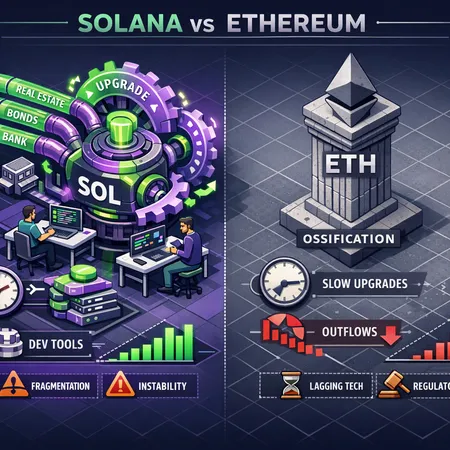
Anatoly Yakovenko, co-founder of Solana, has been explicit: the network’s longevity depends on perpetual evolution rather than pausing at a “finished” spec. That line of thinking—summed up in recent interviews and commentary—frames upgrades as existential rather than optional. The claim is simple: if a base layer stops iterating, it risks obsolescence in the face of new use cases, performance demands, and regulatory patterns.
This article examines that claim, contrasts it with the opposing view that protocols should resist frequent breaking change (the so-called protocol ossification debate popularized in Ethereum circles), and maps the consequences for developer retention, RWA (real-world assets) adoption, and SOL token economics. Along the way we’ll unpack specific Solana upgrade dynamics, the real risks of constant change, and practical signals investors and builders should watch.
Yakovenko’s core argument: evolve or get outcompeted
Yakovenko’s framing—covered in interviews and analysis—positions Solana as a platform that must keep iterating to stay relevant. The essence: new workloads, new compliance needs, and new performance frontiers will continuously emerge; a static protocol cannot support them all. You can read this viewpoint in detail in commentary where Yakovenko underscores perpetual innovation as necessary for survival Solana co-founder argues perpetual evolution is necessary.
This thesis isn’t merely philosophical. It is operational: Solana teams push frequent runtime improvements, experimental features, and performance tweaks that attempt to unlock new classes of applications—especially those tied to high-throughput or low-latency requirements.
What “continuous upgrades” looks like on Solana
Solana’s engineering cadence contains several practical elements:
- Frequent runtime releases and performance patches that adjust validator behavior or transaction processing logic.
- Experimental features enabled on testnets and sometimes staged behind feature flags on mainnet beta before broader adoption.
- Rapid tooling updates (SDKs, RPC libraries, monitoring) to match protocol changes.
- Emphasis on benchmarking and throughput-focused optimizations rather than long stability windows.
Those dynamics create a pipeline where new capabilities reach developers faster—but often with less of the long vetting cycles Ethereum historically uses.
Upgrade mechanics and developer-facing changes
Solana upgrades can touch the runtime, consensus parameters, or transaction processing semantics. That means SDK methods, account models, and low-level tools can change. From a developer’s point of view this looks like fast access to new primitives, but also a need to keep dependencies up to date and test against new validator client behavior.
The counterpoint: Ethereum’s ossification debate
Ethereum’s approach has trended toward ossification—a deliberate conservatism to preserve assumptions developers make about the chain. The value: predictable behavior over long time horizons, easier long-term tooling, and reduced risk for large smart-contract projects.
Ossification isn’t stagnation. Ethereum still upgrades, but its upgrades favor long incubation, EIP-based discussion, and strong backwards-compatibility guarantees. This contrasts with a model that prioritizes speed of iteration over immutability of developer expectations.
Developer incentives and retention: speed vs. stability
Developer retention is a behavioral outcome of two sometimes-conflicting incentives: the desire to build on the latest primitives and the desire for predictable platform guarantees.
- Fast-evolving platforms (Solana) attract teams wanting bleeding-edge performance and willing to iterate quickly. These projects benefit from early access to optimizations and niche ledgers tailored to their needs.
- Conservative platforms (Ethereum/ETH) attract teams building mission-critical systems that prize long-term security assurances and a stable tooling ecosystem.
The retention trade-off is real: some teams will move toward Solana for throughput or cost advantages; others will migrate away if repeated upgrades cause breakage, or if supporting multiple protocol versions becomes expensive.
Why continuous innovation matters for RWA adoption
Real-World Assets—tokenized bonds, mortgages, receivables—carry extra requirements: custody integrations, compliance controls (KYC/AML hooks), more sophisticated settlement guarantees, and often higher throughput for batch processing. Solana’s upgrade-first posture can help here in several ways:
- Rapidly introduce primitives that simplify custodial workflows or native compliance hooks.
- Scale throughput to support high-volume settlement and fractionalization without prohibitive fees.
- Iterate on program-level standards for RWA tokenization more quickly than a conservative chain might.
The market evidence that RWA traction matters for Solana is visible: reporting has highlighted a meaningful milestone—over $1B in RWA activity on Solana—demonstrating demand and the need for infrastructure to keep pace Solana RWAs hit $1B milestone.
In short: if RWA flows are a priority, rapid protocol-level capability growth can be a competitive advantage. But the same speed that helps adoption can also create risky edge cases for custody and regulatory compliance, so execution quality matters.
Token economics: how upgrades affect SOL holders
Frequent protocol change influences token economics indirectly:
- Fee market and throughput changes can alter on-chain revenue for validators and fee-burn dynamics, which in turn affects the effective supply-demand balance for SOL.
- New features that increase utility (e.g., enabling RWA primitives) can expand demand for SOL as collateral, gas, or settlement token.
- Conversely, upgrade-induced instability (downtime, forks, or client incompatibilities) can erode confidence and introduce price volatility.
For investors, this means SOL exposure is partly a bet on execution: upgrades must unlock durable new demand without crippling reliability or fragmenting the developer base.
Risks of constant change: fragmentation, instability, and trust erosion
Pursuing continuous evolution entails several concrete risks:
- Fragmentation: If different validators or major actors run different versions or disagree on runtime semantics, it creates a fractured ecosystem where dApps must support multiple modes.
- Instability: Rapid releases increase the chance of regressions, unexpected interactions, or even brief outages. Solana’s history has included network incidents that feed this narrative.
- Tooling churn: Frequent breaking changes raise maintenance costs for SDKs, indexers, wallets, and custodians.
- Trust erosion: Institutional players (custodians, compliance teams) may be reluctant to onboard assets when the protocol surface can change quickly.
These risks are not theoretical—each has shown up in other fast-moving software ecosystems. The mitigation strategy requires strong testnets, robust upgrade signaling, and conservative gating for breaking changes.
Practical signals investors and builders should watch
If you’re deciding between a fast-evolving chain like Solana and a conservative chain like Ethereum, focus on observable signals rather than rhetoric. Key signals to monitor:
- Upgrade cadence and transparency: frequency of releases, advance notice, and changelogs. Count both patch and breaking releases.
- Testnet health and staging: how long features run on testnets, the breadth of validator participation, and recorded testnet incidents.
- Tooling maturity: stability of SDKs, number of active client libraries, RPC provider uptime, and quality of debuggers and simulators.
- Governance/process clarity: how are decisions made, who vetoes breaking changes, and how are validators and major stakeholders consulted?
- RWA inflows and custody readiness: measurable on-chain tokenization volume, number of institutional counterparts, and presence of regulated custodians.
- Developer onboarding metrics: new program deployments, GitHub activity, and retention of teams across major releases.
- Reliability metrics: validator count, block time variance, rollback events, and mean time between incidents.
For RWA specifically, watch custody integrations and announced partnerships, the dollar volume of tokenized instruments, and on-chain indicators such as wrapped asset minting and settlement frequency. These are direct proxies for the practical ability of the chain to host regulated assets.
A pragmatic middle path: evolve with guardrails
The most sustainable approach may be a hybrid: maintain a strong testnet incubation pipeline and time-limited feature flags while enforcing strict backwards compatibility for core primitives relied upon by large contracts. That path keeps the door open for innovation without destabilizing mission-critical contracts.
Practical guardrails include:
- Long-living compatibility layers or versioning that let dApps opt into new behavior gradually.
- Extensive testnet windows and incentives for validators and ecosystem tooling providers to participate in pre-mainnet releases.
- Clear deprecation schedules so teams can plan migrations.
- Robust telemetry and chaos-testing to surface rare interactions before they hit mainnet.
Conclusion: choice depends on risk tolerance and goals
Yakovenko’s survival thesis is attractive for teams that prize speed, throughput, and quick iteration—especially for RWA use cases that demand bespoke primitives and performance. But that thesis also puts the onus on Solana’s engineering and governance to execute upgrades with discipline. For builders and investors the decision boils down to which trade-offs fit your project:
- Choose fast-evolving chains if you need novel performance or rapid feature landings and you can tolerate higher operational maintenance.
- Choose conservative chains if you prioritize long-term stability, broad institutional tooling, and low migration cost for critical contracts.
Finally, for those building or allocating resources, track the practical signals above. Tools, testnets, RWA flows, and upgrade transparency will tell you more about a chain’s fitness than narratives alone. Platforms such as Bitlet.app and other services will favor ecosystems that combine real demand (RWA inflows) with operational reliability.
Sources
- Solana’s future hinges on constant innovation, says co-founder — interview and framing from Anatoly Yakovenko
- Yakovenko’s adapt-or-die warning lands as Solana RWAs hit $1B — reports the $1B RWA milestone on Solana
For context on cross-chain narratives and market positioning see discussions on Solana and RWA activity across DeFi.