Why Solana Is the Preferred On‑Chain Infrastructure for Stablecoins and Tokenization in 2026
Summary
Executive summary
For product leads and treasury teams evaluating on‑chain rails in 2026, Solana (SOL) is worth a fresh look. Its raw throughput, consistently very low fees, and a measurable rebound in network activity position it as a practical choice for high‑volume stablecoins and tokenization projects that prioritize cost and latency. That said, choosing a chain is not purely a technical decision: regulatory, custodial, liquidity, and operational factors must be assessed in parallel.
This article breaks down Solana’s technical strengths, recent on‑chain signals (including active addresses and ETF‑related volume context), how it stacks up against Ethereum rollups for continuous payment rails, regulatory and custody considerations for issuers, and the most important investment and operational risks to watch.
Why Solana’s technical profile matters for stablecoins and tokenization
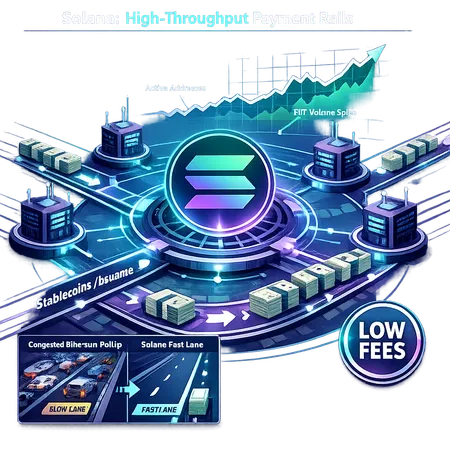
Stablecoin issuers and tokenizers are, at heart, throughput and cost businesses. Tokenized USD rails require predictable settlement, minimal per‑transfer costs, and the ability to handle spikes without catastrophic fee inflation. Solana’s architecture — a combination of a fast consensus pipeline, optimistic transaction processing, and a parallelized runtime — delivers low latency and low fees in normal and stressed conditions, which reduces the operational burden on treasury systems that would otherwise need complex batching and off‑chain workarounds.
Practical implications for issuers:
- Sub‑cent transaction fees lower per‑unit custody and reconciliation costs, which is material when moving thousands of small payments per minute.
- High finality rates and low latency simplify treasury flows: fewer retries, reduced queueing, and tighter slippage assumptions for automated market makers and internal netting.
- On‑chain tokenization workflows (minting, fractionalization, governance hooks) run cheaper and faster, enabling new product designs that would be too expensive on higher‑fee rails.
These technical features make Solana an attractive operational base for stablecoins and tokenized assets that expect consistent, high volume rather than occasional, high‑value settlement bursts.
Recent network momentum: active addresses and ETF volume context
Two market signals in early 2026 reinforce the argument for Solana as a rail for issuance. First, on‑chain metrics show a rebound in active addresses and transaction density following prior cycles; on‑chain analysis highlights a recovery that supports renewed protocol utility and user activity. Coinpedia’s recent piece points to rebounding active addresses and ETF‑adjacent volumes as a potential catalyst for price and usage resets, an indication that demand for transfers and tokenized flows could follow wallet growth.
Second, broader institutional flows tied to ETFs and large custodial venues can produce sustained on‑chain settlements (redemptions, arbitrage, rebalances). Analysts have argued that Solana’s speed and low cost profile increasingly appeal to stablecoin issuers and tokenization proponents who want rails that won’t be brittle under ETF‑related settlement volumes; see this analysis describing how Solana’s operational economics fit that use case.
- Coinpedia analysis on active address recovery and ETF‑connected volumes: Coinpedia: Solana price eyes $150 as active addresses rebound and ETF volumes hit $6B
- Commentary on why Solana’s low costs and speed make it attractive for tokenization and stablecoins: This cryptocurrency could be one of the best to own
These signals don’t guarantee issuance demand, but they lower the activation threshold for product teams deciding whether to build directly on‑chain or keep large parts of their flows off‑chain.
Solana vs. Ethereum rollups: comparative advantages for high‑volume stablecoin rails
Ethereum rollups (Optimistic and ZK) have made meaningful progress on security and tooling and remain the go‑to for composability with the Ethereum L1 ecosystem. Yet for continuous, high‑frequency settlement rails optimized for stablecoins and tokenization, Solana presents a few operational advantages:
- Predictable per‑tx economics: Solana’s fees remain low and less volatile than gas on congested rollups, reducing exposure to sudden cost spikes during demand surges.
- Lower end‑to‑end latency: Rollups introduce batching and sequencing latencies tied to L1 posting; for applications that need near‑instant confirmation and intra‑block settlement, Solana’s single‑layer finality often produces faster user and backend experiences.
- Simpler operational stack: Running issuance, custody, and reconciliation against a single runtime (Solana) avoids some cross‑domain complexities of rollup + L1 state handling.
That said, Ethereum rollups still win on composability with a broad set of DeFi primitives, liquidity pools, and tooling. For teams that need deep on‑chain counterparties, existing stablecoin liquidity, and a mature permissioning ecosystem, a rollup strategy or hybrid architecture (settlement on Solana, custody and pegs mediated through rollup bridges) may be preferable.
A pragmatic pattern many treasury teams consider is hybrid: use Solana as the primary rail for high‑frequency, low‑value movements (e.g., payer rails, micro‑payments, internal netting) and rely on rollups or L1 for occasional large settlements where counterparty composability matters.
Regulatory and custodial considerations for issuers
Technical suitability is necessary but not sufficient. Issuers of USD‑denominated tokens must design for custody, compliance, and regulatory transparency from day one.
Key considerations:
- Custodial models and attestations: Institutional issuers will require enterprise custody solutions with proof of reserves, audited attestations, and clear keys‑and‑operations governance. On Solana, evaluate custodians’ support for validator staking, offline key management, and transaction signing to fit AML/KYC processes.
- Redemption and liquidity rails: Stablecoin issuers must guarantee on‑demand redemptions; integration with fiat rails, bank custody, and regulated broker‑dealers is as important as on‑chain settlement economics.
- Regulatory posture and jurisdiction: Different jurisdictions treat tokenized USD and algorithmic constructs differently. Work with counsel to define the token’s legal wrapper (demand deposit, stablecoin controlled by an issuer, or tokenized IOU) and select custodial arrangements that meet local regulator expectations.
- Auditability and forensics: Solana’s transparent ledger supports audit trails, but treasury systems must standardize reconciliation processes and third‑party monitoring to satisfy internal and external auditors.
Platforms like Bitlet.app show how product teams combine on‑chain rails with fiat rails and custody providers in practice; when evaluating chains, confirm your custody partners and compliance providers have mature Solana integrations.
Investment and operational risks to watch
No chain is risk‑free. For treasury and product leads, the following are practical risk categories that should factor into any decision to issue on Solana.
- Network reliability and congestion risk
Solana has historically faced outages and performance incidents. While throughput and fees are competitive, outages directly impact settlement guarantees and user trust. Mitigation: design retry logic, hold settlement buffers, and have fallback rails for critical flows.
- Liquidity fragmentation and market depth
Stablecoin liquidity, on‑chain AMMs, and cross‑chain bridges can be fragmented. Issuers relying on deep liquidity for peg maintenance should ensure market‑making relationships and cross‑liquidity arrangements are in place. Mitigation: contracted liquidity providers, dual‑listing on major DEXs, and programmatic incentives for market makers.
- Custody and key management
Operational keys, multisig governance, and hot/cold key ergonomics on Solana differ from Ethereum. Choose custodians with proven Solana experience; run regular drills for key rotation, compromise response, and disaster recovery.
- Regulatory and legal changes
Rule changes or guidance around tokenized USD instruments could impose new reserve, reporting, or licensing burdens. Keep legal counsel close and design for agility in compliance and reporting.
- Token economics and peg risk
If reserves or redemption mechanics are not 1:1 explicit and auditable, peg stability can be compromised. Design conservative reserve policies, transparent reporting, and rapid response plans for stress events.
Practical checklist for product and treasury teams
Before issuing on Solana, run this checklist with engineering, compliance, custody, and liquidity partners:
- Technical readiness: stress test settlement volumes, confirm meterability for micro‑fees, and validate finality assumptions under peak load.
- Custody integrations: confirm custodians support Solana multisig, offline signing, and third‑party attestations.
- Liquid markets: secure market‑making arrangements and dual listings to ensure peg maintenance and tight spreads.
- Compliance posture: align with counsel on the token’s legal structure, reserve reporting, and KYC/AML flows.
- Disaster recovery: implement alternate rails (e.g., rollup or L1 fallback) and operational runbooks for outages.
- Monitoring & observability: deploy tools for real‑time balance reconciliation, chain health signals, and counterparty exposure dashboards.
This pragmatic approach keeps the door open to hybrid architectures: many teams choose Solana for high‑frequency rails while preserving a settlement path on rollups or L1 for large or compliance‑sensitive movements.
Decision framing: when to choose Solana
Choose Solana if your primary objectives are predictable, low per‑transaction cost and very high throughput for continuous settlement workloads. Solana is especially compelling for payment rails that will process thousands of low‑value transfers per minute, tokenized micro‑positions, or platforms that benefit from predictable latency and simplified operational stacks.
If your project requires maximal composability with Ethereum‑native DeFi primitives today, or if your legal structure demands tight integration with L1 custody and tooling, carefully weigh the tradeoffs and consider hybrid patterns.
Conclusion
In 2026, Solana presents a credible, often preferable option for stablecoin issuers and tokenization projects that prioritize cost, speed, and operational simplicity for high‑volume rails. Recent upticks in active addresses and ETF‑related settlement context strengthen the case that demand could materialize at scale. However, operational resilience, custody maturity, and regulatory alignment are non‑negotiable prerequisites.
A well‑run issuance program on Solana combines disciplined custody, robust liquidity partnerships, and operational contingencies. For product and treasury teams, the choice is ultimately about matching risk appetite to the rail’s economics — and today, Solana deserves a place on the short list.