XRP’s Institution-Focused Resurgence: UDAX, Evernorth and On‑Chain Signals Point to Wall Street Readiness
Summary
Executive snapshot
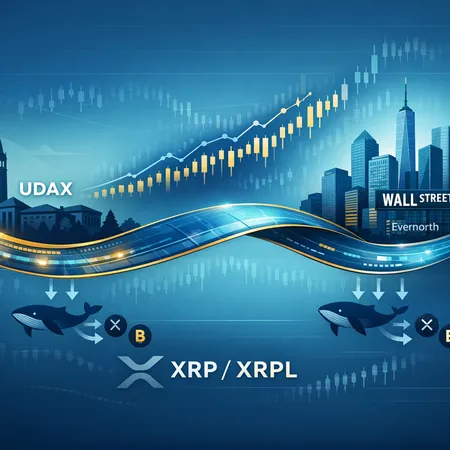
Institutional interest in XRP is no longer only about litigation outcomes or macro narratives; it’s increasingly about product, pipeline and predictable on‑chain usage. Two parallel moves are especially notable: the launch of a UC Berkeley accelerator for XRPL builders (UDAX) that addresses developer onboarding and real‑world use cases, and corporate positioning from Evernorth that explicitly frames XRP as a Wall Street‑ready public asset. Those supply‑side and demand‑side efforts are arriving alongside measurable on‑chain signals — rising daily transactions and a meaningful decline in whale flows to exchanges — which together justify a fresh look at XRPL from institutional desks.
For readers scanning for context, XRP is being reframed from speculative instrument to settlement and liquidity layer. That reframing has practical implications for treasury, custody, and product teams evaluating XRPL alongside other settlement rails like tokenized fiat or wholesale CBDC experiments.
Why Evernorth’s framing matters to institutional allocators
Evernorth’s public plan to make XRP accessible to Wall Street does two things at once: it creates a narrative that large allocators can discuss internally, and it operationalizes pathways for those allocators to access XRP exposure in a manner consistent with institutional compliance and custody expectations. Coverage of Evernorth’s ambitions sketches a roadmap by which XRP becomes comparable — at least in presentation — to other institutional‑grade assets, with formalized custody, reporting, and governance considerations that matter to compliance teams (see Evernorth analysis linked below).
This is significant because capital follows both legal clarity and investable product. If custodians and prime brokers can offer XRP with the operational controls institutions expect, then internal risk committees are likelier to permit allocations. The Evernorth thesis should therefore be treated as a signaling mechanism: it doesn’t by itself guarantee flows, but it reduces frictions that have historically kept balance sheet managers on the sidelines.
UDAX: developer pipeline and product‑market fit for XRPL
On the other side of the stack, UC Berkeley’s Digital Asset Xcelerator (UDAX) — a partnership announced to accelerate founders building on XRPL — tackles the other bottleneck: real use cases and developer talent. Bootstrapping high‑quality teams into XRPL matters because institutional utility requires more than transaction count; it needs composable apps, stable integrations, and predictable settlement behavior.
UDAX can shorten time‑to‑market for custody integrations, cross‑border payment rails, tokenized assets, and liquidity primitives that institutional desks would actually use. For product teams, an established accelerator at a research university provides two concrete benefits: (1) vetted developer flows that generate production‑ready projects, and (2) an academic bridge to experimental work that can be independently validated — both valuable when institutional teams do technical due diligence. The UDAX announcement is an important structural signal for onboarding, talent, and credibility.
(Read the UC Berkeley/UDAX announcement for more detail.)(UC Berkeley UDAX announcement)
On‑chain signals: surge in transactions and what utility‑based valuation implies
A key piece of evidence moving the needle beyond narrative is the uptick in XRPL on‑chain activity. Recent reporting shows a surge in daily transactions and a step up in active payment flows — data points consistent with growing utility rather than speculative churn. More on‑chain transactions can imply several things for institutional valuation:
- Increased baseline demand for native ledger services lowers the marginal cost of settlement and creates recurring revenue or usage models for custodians and relayers.
- Higher throughput tied to utility use cases makes price less hostage to short‑term macro correlation; it becomes more defensible as an operational hedge in treasury workflows.
- Persistent transaction growth improves model inputs for volume‑based tokenomics and liquidity provisioning assumptions.
Put bluntly: if transaction counts reflect genuine payment or settlement behavior (not simple on‑chain wash trading), they strengthen a utility‑first valuation that institutional desks can justify to compliance and risk committees. For readers who track the data, reporting on the spike in transactions is worth reviewing directly for cadence and composition details (NewsBTC coverage on transaction surge).
Whale flows and reduced exchange outflows: less supply shock, more hodl behavior
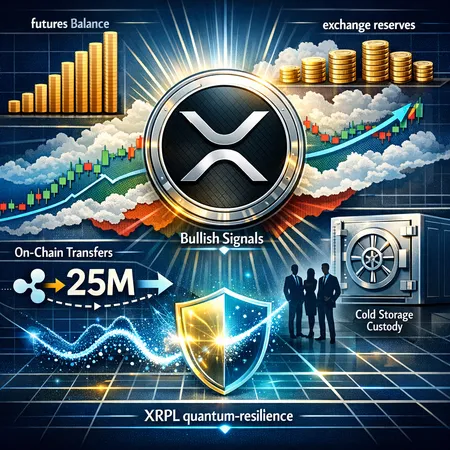
Another on‑chain development that alters the risk profile is a noticeable decline in large XRP inflows to major exchanges. Whale inflows to Binance reportedly plunged to multi‑year lows, a trend that often coincides with increased hodling and reduced immediate sell pressure. When large holders move less to exchanges, the market’s structural liquidity does not get replenished as quickly by potential sellers — and that can dampen volatility on forced‑sell events.
This behavior matters for anyone modeling downside tail risk. Reduced exchange flows suggest: (1) more coins remain in custody or cold storage, (2) longer duration holders are waiting for clearer institutional access or price targets, or (3) entities are preparing to allocate XRP to custody solutions rather than spot market exits. All three outcomes reduce the likelihood of sudden, large liquidity dumps — a positive for institutional stakeholders who worry about market integrity (Coinpaper analysis on whale flows).
How these developments change the trading narrative vs. Bitcoin
Historically, institutional narratives default to a Bitcoin‑centric framework: store of value, macro hedge, correlated risk‑on asset. XRPL’s trajectory suggests a different conversation is gaining traction — one that treats XRP as a settlement and liquidity layer rather than an allocative macro hedge.
Key differences to consider:
- Correlation dynamics: institutional utility (payments, tokenized asset settlement) can decouple XRPL’s short‑term price action from Bitcoin rallies and crashes. Over time, a larger share of demand tied to operational needs should reduce pure risk‑asset correlation.
- Liquidity provision: XRPL plugins and bridges that support institutional rails change who provides liquidity (custodians, market makers focused on settlement spreads) versus retail‑driven liquidity around BTC.
- Product suitability: Treasuries and custodians evaluate XRP on criteria like settlement finality, regulatory clarity, custody integrations and predictable throughput — not just macro narratives.
Standard Chartered and other institutional research teams laying out price targets are useful for long‑term expectations, but product teams should weigh operational fit first. For market structure analysis and price sensitivity, combine macro research with on‑chain metrics and custody pipeline progress (Standard Chartered price thesis and institutional framing).
Practical takeaways for institutional researchers and product teams
For teams evaluating XRPL as a settlement or enterprise play, here are actionable angles to prioritize:
Technical due diligence: analyze XRPL finality, throughput limits, and how UDAX‑incubated projects handle fault scenarios and compliance tooling. UDAX will produce early case studies to review (UDAX announcement).
Custody and operational pathways: confirm whether custody providers tied to Evernorth’s narrative meet your firm’s control requirements and can integrate with existing treasury workflows (Evernorth coverage).
On‑chain surveillance: monitor not only transaction counts but composition — are transactions peer payments, tokenized asset settlements, or exchange routing? Use the recent transaction surge as an invitation to dig into flow types (NewsBTC transaction analysis).
Liquidity risk modeling: update stress scenarios to reflect lower exchange inflows from whales; simulate slower unwind windows and the operational effects of custody‑led liquidity rather than exchange liquidity (Coinpaper whale flow report).
Narrative positioning: if pursuing XRPL‑based products, craft a risk narrative that emphasizes settlement utility, compliance readiness, and counterparty settlement benefits rather than pure price appreciation forecasts. Institutional buy‑in often requires operational stories.
For teams building tooling, Bitlet.app has been tracking custody and settlement primitives across rails; such platforms will be important partners as XRPL matures into institutional use cases.
Conclusion
Ripple’s dual approach — scaling developer talent via UDAX and legitimizing access through players like Evernorth — is starting to show up in the on‑chain data. A rising baseline of transactions and a decline in whale exchange outflows reduce certain market risks and make an operational valuation for XRPL more credible. That doesn’t mean XRP will replace Bitcoin as a macro hedge, but it does mean institutional teams should treat XRPL as a distinct settlement proposition with different correlation properties and product requirements. For researchers and product teams, the proper response is pragmatic: run robust technical due diligence, update liquidity stress tests, and treat the evolving institutional plumbing as the primary driver of long‑term utility and adoption.
Sources
- https://www.tokenpost.com/news/insights/18340
- https://coinpaper.com/13824/evernorth-sets-xrp-on-a-direct-path-to-wall-street?utm_source=snapi
- https://www.newsbtc.com/xrp-news/surge-in-xrp-transactions-1-45-million-daily-users-could-signal-price-rally-ahead-says-expert/
- https://coinpaper.com/13825/whale-watch-xrp-inflows-to-binance-plunge-to-2021-lows-hodl-mode-engaged?utm_source=snapi
- https://www.fool.com/investing/2026/01/17/xrp-ripple-will-soar-this-price-2028-wall-street/