What a Senate Vote Could Mean for Dogecoin: Legal Risk, ETF Pathways, and Exchange Listing Implications
Summary
Executive summary for compliance officers
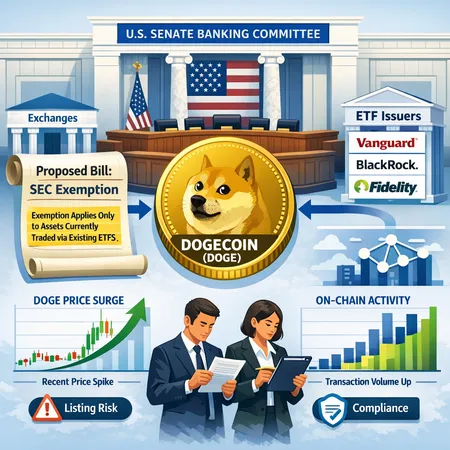
A reported Senate Banking Committee proposal would carve out Dogecoin from the SEC’s securities laws by tying the exemption to a token’s ETF trading status. That is, if DOGE is the subject of an exchange‑traded product meeting the bill’s criteria, it would not be treated as a "security" under federal securities statutes for certain purposes. Coinpaper summarizes the bill and the scheduled committee action; market participants already reacted, sending DOGE higher on the headline (see coverage of the price move).
For exchanges and ETF issuers, the immediate takeaway is practical: the bill (if enacted) reduces — but does not eliminate — securities enforcement risk for DOGE-related listings and products. It also creates a playbook for memecoin issuers to seek protection via ETF pathways, and it raises novel prudential, surveillance, and precedent questions that compliance teams must plan for now.
What the proposed bill appears to do (text and conditional mechanics)
According to reporting, the Senate measure would create a narrowly‑drawn statutory exemption from the securities laws for Dogecoin, conditioned on the token’s relationship to regulated ETF trading. The key mechanics — as described publicly — are:
- The exemption is tied to whether a spot DOGE ETF (or a substantially similar exchange‑traded product) is trading on a national securities exchange or otherwise meets defined registration and surveillance standards.
- If the ETF (or qualifying product) is operating under the federal securities framework, the underlying token — here, DOGE — would be treated outside the securities statutes for certain enforcement or registration purposes.
- The bill therefore does not declare DOGE to be a non‑security across the board; it draws a functional line: ETF‑covered tokens receive a statutory safe harbor from securities classification for discrete regulatory contexts.
This approach relies on a market‑structure proxy (presence of an ETF) rather than objective token attributes alone (e.g., decentralization tests). The result is a hybrid, status‑based exemption that invites coordination between SEC, exchanges, and ETF issuers on surveillance, custody, and disclosures. See the reporting on the Senate Banking Committee vote for background on timing and legislative intent.
How an ETF‑tied exemption would work in practice
Operationally, an ETF‑tied exemption creates two interlocking pathways:
Product pathway: ETF issuers petition the SEC (or rely on a modified statutory route if the bill is enacted) to list a spot DOGE ETF on a registered national exchange. Once the ETF meets the bill’s registration/surveillance criteria and is trading, the underlying token benefits from the exemption.
Listing/pathway for the token: Exchanges that list or custody DOGE would use the ETF’s trading status as evidence that DOGE is covered by the statute, reducing securities‑classification risk for marketplace listings and related services.
Because the exemption is conditional, compliance workflows must validate and continuously monitor the underlying product’s status. Controls would include:
- Daily verification that a qualifying DOGE ETF remains listed and compliant with exchange rules and the statute’s conditions.
- Surveillance‑sharing agreements between ETF sponsors and token markets to replicate the surveillance and anti‑manipulation expectations typical of listed securities.
- Custody and insurance standards for token holdings aligned with those used by ETF custodians.
These operational requirements mean the exemption is not purely a legal shield: it is an operational contract that binds ETF issuers, exchanges, and custodians to ongoing governance commitments.
Listing risk: how exchanges should reframe DOGE policy
If the bill becomes law, the securities component of listing risk for DOGE diminishes in the narrow statutory context the bill covers. But other listing risks remain:
- Administrative risk: the bill could be challenged, amended, or limited in scope. Exchanges should not assume permanence.
- Secondary regulation: other federal statutes (e.g., anti‑fraud provisions), the CFTC’s commodity jurisdiction, and state blue‑sky laws may continue to apply to DOGE trading and issuers.
- Market integrity risk: memecoins have history of extreme volatility and concentrated holdings; exchanges remain exposed to trading‑venue operational risk (liquidity, order routing, market manipulation claims).
- Reputational and prudential risk: listing a token that benefits from a statutory carve‑out still requires governance controls to address AML/KYC, sanctions screening, and consumer disclosures.
Practical steps for exchanges:
- Update listing policies to include a statutory‑status verification step tied to ETF trading and provide a sunset or contingency plan if ETF status changes.
- Negotiate surveillance‑sharing and liquidity‑monitoring agreements with ETF sponsors to demonstrate proactive market‑protection measures.
- Maintain conservative custody and insurance prerequisites for tokens that rely on the exemption.
ETF issuers: product design, approval risk, and obligations
For ETF issuers, the bill makes a DOGE spot ETF a strategic instrument: not only a product opportunity but a mechanism by which the underlying token gains narrower legal cover. That incentivizes rapid product filing, but issuers will face heightened scrutiny:
- Market surveillance: exchanges and regulators will expect comprehensive surveillance and market‑abuse mitigation plans. Sponsors should prepare trade surveillance data pipelines tied to on‑chain indicators and centralized order books.
- Custody rigour: custodians must demonstrate secure, auditable custody for DOGE private keys and robust proof of reserves and reconciliation processes.
- Disclosure and investor protections: product prospectuses will need to address volatility, concentration risks, and the conditional nature of the statutory exemption.
ETF issuers should coordinate with compliance counsel on whether the bill changes the standard SEC review playbook or simply reduces the odds of a securities‑related enforcement action against the token once the ETF is live.
Precedent for other memecoins: limited, but not negligible
A statute that ties exemptions to ETF trading status creates a route for other memecoins, in theory. However, practical barriers limit immediate replication:
- Liquidity and custody: many memecoins lack the deep, liquid markets and reliable custodial solutions needed to support a spot ETF.
- Surveillance suitability: exchanges and the SEC (or Congress) will likely expect surveillance arrangements that many smaller memecoins cannot meet today.
- Political and enforcement limits: Congress can design the DOGE carve‑out narrowly; a broadly framed memecoin exemption is less likely.
Thus, while this bill could become a template, each memecoin’s path to exemption would require discrete, product‑level infrastructure upgrades and regulatory buy‑in. In short: precedent is possible, but not automatic.
Price action and on‑chain momentum: reading the market signal
News of the Senate action produced an immediate market response: DOGE jumped after the headline, as reported by CoinDesk. That price move reflects a familiar feedback loop — regulatory headlines drive speculative flows, which in turn change on‑chain metrics (trading volume, exchange inflows, wallet activity).
For compliance teams, such price moves matter for two reasons:
- Liquidity and margining: sudden volume spikes can strain risk controls, margin models, and monitoring systems.
- Surveillance and AML signals: increased token movements and exchange flows raise false positive rates and require tuning to avoid operational overload.
Monitoring recommendations:
- Set early‑warning triggers for spikes in DOGE exchange inflows, on‑chain transfer volumes, and new wallet creation.
- Coordinate with custody and clearing teams to ensure settlement and reconciliation keep pace during pro‑volatility events.
What this does — and does not — change legally
What it does:
- Lowers the probability that SEC securities‑registration/qualification theories, at least for DOGE in the contexts covered by the statute, will be the primary enforcement lever.
- Gives exchanges and ETF issuers a statutory foundation to justify listing and product launches tied to DOGE.
What it does not do:
- Remove all regulatory exposure. Anti‑fraud rules, money‑transmission, AML obligations, and commodity jurisdiction issues persist.
- Guarantee immunity from private litigation or state enforcement actions.
Practical checklist for legal and compliance teams
- Legal assessment: update legal memos to reflect the statute’s scope and conditions; model worst‑case scenarios if the statute is reversed or narrowed.
- Listing policy updates: incorporate an ETF‑status verification process and contingency delisting triggers.
- Surveillance & data sharing: negotiate surveillance‑sharing and cross‑market data agreements with prospective ETF sponsors.
- Custody and insurance: require ETF‑grade custody controls for any token relying on the exemption.
- Market‑risk tuning: stress‑test risk engines for sudden DOGE volatility and reprice fees/margins accordingly.
- Regulatory engagement: coordinate with counsel and regulators (SEC, CFTC, state regulators) to clarify how the exemption is implemented and enforced.
- Communication plan: prepare clear customer disclosures about the conditional nature of the exemption and potential delisting or product changes if ETF status changes.
Policy implications and longer‑term questions
If Congress adopts a model that ties token status to exchange‑traded product existence, the long‑term landscape shifts from a purely attributes‑based securities analysis to a market‑structure analysis. That has pros and cons:
- Pro: Provides a predictable, administrable test that marketplaces can implement operationally.
- Con: Incentivizes a two‑tier system where tokens with capital to secure ETFs gain statutory advantages, potentially privileging established projects over grassroots tokens.
For regulators and market participants, the critical debate will be balancing investor protection against the desire for clear, workable rules.
Final recommendation (practical next steps)
Treat the reported Senate action as a material conditionality: prepare policies and operational controls now so your organization can move quickly if the exemption becomes law — but do not presuppose permanence. Update legal analyses, build surveillance and custody workflows that meet ETF‑grade expectations, and rehearse communication and contingency plans for both a passage and a reversal scenario.
For teams that want a practical benchmark, review existing ETF surveillance and custody playbooks and align DOGE procedures to those standards. This approach minimizes disruption and positions your exchange or product desk to act fast while maintaining compliance rigor.
For more technical background on market behavior and how memecoin sentiment moves price and on‑chain activity, teams can review market coverage and short‑term flow analysis — the immediate DOGE price reaction after the Banking Committee headlines is a useful, live case study of how regulation and speculation interact. See contemporary reporting for market reaction and context: Dogecoin regulatory status at stake in Thursday’s Senate Banking Committee vote and coverage of the price move in CoinDesk.
Bitlet.app’s compliance and listings team may find it useful to coordinate across product, legal, and market surveillance groups now rather than later; the operational work is the real gating factor if Congress ties token status to ETF trading.
Sources
- Coinpaper report on Dogecoin’s regulatory status and the Senate Banking Committee vote
- CoinDesk coverage of DOGE price action after the vote news
For related market context, consider review articles on Bitcoin market‑infrastructure precedent and how spot ETF approvals changed exchange behavior, and how broader token policy interacts with DeFi surveillance and custody expectations.