Zcash crisis explained: what the ECC devs’ mass resignation means for ZEC and governance risk
Summary
Executive summary
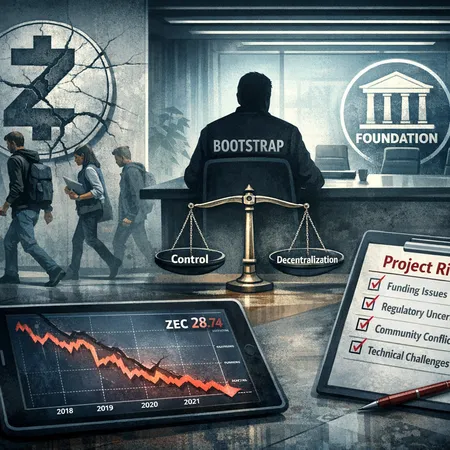
A sudden, public rupture between the Electric Coin Company (ECC) engineers and a governance actor known as Bootstrap led to the entire ECC core development team resigning. The announcement produced immediate market pain — ZEC plunged by double digits as markets re‑priced project risk — and prompted debate about how foundation‑backed and privacy projects should be governed. This article reconstructs the timeline, explains technical and trust consequences when core teams walk, assesses short‑term market fallout, and gives a practical risk checklist for asset managers and custodians.
What happened — a short timeline and the public record
In recent weeks reports emerged that the ECC development team resigned en masse after a governance clash with Bootstrap. A detailed report on the departures describes the dispute and the team’s exit as a governance rift that removed the people who maintain Zcash’s codebase and technical roadmap (Electric Coin Company’s entire Zcash team quits in bootstrap governance rift).
Markets reacted quickly. Coverage noted a sharp drop in ZEC price following the resignations, with exchanges and price aggregators recording a double‑digit fall amid heightened sell pressure and uncertainty (Zcash (ZEC) plunges by double‑digits after dev resignations). Independent commentary framed the resignations as revealing deeper structural flaws in foundation‑backed projects and the fragility of teams maintaining privacy technology (Zcash core developers resign in unexpected transition). Other reporting highlighted community fallout and allegations of malicious governance behavior in the dispute, which further inflamed market sentiment (Zcash dev team quits; ECC alleges malicious governance).
Together, these sources sketch a rapid sequence: governance conflict → core dev exit → community uncertainty → market selloff. The downstream effects — stalled upgrades, support gaps and reputational damage — begin immediately.
Why this matters: technical risks when a core team walks
Privacy projects like Zcash rely on specialized cryptographic engineering: zk‑SNARKs, shielded transactions, parameter ceremonies, and performance optimizations. That specialization becomes a liability when the team that understands and maintains those systems is gone. Key technical risks include:
- Unpatched vulnerabilities: Without core maintainers, newly discovered bugs — including cryptographic issues — may remain unaddressed for longer. That increases the chance of exploits.
- Upgrade paralysis: Planned hard forks or consensus upgrades can stall, leaving the network unable to respond to urgent fixes or to evolve. That weakens developer confidence and integration with wallets or services.
- Loss of institutional knowledge: Core contributors hold informal but critical knowledge (build processes, deployment keys, vendor relationships) that isn’t easily transferred.
- Single points of operational control: If release signing keys, treasury multisigs, or infrastructure admin access are controlled by the departing team, the protocol faces operational paralysis.
These are not hypothetical: specialist knowledge in privacy protocols magnifies both exploit risk and the time required to onboard replacement developers.
Trust risks and community fragmentation
Even if the code continues to run, the social layer matters. Foundation‑backed projects often depend on a small set of institutions for funding, governance, and public trust. The resignation triggered never‑clean narratives: accusations of malicious governance, opaque decision‑making, and leadership failure. That dynamic produces several trust risks:
- Liquidity drainage: Exchanges and market makers may widen spreads or withdraw ZEC exposure until governance clarity returns.
- Custodial anxiety: Institutional custodians may limit onboarding or require additional approvals for ZEC exposure.
- Developer flight: Other volunteer contributors may disengage if they perceive governance instability or reputational risk.
Because privacy coins already face regulatory scrutiny, these trust fractures can accelerate delistings, KYC tightening, or compliance reviews by service providers.
Market fallout: the immediate and near term
The short‑term market reaction is often predictable: a confidence shock prompts selling, which is amplified by low liquidity and concentrated holdings. As reported, ZEC experienced a double‑digit price drop on the news of ECC resignations, illustrating how governance events translate to valuation risk (cryptopotato coverage).
From an asset‑manager perspective, the key market channels to watch are:
- Liquidity and spreads: Thin order books make price impact larger. Watch intra‑day spreads and the depth of bids and asks.
- Margin and leverage cascades: Sharp slides can trigger liquidations that compound selling pressure.
- Counterparty risk: Exchanges, custodians and OTC desks reassess exposure and may impose limits or additional collateral requirements.
Contrast this with broader markets: for many traders, Bitcoin remains the primary bellwether, but idiosyncratic shocks like this can de‑link an asset’s performance from BTC for extended periods.
Governance models that reduce single‑actor risk
This crisis spotlights alternatives that would lower the odds of a single governance clash producing systemic disruption. The following models and practices mitigate the concentration of power:
- On‑chain governance with explicit upgrade paths: Clear, auditable proposals and time‑locked changes reduce the ability of any off‑chain actor to unilaterally derail progress.
- Diversified funding and distributed maintainer teams: Multiple organizations or a broader grant program reduce dependency on a single company.
- Multisig and threshold cryptography for operational keys: Require multiple independent approvals for releases and treasury moves to prevent operational lockout.
- Code escrow and external maintainers: Having community‑trusted code custodians and third‑party firms capable of taking over builds reduces downtime risk.
- Transparent dispute resolution frameworks: Formal processes for governance disagreements — mediators, arbitration clauses, or on‑chain referenda — can contain frictions before they escalate.
No single fix is a silver bullet. But combining these elements creates redundancy across social, economic and technical axes.
Practical steps: a risk checklist for asset managers and custodians
Below is an operational checklist you can run when evaluating exposure to any foundation‑dependent or privacy project. Treat it as a living due‑diligence script.
Governance & Organizational:
- Who controls protocol upgrades and treasury? Are governance rules written and public?
- Is funding concentrated in one institution or diversified across multiple streams?
- Are dispute‑resolution mechanisms defined and operational?
Technical & Codebase:
- Are key release procedures protected by multisig or time‑locks?
- Is the codebase well‑documented, actively maintained, and covered by recent security audits?
- Are cryptographic parameters and ceremonies reproducible and auditable by third parties?
Operational & Custody:
- Do custodians hold wallet‑level controls split across jurisdictions and independent signers?
- Are there playbooks for emergency forks, redeployment, or replay protection?
- Can custodians pause flows or delist from custody policies if a protocol becomes unsupportable?
Market & Liquidity:
- What is on‑chain and off‑chain liquidity depth? How concentrated are token holders?
- Are there hedging instruments or correlated exposures that reduce idiosyncratic risk?
Communication & Monitoring:
- Is the project’s governance, roadmap and communications cadence public and consistent?
- Does the team publish post‑mortems, incident reports and keyholder lists?
Operationalizing the checklist: convert answers into quantitative thresholds (e.g., minimum number of independent maintainers, maximum funding concentration) and require re‑assessment on material governance changes.
Immediate actions for token holders and custodians after a core dev exit
If you hold ZEC or custody it for clients, prioritize these steps:
- Increase monitoring: watch on‑chain metrics, project channels, and exchange liquidity.
- Reassess counterparty limits: ask exchanges and OTC desks about exposure limits and emergency support.
- Secure keys and segregate holdings: keep client assets isolated from any experimental operational accounts.
- Prepare for forks: ensure custodial tech can support snapshotting, replay protection and client notice processes.
- Engage governance: demand transparency, timelines for replacement maintainers, and a public roadmap for continuity.
These are practical, not theoretical, actions—custodians who moved quickly after prior developer incidents prevented operational blackouts and limited client losses.
Lessons for privacy projects specifically
Privacy coins face compounded risk: their technical stack is narrow and complex; regulatory pressure can shrink the pool of contributors; and privacy features require careful parameter management. Projects should prioritize:
- Broader contributor pipelines: fund multiple teams to work on cryptography, client wallets, and infra.
- Auditable privacy operations: publish ceremonies, seed management and how shielded‑chain operations are handled.
- Legal contingency planning: understand how regulatory actions could intersect with developer availability.
The Zcash episode is a reminder that privacy by obscurity is not a resilience strategy. True resilience comes from transparency around processes and distributed ownership of critical systems.
Conclusion — recalibrating project risk
The ECC dev team’s mass resignation and the governance clash with Bootstrap forced a quick market reckoning for ZEC and sent a broader message to investors: foundation‑backed projects can concentrate operational and governance risk in ways that are not immediately visible on balance sheets. For crypto asset managers and custodians, the right response is practical: embed governance and operational checks into due diligence, insist on redundancy for critical keys and contributors, quantify exposure to single‑actor failure, and prepare playbooks for rapid response.
Institutional practices are catching up. Exchanges, custodians and institutional buyers now treat governance clarity as a first‑order risk — the same way they treat code audits or legal opinions. Platforms such as Bitlet.app highlight the market need for robust custody and clearer governance when trading or providing credit against tokenized assets.
Sources
- Electric Coin Company’s entire Zcash team quits in bootstrap governance rift — https://crypto.news/electric-coin-companys-entire-zcash-team-quits-in-bootstrap-governance-rift/
- Zcash (ZEC) plunges by double‑digits after dev resignations — https://cryptopotato.com/zcash-zec-plunges-by-double-digits-bitcoin-btc-slips-below-90k-market-watch/
- Zcash core developers resign in unexpected transition; price reacts — https://u.today/zcash-core-developers-resign-in-unexpected-transition-price-reacts?utm_source=snapi
- Zcash dev team quits; ECC alleges malicious governance — https://cryptonews.com/news/zcash-dev-team-quits-ecc-malicious-governance-zec-price-drops/