Why Ethereum’s Infrastructure Upgrades and DeFi Milestones Matter for Institutional Flows
Summary
Executive summary
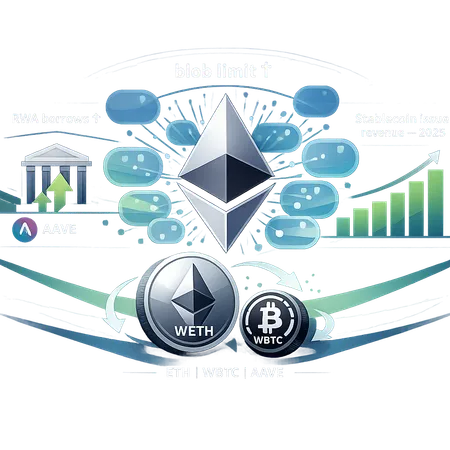
Ethereum’s recent infrastructure and DeFi milestones are starting to coalesce into a credible narrative for institutions considering on-chain reserves and payments. The blob limit increase and improved EVM data-blob handling raise per-block data capacity; stablecoin issuers captured roughly $5B in revenue on Ethereum during 2025; Aave Horizon’s real‑world‑asset (RWA) borrows topped $200M; and some funds are rotating exposures toward WETH from WBTC. Together these developments lower cost and technical friction for high-volume flows while exposing a new set of operational and governance questions.
What the blob-limit increase actually enables
In a nutshell: raising the blob limit increases the amount of EVM data blobs that can be processed per block, boosting how much off-chain or rollup-produced data can be posted to L1 per unit of gas. The recent hard fork that increased the blob limit expands per-block data capacity and improves the economics of rollups and high-throughput settlement systems (Cryptopolitan — Ethereum raises blob limit to 21).
Why this matters for institutions:
- Lower marginal settlement cost for rollups. More blob capacity means rollups can post more compressed batch data without crowding L1, reducing per-transaction amortized settlement fees. That’s important when you need thousands of small payments or stablecoin movements to reconcile quickly.
- Improved data availability (DA) assumptions. Larger blob windows let DA layers and sequencers rely on predictable L1 posting cadence, tightening guarantees for custodians and auditors.
- Enables richer on-chain telemetry. Higher data throughput helps exchanges, OTC desks, and treasury systems reconcile flows on-chain rather than off-chain spreadsheets.
Technical implications for rollups and payments
The blob-limit change is a piece—not a panacea. Rollups still need efficient compression, sequencer performance, and robust fraud/proof mechanisms. But combined with better DA bandwidth, the economic case for running payment rails and large stablecoin settlement batches on Ethereum strengthens: fewer rollup batches hit sudden L1 congestion spikes, and amortized costs fall.
Stablecoin revenue on Ethereum: economic proof of demand
Stablecoin issuers recorded roughly $5 billion in revenue on Ethereum in 2025 — a striking figure that signals institutional usage beyond speculative trading (Cryptopolitan — Stablecoin issuers rake in $5B rev). For product teams and strategists, this is proof that liquidity and settlement demand are substantive and monetizable.
How to interpret that number:
- Not just fees, but economic activity. Much of that revenue comes from spread capture, on‑chain settlement fees, and interest from treasury operations — all of which scale when more payments and reserves sit on-chain.
- Network effects for rails. As stablecoin flows concentrate on Ethereum, ancillary markets (liquidity pools, lending markets, custodial services) deepen, which in turn reduces slippage and improves execution for large counterparties.
- Regulatory signal. Revenue concentration can attract scrutiny, but it also motivates better self‑governance, transparency, and institutional-grade tooling (audited smart contracts, AML controls, and custody integrations).
Aave Horizon and RWAs: lending real assets on-chain
Aave Horizon’s RWA borrows surpassing $200 million is more than a headline — it’s a practical example of capital migration into on-chain credit markets (AltcoinBuzz — Aave Horizon RWA borrows hit $200M record). RWAs convert traditional cashflows (invoices, leases, bonds) into tokens that DeFi protocols can lend against.
Why RWAs matter for institutions:
- Yield diversification. Institutional treasuries seeking low-volatility return can place surplus capital into RWA-denominated lending pools with clearer cashflow profiles than pure crypto collateral.
- Credit-layer integration. When RWAs are embraced by major lending protocols like Aave, on-chain lending becomes a stronger complement to off‑chain treasury management.
- Composability of reserves. Funds holding stablecoin reserves can earn additional yield by deploying into vetted RWA credit lines, reducing net custody costs.
Risk and operational considerations
RWAs introduce counterparty, legal, and oracle risks. Product teams must ensure strong legal wrappers, transparent asset audits, and resilient price/cashflow oracles. The AAVE community and protocol governance are active risk surfaces — institutions will look for clear dispute resolution and liquidation playbooks before committing large reserves.
Funds rotating toward WETH: why native ETH liquidity matters
Several funds are increasing WETH exposure while trimming WBTC allocations — a behavioral signal documented in market reporting (Cryptopolitan — World Liberty FI increasing ETH, divesting WBTC). The rotation reflects practical preferences:
- Native settlement and fewer wrapping layers. WETH is simply wrapped ETH and lives natively on Ethereum, avoiding cross-chain wrapping steps and custody frictions that WBTC (a custodial wrap with BTC as the underlying) entails.
- Liquidity and slippage advantages. ETH/WETH markets tend to be deeper on DEXes and on L2s, reducing execution costs for large trades or treasury rebalances.
- Protocol alignment. As many DeFi primitives (lending pools, liquid staking, fee markets) are ETH‑native, holding WETH simplifies integrations and reduces composability plumbing.
For institutional treasuries this implies:
- Re-examine reserve allocations to favor native-token liquidity where settlement speed, on-chain yield, and composability matter.
- Coordinate custody and settlement workflows to account for WETH’s on-chain simplicity versus WBTC’s off-chain exposures.
Putting it all together: is Ethereum ready for larger reserve and payment flows?
Short answer: materially closer than a year ago, but not turnkey.
Strengths that move the needle:
- Data capacity and rollup economics: The blob-limit increase eases throughput constraints and lowers the per-settlement cost of rollups and batch reconciliations.
- Market validation: $5B in stablecoin issuer revenue and Aave Horizon’s RWA traction demonstrate commercial demand and the beginnings of institutional product-market fit.
- Liquidity preferences: A rotation to WETH sharpens on-chain settlement plumbing and reduces multi-party custodial complexity.
Remaining gaps and questions for product teams:
- Custody and custody-as-a-service maturity. Institutions need multi-sig, regulated custodians, and insured custody with straightforward recovery procedures.
- Oracle and legal frameworks for RWAs. On-chain representations must have enforceable off-chain claims, transparent audits, and fallback dispute processes.
- Regulatory clarity. Stablecoin issuer revenue and concentrated flows will accelerate regulatory interest; proactive transparency and compliance tooling are essential.
Bitlet.app and other custody/payment providers should be watching these metrics — blob-limit utilization, stablecoin revenue trends, Aave Horizon RWA growth, and WETH/WBTC portfolio ratios — as barometers of readiness.
Actionable checklist for DeFi product teams and strategists
- Integrate and test rollup settlement flows that assume higher blob throughput; measure per-batch cost reductions.
- Build treasury modules that accept and reconcile stablecoin inflows on L2s and L1 with automated settlement batching.
- Partner with regulated custodians to offer native WETH custody and frictionless bridge/wrap processes where necessary.
- Perform legal and oracle due diligence before allocating Treasury to RWAs; require standard documentation and third‑party audits.
- Monitor these KPIs monthly: blob-limit utilization, stablecoin revenue by issuer, Aave Horizon RWA outstanding borrows, and WETH/WBTC exposure ratios.
Sources
- https://www.cryptopolitan.com/ethereum-raises-blob-limit-to-21/
- https://www.cryptopolitan.com/stablecoin-issuers-rake-in-5b-rev/
- https://www.altcoinbuzz.io/cryptocurrency-news/aave-horizon-rwa-borrows-hit-200m-record/
- https://www.cryptopolitan.com/world-liberty-fi-increasing-eth-divesting/
For more background reading on protocol-level tradeoffs and design options, see coverage on Ethereum and broader DeFi.