Institutional Flows into Bitcoin in 2026: What Spot-Led Gains Mean for Price Discovery
Summary
Executive summary
Institutional flows into Bitcoin are louder and more consequential in early 2026 than many expected. Changes to index treatment and renewed product interest have reduced some regulatory and indexation friction, while a visible rotation of smart money and corporate stake adjustments is shifting how price is discovered: more on the spot market, less in derivatives froth. For allocators and PMs, this environment offers opportunity — and new execution challenges — as spot-led gains imply different liquidity and slippage dynamics than levered, derivatives-driven rallies.
MSCI adjustments and the institutional framing
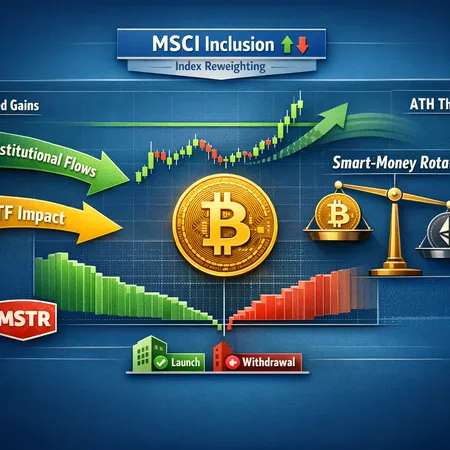
The most immediate structural story this year has been index-level housekeeping. MSCI’s decision to reduce near-term index exclusion risk for bitcoin-treasury equities has already catalyzed re-ratings in companies with meaningful BTC on their balance sheets. That kind of change matters because many large allocators route exposure indirectly — through index funds and equity screens — and index treatment can be just as important as regulatory clarity when pension funds and insurers run models.
To be precise: when MSCI narrows the odds that a security will be excluded from broad indexes, it reduces a forced seller cohort. That in turn improves the expected free float and lowers the cost of holding allocators’ positions. You can see the market’s reaction in re-ratings of bitcoin-heavy equities such as MSTR, which often act as a proxy for institutional appetite when direct spot access is constrained.
For traders who follow on-chain and spot flow signals, it’s worth remembering that index moves are a slow but durable catalyst: flows triggered by index rebalancing arrive over weeks and months, not hours. That pacing is one reason large buy-side orders are increasingly executed into the spot market rather than through synthetic derivatives structures.
ETF impact, product launches and withdrawals: a mixed signal
2026 has produced a mixed bag of product headlines: new spot-capable vehicles and bespoke custody arrangements have launched at the same time some funds have seen withdrawals or temporary suspensions. The net effect is not simply “more demand” — it’s a redistribution of where demand lands.
Spot-led ETFs and custody products put permanent cash into the spot market, which is meaningful because it tightens the basis (the premium of spot over futures) and anchors price discovery to actual ownership. Recent analysis of the market shows that the latest BTC advance looks spot-driven, with derivatives lagging — a condition that generally supports a healthier and more durable upward price path than a derivatives-first run-up. See coverage that highlights this divergence between spot and derivatives momentum and why it matters for durable price discovery.
At the same time, product withdrawals and redemptions are reminders that liquidity is bi-directional. Allocation committees should therefore model both episodic accumulation and sudden outflows, especially where concentration exists in a handful of products or custodians.
Smart-money rotation: from BTC to ETH and what it signals
There’s a clear tactical rotation playing out among sophisticated traders and whales: taking profits on rallying BTC and redeploying into Ethereum and select alt narratives. Reporting that a large Hyperliquid whale closed a BTC trade and went long ETH is illustrative — it’s not just retail chasing narratives; this is capital allocation by players who track cross-market signals and funding costs.
Why does that matter? Smart-money rotation can broaden market leadership and reduce the single-asset concentration risk of a BTC-only rally. For price discovery, the rotation creates two simultaneous effects: it siphons some spot demand away from BTC (potentially capping instantaneous upside) while injecting fresh liquidity into ETH markets, where new narratives (L2 settlements, rollups, tokenized infra) can accelerate price discovery on their own merits.
Importantly, rotation by well-capitalized players tends to be executed in sizable, measured blocks and often uses OTC and block desks to reduce slippage. That makes on-chain flows and exchange inflows less obvious in the short term, so PMs should combine on-chain metrics with OTC and prime-broker reports to build a full picture.
The ATH thesis and the chorus of bullish voices
A louder public chorus this year argues that BTC is poised for a new all-time high. Prominent industry voices and institutional figures publicly predicting a 2026 ATH are part of the narrative. These voices can shape sentiment and, crucially, shorten the horizon for momentum-chasing allocators.
Yet sentiment alone doesn’t create a sustainable high; it needs capital and execution. The combination of positive index treatment, fresh spot-oriented products, corporate and tech-sector interest in holding BTC, and concentrated smart-money re-allocation can provide that capital. Still, portfolio managers should treat headline optimism as one input among many — important for crowding risk and timing, but insufficient without observable spot flows, narrowing basis, and corroborating on-chain accumulation.
Mechanics: how institutional demand translates into spot-led rallies
Understanding the plumbing is essential for execution and risk management. Here are the key mechanical steps that convert institutional intent into durable spot-led price moves:
- Trade initiation and custody: Institutional allocations are often executed via prime brokers, OTC desks or authorized participants who source spot BTC for the fund or ETF. The transfer of coin to secure, regulated custody is the literal movement of supply that matters.
- Basis compression: Large spot buying tends to compress the basis (spot vs futures price). When spot demand outstrips futures-driven leverage, the basis tightens or flips, signaling that new demand is being soaked up by actual coin purchases rather than synthetic exposure.
- Reduced derivatives amplification: If spot flows dominate, the typical derivatives feedback loops (high funding rates, aggressive perpetual buying) are muted, producing a more measured, less explosive price path.
- Corporate balance-sheet effects: When corporations or tech founders disclose or adjust BTC holdings — as happened previously with notable founders and acquisitions that drew attention to early bitcoin roots — it changes the supply landscape by locking more BTC out of circulating supply.
- Re-rating and equity flows: Index adjustments and improved index inclusion prospects can trigger equity reallocation into bitcoin-heavy corporate equities, adding another vector of institutional capital beyond spot ETFs.
Taken together, these mechanisms explain why analysts have observed BTC’s recent move as spot-led, which in turn supports the narrative of a higher-quality price discovery process than what’s seen in purely derivatives-driven rallies. For a deeper breakdown of spot-driven implications, see the analysis arguing recent BTC gains are outpacing derivatives activity.
Risks and execution pitfalls for allocators
Institutional flows aren’t a one-way ticket. Several risk vectors deserve attention:
- Liquidity and slippage: Spot-led accumulation consumes order book liquidity. Execution quality matters; large buys pushed through concentrated venues can create adverse price moves.
- Crowding: As the ATH thesis gains airtime, strategy crowding can produce sharp reversals. Monitor concentration across products and counterparties.
- Regulatory and index reversals: Index providers and regulators can change treatment; the MSCI tailwind could be temporary or conditional. Scenario-test for the sudden return of forced selling.
- Correlation and macro beta: BTC’s correlation to risk assets can re-emerge, especially in macro stress. Don’t assume crypto will always decorrelate.
For PMs, implementation matters. Use a mix of OTC, algos and block trades; stagger accumulation; and put sell-side guardrails in place for rapid redemptions.
Signals to watch in 2026 (practical checklist)
- ETF net flows and authorized participant activity: are flows persistent or front-loaded?
- Basis and funding rates: is spot tightening while futures funding remains subdued? That’s a hallmark of spot-led rallies.
- On-chain accumulation by exchanges vs custodial outflows: sustained custodial inflows to cold storage suggest long-term holding.
- Large-wallet rotation: follow smart-money moves and large block OTC prints; they often precede broader market rotations.
- Index provider notices and corporate treasury filings: MSCI notes or SEC/XBRL filings from bitcoin-holding companies can be catalysts.
- Macro liquidity indicators: central bank moves and dollar liquidity still shape risk appetite.
Monitoring these signals together gives a higher-probability read on whether institutional flows are permanent or transient.
Practical allocation takeaways
For investors and portfolio managers weighing allocations in 2026:
- Treat BTC as allocation-grade when you can manage execution risk and custody; spot-led supply absorption is a favorable structural signal.
- Consider complementary exposure: equity proxies like MSTR can be useful tactical tools but carry idiosyncratic equity risk and must be stress-tested alongside direct spot allocations.
- Use ETH exposure selectively: smart-money rotation implies alpha opportunities in ETH when BTC rallies slow, but execution and gas-fee dynamics matter.
- Roll execution into strategy: use staggered buys, OTC/prime desks, and custody diversification. Tools and platforms such as Bitlet.app are part of a broader execution toolkit for retail and institutional participants.
Conclusion: durable price discovery or froth? A conditional bullish case
The balance of evidence in early 2026 leans toward a healthier price-discovery regime. MSCI’s index moves, product evolution, visible spot demand and smart-money rotation create a multi-vector demand environment that favors spot-led rallies and makes the ATH thesis operationally plausible. That said, durability depends on continued, observable spot accumulation and disciplined execution by institutions — not just bullish headlines.
For portfolio managers, the task is to synthesize cross-market signals, protect against crowding and liquidity shocks, and execute thoughtfully. If spot demand remains the dominant force, 2026 could rewrite the playbook for institutional crypto allocations.
Sources
- MSCI decision reduces near-term index exclusion risk for bitcoin-treasury equities (CoinDesk)
- Former BlockFi CEO Zac Prince predicts a new BTC ATH in 2026 (CoinPedia)
- Hyperliquid whale closes BTC trade, goes long on Ethereum (CoinSpeaker)
- Bitcoin price enters moderate expansion as spot-driven gains outpace derivatives (Crypto.news)
- Meta acquisition highlights early bitcoin roots of founders (Bitcoin.com News)