Bitget’s TradFi Launch and the Tokenized Stocks Race: Mechanics, Risks, and Why BGB Matters
Summary
Executive summary
Bitget has opened its TradFi trading suite to the public after a successful private beta, marking a step-change in how centralized exchanges distribute tokenized stocks and TradFi-like products to global clients. The move accelerates a broader industry debate: are tokenized stocks simply another wrapper or a new settlement primitive that can reshape market structure?
This feature explains how Bitget’s TradFi product works at a product and institutional level, summarizes beta performance signals and findings from the Block Scholes report on exchange-led tokenization, and explores the custody, regulatory and market risks — including how token unlock schedules (for example, BGB and ONDO) can stress or support tokenized markets. For readers building or choosing rails — product managers and institutional traders — the focus is on claim mechanics, liquidity, hedging, and systemic operational risk.
For many traders, Bitcoin still sets headlines, but tokenized equities are quietly creating a parallel rail that blends crypto-native primitives with traditional market exposure.
What Bitget’s public TradFi suite offers now
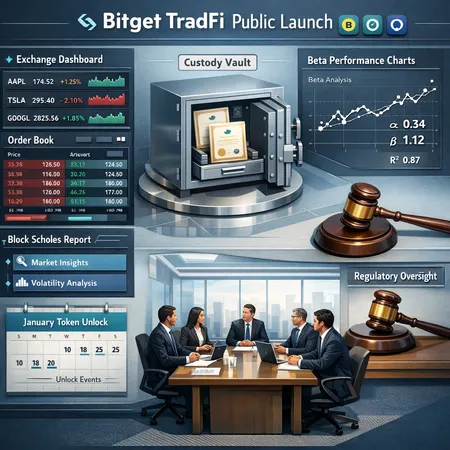
Bitget announced that its TradFi suite — previously available to a limited beta cohort — is now open to the public, having passed the private testing phase and product-market fit checks. Public availability means broader on-boarding, new order flow, and a testing ground for cross-product synergies between spot tokenized stocks, derivatives and the exchange’s native token incentives.
At a high level the suite typically offers:
- Tokenized shares or share-representation tokens that track listed equities. Implementation can be fully-collateralized (each token backed by an underlying share or cash-equivalent) or synthetically replicated with derivatives or pools.
- An order-book and matching engine familiar to exchange traders — but with 24/7 trading and crypto-like rails for settlement finality.
- Integrated custody and redemption flows: users can often trade tokenized stocks on-chain while redemption/creation paths tie back to an off-chain custodian or issuer.
- Fee and incentive schemes that lean on exchange native tokens (e.g., BGB) for discounts, liquidity mining or market-making rebates.
Bitget’s public rollout follows a private beta that, according to the company announcement, validated product stability and user flows before wide release. The launch article framed the move as a scaling step from a controlled environment to production with broader exposure and liquidity formation (Bitget TradFi public announcement).
How tokenized stocks work in practice: mechanics product teams must map
Tokenized stocks are not a single technical pattern — they’re a set of design choices that determine legal enforceability, counterparty risk, and settlement finality. Product managers should map these dimensions explicitly.
Core components:
- Legal wrapper and issuer: a legal vehicle issues tokens representing economic exposure. The issuer contractually links token-holders to rights (dividends, voting — if offered) or to cash-settled returns.
- Custody and backing: tokens can be fully-backed (custodian holds underlying shares) or synthetic (delta-hedged exposures, derivatives, or pooled collateral). The backing model dictates redemption safety.
- On/off ramps and custody reconciliation: redemption mechanisms must reconcile on-chain token balances with off-chain custodial records. This is where operational risk accumulates — delayed reconciliations, failed settlements and cross-border custody frictions are common pain points.
- Oracles and pricing: reliable feeds are used for mark-to-market and margining. The oracle design determines vulnerability to manipulation and procyclical margin calls.
- Governance and enforceability: does a token-holder legally own the underlying asset, or only a claim on a trust? The difference matters in insolvency.
From a trader’s point of view the crucial questions are: can I hedge exposure off-exchange, what's the latency/precision of the oracle, and what are the redemption lead-times if I need to convert tokens back to the underlying share?
What beta performance and industry reporting reveal
Bitget framed the public launch as a maturity milestone after private testing. The private phase was used to refine matching, custody workflows and liquidity incentives; the public launch will stress those systems at scale. Industry coverage also highlights Bitget’s broader involvement in tokenized asset experiments: Block Scholes’ reporting places Bitget among exchanges advancing tokenized stock initiatives and exchange-issued tokens such as UEX in this space (Block Scholes report coverage).
Key performance signals product teams should look for in a maturation phase:
- Order-book depth and spread behavior during the first weeks of public beta. Tight, stable spreads imply effective market-making and low slippage.
- Reconciliation latency between on-chain transfers and off-chain custodian reporting. Short latencies reduce settlement and counterparty risk.
- Redemption fill rates: how often can token-holders convert tokens into underlying shares and what operational frictions appear?
- Margining performance during stress windows: does the oracle-triggered margin handle volatility spikes cleanly?
While exchanges often report aggregate successes, independent due diligence (e.g., checking fill rates, L2 statements, proof-of-reserves and custodian contracts) remains vital before allocating institutional capital.
Market-structure implications: trading hours, liquidity plumbing and fragmentation
Tokenized stocks change several structural assumptions:
- 24/7 liquidity vs synchronized markets: tokenized stocks can trade around the clock, decoupling liquidity from a primary exchange’s hours. That’s attractive for global arbitrageurs but raises questions about price convergence and information asymmetry when primary markets are closed.
- Fractionalization: tokens make micro-share ownership practicable, broadening participation but adding layers of custodial sub-ledgers and potential settlement mismatches.
- Liquidity provenance: liquidity can come from centralized market-makers, AMMs, or cross-listed liquidity providers. Market microstructure will likely be hybrid — order-book matching for large sizes and DEX-style pools for instant fills at smaller sizes.
- Cross-border legal arbitrage: because tokenized offerings often live in friendly jurisdictions, they create competition for traditional custodians and clearing houses.
These changes matter to institutional hedging: a buy-side desk must assume that the tokenized market’s price might deviate from the primary exchange during off-hours and plan hedges accordingly.
Regulatory and custody risks — the gating constraints
Tokenized stocks straddle securities law, custody regulation, and cross-border AML/CF. Four categories of legal and operational risk matter most:
Securities classification and licensing: many regulators treat tokenized shares as securities, which may trigger prospectus rules, broker-dealer licensing and exchange registration. Market access can be conditioned on local law compliance.
Custody and segregated asset controls: who holds the underlying shares? If a single custodian fails, token-holders’ claims may be unclear. Use of regulated trust companies, independent custodians and legally enforceable segregation reduces this risk.
Redemption enforceability: does the token-holder have a direct, enforceable right to redeem tokens for the underlying asset? Or is the token merely a contractual claim against an issuer? The latter holds higher counterparty risk.
Operational transparency and proof-of-reserves: without audited proofs and reconciliations, users can’t easily verify backing. Exchanges that publish periodic attestations reduce counterparty uncertainty.
Regulators in major markets (e.g., US SEC, EU authorities) are increasingly focused on the custody and investor-protection aspects of tokenized securities. For product teams, aligning custody flows with regulated custodians and clear investor disclosures is non-negotiable.
Token unlock calendars and their interplay with tokenized markets
Token unlocks are scheduled releases of previously locked or vested tokens into circulating supply. January’s token unlock calendar, for example, flagged concentrated unlocks including BGB and ONDO — events that can materially change supply-side incentives (Cointelegraph token unlock calendar).
How unlocks interact with tokenized-stock markets:
- Liquidity provision and fee incentives: exchanges often pay market-makers in native token (e.g., BGB). Large token unlocks can increase selling pressure, reducing the token’s value and thereby lowering the real-world cost of incentives. That can worsen spreads if not hedged.
- Collateral and margin dynamics: if native tokens are accepted as collateral or fee credits, a price shock from an unlock can force re-margining or increase counterparty demand for non-native collateral.
- Behavioral flows: token unlocks coincide with portfolio rebalancing by teams or early investors; correlated selling into fragile tokenized-stock order-books can amplify volatility.
Institutional desks should model unlock windows as scheduled macro events and consider hedges (options, short futures, or increasing non-token collateral requirements for market-making) to offset the risk of native-token volatility impacting execution.
Why exchanges like Bitget — and BGB — matter in the tokenization race
Exchanges are natural distribution points for tokenized stocks because they control matching, custody interfaces and customer onboarding.
Three reasons they matter:
- Network effects and liquidity aggregation: a large exchange brings order flow, market-makers and a retail base — all of which compress spreads and attract institutional counterparties.
- Product integration: exchanges can combine tokenized stocks, derivatives, margin products and native-token incentives into tightly integrated stacks, creating compelling liquidity loops.
- Economic layering via native tokens: BGB-style tokens can subsidize liquidity provision, finance rewards and discount fees. But that also links tokenized markets’ health to token economics; token unlocks and tokenomics design therefore materially affect market robustness.
Block Scholes’ reporting underscores this point, showing how exchange-led tokenization projects — such as Bitget’s UEX initiatives — are central to the current wave of product experimentation and distribution (Block Scholes coverage of Bitget and UEX). For product managers, the strategic trade-off is clear: exchange distribution accelerates liquidity but demands rigorous tokenomics and safeguards to prevent native-token volatility from contaminating the tokenized-assets market.
Practical checklist for product managers and institutional traders
If you’re evaluating tokenized-stock rails or building an offering, prioritize these checks:
- Legal enforceability: read the issuer’s legal opinion. Can token-holders enforce redemption in court?
- Custodian strength: who holds underlying assets and under what custody model? Prefer regulated custodians with audited segregation.
- Redemption mechanics: simulate a forced redemption. What are lead-times and failure modes?
- Price discovery and oracle design: is there a robust, multi-source price feed? What’s the failover behavior in oracle downtime?
- Tokenomics stress testing: map upcoming unlock schedules (including native exchange tokens) and model liquidity/taker-cost shocks across plausible scenarios.
- Proofs and attestations: demand periodic, granular proof-of-reserve and reconciliation reports.
Operationally, trading desks should incorporate intraday basis risk models between the tokenized asset and the primary listing, and build hedges that can be executed when primary markets are closed.
Conclusion: a new rail, with familiar guardrails
Bitget’s public TradFi rollout signals a maturation in exchange-led tokenization: these are not experiments in isolation but a coordinated attempt to create tradable rails for equity exposure that sit between crypto infrastructure and legacy markets. The product opportunity is real — extended hours liquidity, fractional access and composability with crypto primitives — but so are the legal and custody questions.
Exchanges provide reach and liquidity; native tokens like BGB can grease the wheels. Yet token unlocks, custody models and the enforceability of claims determine whether tokenized stocks are a robust institutional-grade product or a risky wrapper that amplifies counterparty exposure. Product managers and institutional traders should evaluate tokenized offerings with a forensic lens on redemption enforceability, custody segregation and tokenomics stress scenarios.
Bitget’s initiative — and the broader competition to issue tokenized assets — will test how quickly exchanges can blend crypto-native rails with the legal and operational rigor required by institutions. Expect more experiments, more reporting (like Block Scholes’) and more calendar-driven volatility as native-token unlocks and product launches intersect.
Bitlet.app users and market designers should watch these dynamics closely: distribution wins markets, but trust wins customers.
Sources
- Bitget opens TradFi trading to the public after private beta: https://beincrypto.com/bitget-tradfi-trading-now-public/
- Bitget’s role with UEX and tokenized stocks (Block Scholes report coverage): https://beincrypto.com/bitget-uex-tokenized-stocks-block-scholes-report/
- January token unlock calendar (BGB, ONDO and others): https://cointelegraph.com/news/january-crypto-token-unlocks-ondo-bgb-hype-trump?utm_source=rss_feed&utm_medium=rss&utm_campaign=rss_partner_inbound
For background reading on decentralized liquidity mechanics and complementary primitives, see coverage on DeFi.