From Hype to Play: How Memecoins Pivot to Product-Led Utility
Summary
Why memecoin teams are pivoting to product-led utility
Memecoin utility is no longer just a marketing tagline. After years in which narrative and social media hype dominated price action, many token teams are realizing that attention alone is a fragile foundation. Building real products — on‑chain games, marketplaces, or layer‑2 ecosystems — is a pragmatic attempt to convert casual attention into recurring on‑chain activity and, ideally, sustained demand for a token like $TRUMP or SHIB.
Two recent moves crystallize this shift. The team behind TRUMP coin is preparing to launch a Trump‑themed mobile game to give the token more functional use cases, a classic on‑chain games play designed to tie gameplay mechanics to token flows (TokenPost report). Meanwhile, Shiba Inu’s broader roadmap is focused on Shibarium, a layer‑2 environment that aims to lower fees and enable richer dApp experiences — a more infrastructure‑oriented route that has attracted renewed interest after Coinbase futures commentary and listings spurred fresh on‑chain speculation (CoinTribune coverage).
Two utility playbooks: gaming vs. L2 infrastructure
On‑chain games. Token teams view games as a relatively direct way to create token sinks and recurring user engagement. Games can create predictable token issuance and burn pathways (rewards, item purchases, energy systems) and — when designed well — produce habits: daily logins, tournaments, and secondary markets for NFTs. The TRUMP mobile game is an archetypal example: it aims to graft a familiar theme and community energy onto a product that can mint, distribute, and spend $TRUMP inside a closed economy. That’s appealing to product teams because it turns social fervor into measurable metrics: DAU, retention, and in‑game transaction volume.
Layer‑2 ecosystems. L2s like Shibarium attack a different problem: high base‑layer fees and limited composability. By offering lower transaction costs and developer tooling, an L2 can attract a broader set of dApps — marketplaces, games, and DeFi primitives — that all use the native token for fees, governance, or rewards. Shibarium’s progress is a bet that infrastructure utility scales beyond the core community and creates organic demand as more services onboard. Combined with exchange interest — for example, futures discussions or listings on major venues — L2 progress can change how capital views a token’s long‑term utility profile.
How exchange products shift the economics of memecoin demand
Futures listings and institutional exchange products materially alter the market microstructure around a memecoin. When Coinbase or other large exchanges list futures or provide derivatives access, they open the asset to leveraged strategies, hedging by market makers, and greater participation from professional traders. That often increases liquidity and narrows spreads but it also introduces directional and basis risks that didn’t exist in a cash‑only market.
The presence of futures affects price discovery and can either stabilize or amplify volatility. For tokens like SHIB, the announcement or speculation about Coinbase futures drew renewed interest and trading volume, which in turn changes short‑term correlations with the broader market and alters funding rates and open interest dynamics (Finbold discusses how meme market sentiment affects odds for coins like DOGE). In simpler terms: futures make a memecoin feel more like a tradable commodity and less like a community token — with all the institutional capital and speculative pressure that entails.
Metrics that matter when utility claims are made
If token teams claim they’re moving to product‑led growth, retail investors and product managers should demand measurable KPIs rather than slogans. Useful metrics include:
- Active addresses and retention curves tied to the product (not just wallet snapshots).
- On‑chain tx volume specifically attributable to product use (in‑game purchases, L2 gas paid in token, NFT marketplace turnover).
- Token sink rates: how many tokens are burned or locked per period versus newly minted rewards.
- Revenue share and cashflows to a treasury or DAO that can sustain development.
- Code audits, open‑source contributions, and third‑party dApp integrations on an L2.
For example, a mobile game that drives thousands of daily microtransactions denominated in $TRUMP and burns a portion on each trade is a stronger signal than a whitepaper promise. Likewise, Shibarium’s measurable reduction of fees and new dApp launches on the network are better evidence of product traction than tweets alone.
Community-driven demand vs product-driven durability
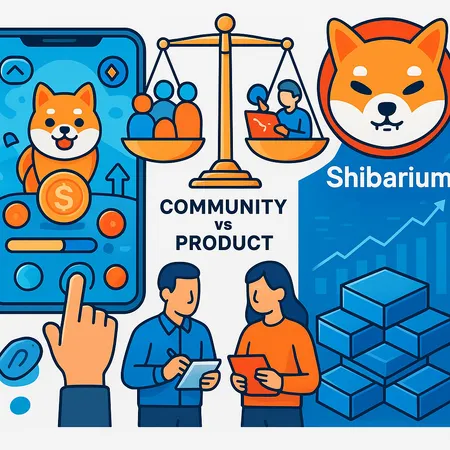
Community fervor is powerful: it can create explosive price rallies and organic marketing that no team budget can match. But community demand often decays when the narrative shifts. Product-driven demand, by contrast, can create recurring utility that’s less sensitive to Twitter cycles — provided the product is genuinely useful and well‑adopted.
Compare two scenarios. A memecoin with a large Discord and viral socials can pump on sentiment but may lack persistent token sinks. Another project with a modest community but a widely used L2 or popular on‑chain game can convert sporadic buyers into regular users, stabilizing velocity and potentially supporting a tighter circulating supply dynamic. That said, product success is rarely binary: many memecoins still need community advocacy to bootstrap initial user acquisition for games or developer interest on an L2.
Practical red flags for investors and product managers
When evaluating whether a utility roadmap materially changes risk, watch for these warning signs:
- Vague product details: Roadmaps that promise “gaming, metaverse, and NFTs” without technical specs, timelines, or budgets.
- Centralized control and unilateral minting: Large developer wallets or continuous mint functions that can dilute holders.
- No credible token sinks: Games or L2s that don’t demonstrate sustainable burn or value capture mechanisms.
- Marketing-first launches: Products announced primarily to lift price with no signups, beta users, or third‑party audits.
- Token economics misalignment: Reward schedules that hand out massive inflation to insiders or short‑term stakers.
- Single‑point dependency: Utility that requires one centralized off‑chain server or a closed ecosystem controlled by the team.
A practical rule: ask teams for numbers. Beta user metrics, a dashboard of on‑chain flows, audit reports, or partnerships are real signals. If a project points only to social media metrics and influencer endorsements, treat utility claims with skepticism.
How product managers should think about designing durable memecoin utility
If you’re a product manager in the space, design decisions should prioritize alignment and measurable value capture. Consider these principles:
- Build explicit token sinks: fees, consumables, upgrade costs, or slashing mechanisms that reduce circulating supply.
- Prioritize composability: let other developers build on your L2 or integrate your token so demand aggregates across products.
- Make onboarding low friction: wallets, fiat rails, and simple UX matter more than clever tokenomics if you want non‑crypto users.
- Separate speculation from utility flows: ensure market makers and exchanges can hedge without breaking the in‑app economy.
- Be transparent: publish dashboards, audits, and on‑chain KPIs so the community can verify claims.
These are the kinds of changes that could tilt a memecoin’s risk profile from purely speculative to product‑adjacent.
What retail investors should do now
For retail investors assessing $TRUMP, SHIB, or similar projects, take a two‑pronged approach: fundamental product checks and market structure awareness. Validate whether the announced products (the TRUMP mobile game, Shibarium dApps) have real users, verifiable on‑chain activity, and sound token sinks. At the same time, understand how exchange products like futures can change volatility characteristics and the potential for rapid deleveraging events.
Remember: token utility reduces some risks but introduces others. A thriving game can still be dependent on player acquisition strategies that cost more than they return. An L2 can struggle to attract developers without funds and incentives. And futures markets, while increasing liquidity, bring in leveraged flows that can amplify drawdowns.
Conclusion: utility matters — but execution matters more
Memecoin utility is a meaningful evolution in the ecosystem: teams are moving from narratives to products because sustainable demand ultimately requires real use cases. Both on‑chain games (the TRUMP mobile game example) and L2 adoption (Shibarium’s march forward and the attention from Coinbase futures) offer plausible routes to convert social capital into economic activity. However, the effectiveness of those strategies hinges on execution, transparent metrics, and aligned tokenomics.
For product managers, the takeaway is clear: build measurable, composable products with genuine token sinks. For retail investors, the message is caution — look beyond press releases, demand data, and watch how exchange products reshape market dynamics. Bitlet.app users and other retail audiences should keep these signals in mind when deciding whether a memecoin’s roadmap truly reduces risk or simply repackages speculation.
Sources
- TRUMP coin mobile game coverage: TokenPost
- Shiba Inu Shibarium and Coinbase futures interest: CoinTribune
- Meme market sentiment and futures context: Finbold
For broader context on market behavior, many traders still watch Bitcoin and cross‑check activity across DeFi dashboards when evaluating token utility.